

Assessing demand sustainability and regulatory pressures in a high-contributing segment enhances competitive intelligence by clarifying long-term market viability and risk exposure. For instance, internal combustion engine (ICE) vehicles still account for 70–75% of global vehicle sales but face tightening emission norms, impacting future demand. It helps businesses evaluate whether demand will decline due to policy shifts, carbon targets, or evolving customer preferences toward EVs.
ICE vehicle analysis evaluates performance, fuel efficiency, emissions, cost, and technology, benchmarking engines, transmissions, and components. With regulations targeting up to 30–50% emission reductions, such insights help identify gaps, optimize designs, and ensure compliance.
These insights enable proactive portfolio shifts, capital reallocation, pricing strategy refinement, and capacity planning while mitigating transition risks and sustaining competitiveness.
Key Elements of Demand Sustainability and Regulatory Pressure Assessment
Assessing demand sustainability and regulatory pressures in a segment that still contributes significantly to sales helps businesses evaluate long-term viability, risks, and transition readiness. Competitive intelligence services provide structured insights to balance current profitability with future market and policy shifts.
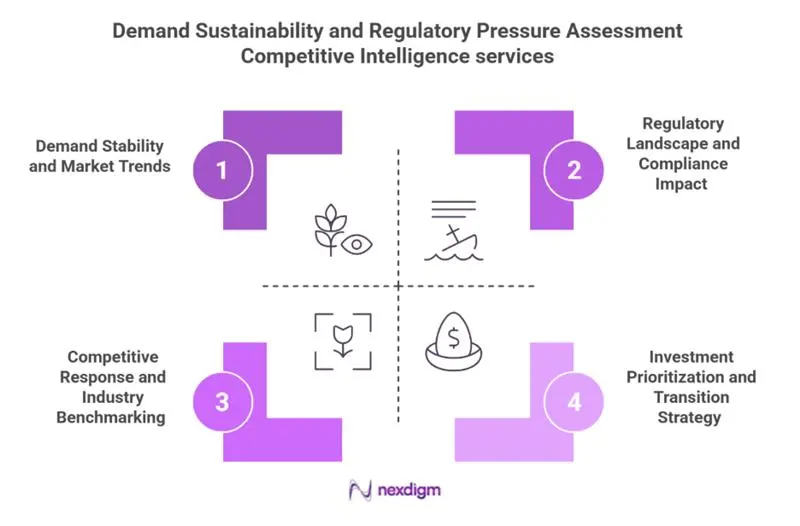
Demand Stability and Market Trends
This involves analyzing historical and projected demand patterns, customer preferences, and sales contributions. It helps determine whether the segment’s demand is stable, declining, or shifting, enabling companies to align production, pricing, and long-term portfolio strategies accordingly.
Regulatory Landscape and Compliance Impact
This focuses on current and upcoming regulations such as emission norms, safety standards, and policy mandates. It evaluates how these rules affect product viability, cost structures, and timelines, helping businesses prepare for compliance and avoid operational or financial risks.
Competitive Response and Industry Benchmarking
This examines how competitors adapt to demand shifts and regulatory changes. It includes benchmarking product strategies, investments, and transitions, enabling companies to identify gaps, adopt best practices, and maintain competitive positioning in evolving market conditions.
Investment Prioritization and Transition Strategy
This assesses how companies allocate resources between sustaining current segments and investing in future technologies. It supports decision-making on capital allocation, innovation focus, and risk mitigation, ensuring a balanced approach toward profitability and long-term growth.
Framework for Demand Sustainability and Regulatory Assessment
Nexdigm’s ICE Vehicle competitive intelligence framework for assessing demand sustainability and regulatory pressures provides a structured approach to evaluate market longevity, compliance risks, and strategic priorities. It enables businesses to align current revenue streams with future-ready strategies in evolving regulatory and demand environments.
Demand Lifecycle Assessment
This framework evaluates demand trends, segment maturity, and future growth potential. It helps identify whether the segment is expanding, stable, or declining, supporting informed decisions on production, portfolio, and long-term strategic direction.
Regulatory Impact Mapping
It analyzes current and upcoming regulations, including emissions and safety norms, to assess their impact on product viability, cost structures, and timelines, ensuring proactive compliance and reduced regulatory risk exposure.
Competitive Benchmarking Model
This component compares competitor strategies, investments, and responses to demand and regulatory shifts. It identifies best practices, performance gaps, and positioning opportunities to strengthen competitiveness in transitioning markets.
Investment Prioritization Framework
It guides allocation of capital between sustaining existing segments and investing in future technologies. This ensures balanced decision-making, optimizing returns while minimizing risks associated with regulatory changes and declining demand segments.
Risk and Scenario Analysis
This framework evaluates potential risks from demand fluctuations and regulatory pressures. It supports scenario planning, enabling businesses to adapt strategies, mitigate uncertainties, and maintain resilience in a rapidly changing automotive landscape.
Nexdigm’s Case:
Nexdigm supported an OEM where a legacy segment contributed 45% of revenue but faced 20% demand decline risk due to stricter norms, enabling 30% faster transition planning and 15% regulatory cost reduction.
To take the next step, simply visit our Request a Consultation page and share your requirements with us.
Harsh Mittal
+91-8422857704