

As organizations expand across cloud applications, hybrid infrastructure, and distributed workforces, managing digital identities has become a critical security priority. The 2026 RSA ID IQ Report found that 69% of organizations experienced an identity-related breach in the preceding three years, highlighting persistent weaknesses in access management.
The 2026 SANS Identity Threat Detection and Response survey further found that 68% of organizations detected identity attacks within 24 hours, but only 55% contained them within the same period. These findings underline the need for stronger identity controls and coordinated access governance.
Through identity and access management vendor comparison, enterprises can assess how providers address authentication, privileged access, identity lifecycle management, and integration across complex technology environments.
Why Identity and Access Management Requires a Broader Perspective
Identity and access management extends beyond verifying user credentials. It determines who can access enterprise resources, what permissions they receive, and how those permissions change over time. As organizations adopt cloud services, third-party applications, and automated workflows, effective IAM requires coordinated authentication, authorization, governance, and monitoring across human and non-human identities.
The IAM Capabilities That Shape Vendor Evaluation
When comparing IAM platforms, organizations should consider how providers address three fundamental access-management requirements:
- Authentication and Access: Assess SSO, MFA, adaptive authentication, and passwordless capabilities for secure and convenient user access.
- Privileged Access Management: Examine privileged account discovery, credential vaulting, session monitoring, and just-in-time access controls.
- Identity Governance: Evaluate access certification, role management, segregation of duties, and automated provisioning and deprovisioning workflows.
Together, these capabilities provide a foundation for comparing vendors against enterprise security and access-management priorities.
Nexdigm’s Expert-led Initiative to Map the IAM Vendor Ecosystem
The IAM market includes established enterprise technology providers, specialist identity security companies, and emerging platforms focused on specific access-management requirements. Our identity and access management vendor comparison approach can help organizations understand this ecosystem by examining:
- Full-Suite IAM Providers: Identify suppliers offering integrated SSO, MFA, identity governance, and privileged access capabilities.
- Specialist IAM Vendors: Map providers focused on PAM, authentication, identity lifecycle management, or access intelligence.
- Emerging Technology Companies: Track new entrants developing passwordless authentication, decentralized identity, and AI-driven identity security solutions.
This segmentation helps enterprises understand market coverage, supplier specialization, and potential alternatives across IAM categories.
How Nexdigm Evaluates Vendor Differentiation and Platform Compatibility
Beyond identifying suppliers, enterprises need to understand how their platforms differ and whether they can operate within existing technology environments. Our experts can support this assessment through:
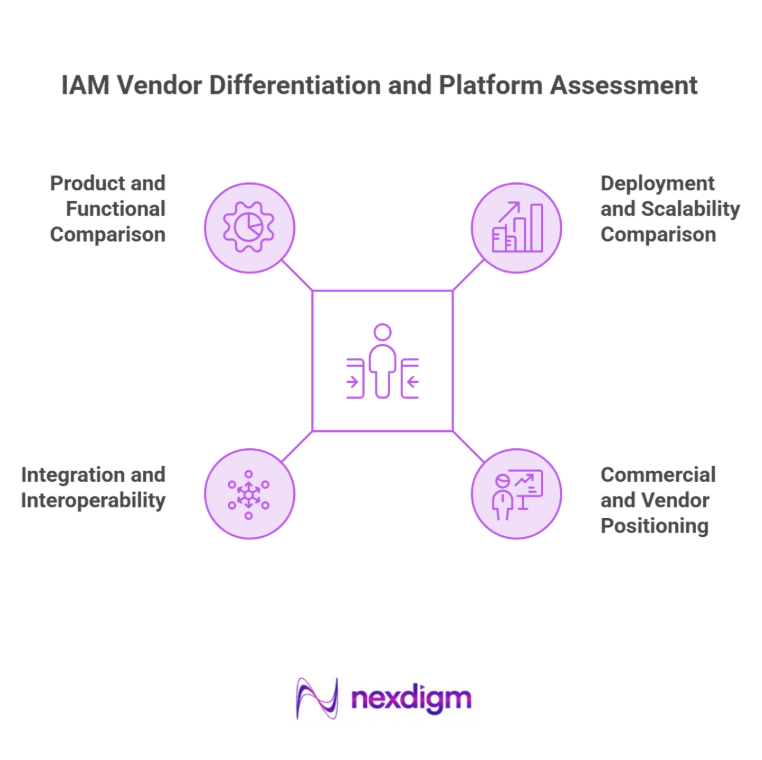
- Product and Functional Comparison: Examine feature depth, authentication methods, governance workflows, privileged access controls, and administrative capabilities.
- Integration and Interoperability: Assess compatibility with enterprise directories, HR systems, cloud applications, SIEM tools, and existing security infrastructure.
- Deployment and Scalability: Compare cloud-native, on-premises, and hybrid options, including support for complex user environments and growing identity volumes.
- Commercial and Vendor Positioning: Review licensing models, product packaging, support arrangements, partnerships, and competitive differentiation.
This analysis can help decision-makers understand which providers align with their technical environment and long-term IAM requirements.
Addressing Enterprise IAM Complexity Through Nexdigm’s Vendor Insights
As enterprises manage employees, contractors, partners, and machine identities, access requirements can vary significantly across systems. Our research can help organizations understand how vendors address fragmented identity environments, excessive permissions, inconsistent access policies, and lifecycle management challenges. These insights provide context for evaluating platform suitability and identifying solutions that support stronger access governance across enterprise operations.
Nexdigm’s Case
An enterprise sought to strengthen identity security across its cloud applications, internal systems, and distributed workforce. Nexdigm conducted a comparative assessment of 15 IAM vendors, examining authentication, privileged access management, identity governance, integration, and scalability. The research identified gaps in integration and access governance across several platforms and helped the enterprise shortlist 7 vendors for further technical and commercial evaluation.
To take the next step, simply visit our Request a Consultation page and share your requirements with us.
Harsh Mittal
+91-8422857704