

As enterprise infrastructure becomes increasingly distributed across cloud platforms, SaaS applications, APIs, automated workflows, and AI systems, identity has become the control point connecting users to applications, data, and infrastructure. The security perimeter is therefore increasingly defined by who or what can access a resource, under which conditions, and for how long.
The identity landscape is also expanding beyond employees. API tokens, service accounts, OAuth credentials, CI/CD runners, machine identities, and autonomous AI agents can all initiate transactions or access enterprise resources. These non-human identities can outnumber human identities by substantial margins, while often operating with persistent credentials and limited ownership visibility.
The Identity Attack Surface Is Expanding
Human identities remain exposed to phishing, credential theft, session hijacking, and social engineering. Machine identities introduce a different set of risks. Static API keys can remain embedded in code, service accounts can accumulate permissions over time, and automated credentials may continue operating long after their original purpose has disappeared.
AI agents add another layer. An agent authorized to retrieve information, update a database, invoke an API, or execute a transaction effectively becomes an identity with operational privileges. Its security therefore depends on the scope, duration, context, and monitoring of those permissions.
This creates a governance challenge for conventional IAM architectures. Identity security market assessment increasingly needs to account for workforce identities alongside machine, privileged, application, and agentic identities rather than treating employee access as the complete identity universe.
From Static Access to Continuous Entitlement Management
Traditional IAM has largely centered on authentication, SSO, directory services, and role-based access control. Cloud environments require more granular controls because permissions can change continuously across workloads and accounts.
CIEM addresses part of this problem by analyzing cloud entitlements and identifying excessive or unused permissions. PAM adds controls around privileged access and temporary elevation. Together, these capabilities can support a move toward just-in-time access, least privilege, and continuous entitlement review.
The important shift is from determining whether an identity is legitimate to determining whether a particular action is legitimate at a particular moment.
An employee may legitimately access a production system without being authorized to export sensitive data. A service account may legitimately call an API without requiring administrative permissions. An AI agent may need access to a customer database for one transaction without receiving unrestricted database privileges.
Security architecture therefore increasingly depends on contextual authorization rather than permanent access.
AI Agents Are Creating a New Identity Layer
AI agents complicate identity governance because they can operate with greater autonomy than conventional software services. An agent may authenticate through an application identity, invoke several downstream APIs, retrieve data, and initiate actions based on instructions received at runtime.
The resulting control requirements extend beyond authentication. Enterprises need visibility into which agents exist, which identities they use, what permissions they possess, what systems they can reach, and whether their behaviour remains within an expected operating boundary.
Agent identity also creates a connection between identity security and application security. A compromised token, excessive authorization scope, or manipulated instruction can potentially turn a legitimate agent into an unintended pathway to enterprise resources.
What Should Enterprises Measure?
A practical identity strategy should evaluate five areas:
- Identity inventory: Identify workforce, privileged, machine, service, application, and AI-agent identities across cloud and on-premises environments.
- Entitlement exposure: Measure standing privileges, unused permissions, excessive scopes, orphaned accounts, and toxic combinations across identity and infrastructure platforms.
- Access duration: Determine how much privileged access remains permanent and where just-in-time or time-bound authorization can replace standing rights.
- Behavioural controls: Establish expected transaction, API, and resource-access patterns for machine identities and autonomous agents.
- Lifecycle governance: Track credential creation, ownership, rotation, escalation, suspension, and retirement throughout the identity lifecycle.
Nexdigm Identity Security Assessment Framework
Nexdigm can structure an identity security assessment around the operational exposure created by distributed identities:
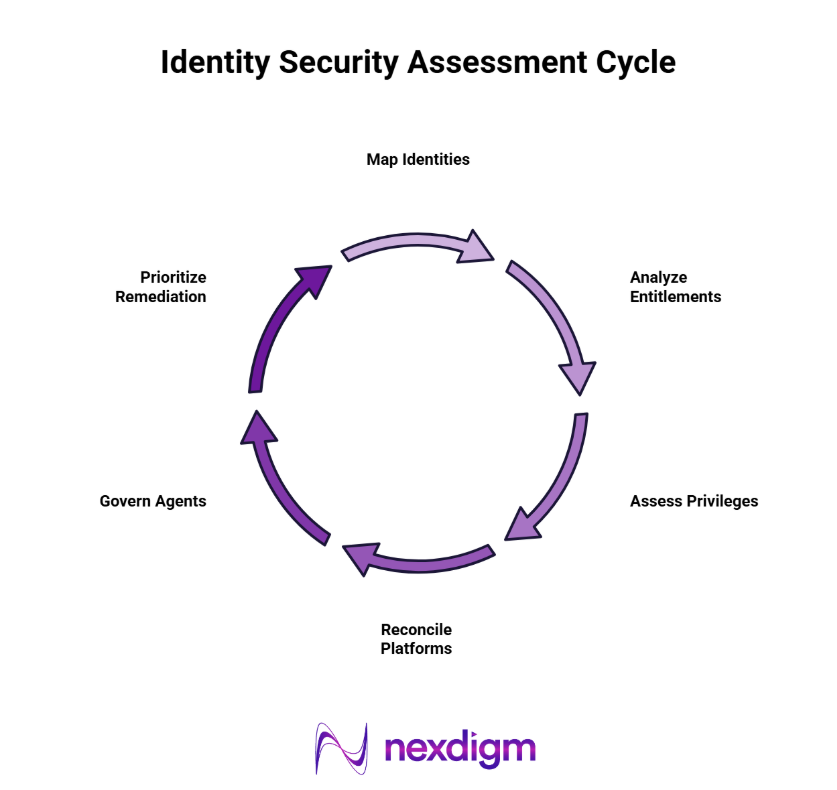
- Identity landscape mapping: Catalogue human, privileged, machine, application, service, and AI-agent identities across the enterprise.
- Entitlement analysis: Benchmark permissions against actual usage to identify excessive, dormant, and orphaned access.
- Privilege-risk assessment: Evaluate standing administrative access and opportunities for just-in-time provisioning.
- Cross-platform reconciliation: Compare identity-provider roles with effective permissions across cloud infrastructure and applications.
- Agentic identity governance: Define authentication, authorization, transaction boundaries, monitoring, and escalation controls for autonomous AI agents.
- Remediation prioritization: Rank identity risks according to business criticality, exploitability, privilege level, and potential lateral movement.
Nexdigm Case: Cybersecurity and Identity Control for a Trade Finance Platform
Nexdigm supported a global digital trade finance platform through a Virtual CISO engagement covering authentication, API governance, Entra ID policy optimization, vulnerability mitigation, and endpoint security. The engagement strengthened identity and security controls while delivering a 70% annual cost saving for the client.
To take the next step, simply visit our Request a Consultation page and share your requirements with us.
Harsh Mittal
+91-8422857704