

Identity verification is becoming a critical control as digital onboarding, remote access, and AI-enabled fraud expand. Entrust’s 2026 Identity Fraud Report analyzed more than 1 billion identity-verification events across 195 countries and 30+ industries, finding an average fraud rate of 3.1% in 2024. It also found that deepfakes were linked to one in five biometric-fraud instances.
The threat continued to intensify in 2025. Entrust reported a 58% increase in deepfake selfies and a 40% year-over-year surge in injection attacks, where manipulated media is fed directly into verification processes.
The scale of verification is also expanding. LexisNexis Risk Solutions, citing Juniper Research, expects 100.4 billion digital identity-verification checks globally in 2026, representing 16% year-on-year growth. Against this view, identity verification service supplier research can help institutions compare providers across authentication strength, fraud controls, integration, geographic coverage, scalability, and their ability to support evolving identity risks.
Identity Verification Is Becoming a Continuous Trust Function
Verification is increasingly extending beyond a single onboarding check. Providers are combining document verification, biometrics, liveness detection, device intelligence, behavioral signals, authentication, and fraud analytics to establish trust across different stages of the customer lifecycle. The UK’s 2026 Digital Identity Sectoral Analysis found that 90% of digital-identity firms serve financial and professional services, while 53% report KYC/AML use cases and 50% report fraud-prevention applications.
The Right Provider Depends on More Than Verification Accuracy
A provider may perform strongly on document or biometric verification but have weaker capabilities around authentication, fraud detection, integration, or international coverage. Effective supplier research therefore needs to consider how the full identity capability operates within the institution’s customer journey and technology environment, rather than treating verification accuracy as the sole measure of performance.
What Should Identity Verification Supplier Research Reveal?
A useful supplier assessment should answer three practical questions:
- Can the Provider Establish Trust? Assess document checks, biometrics, liveness, database verification, authentication, and identity-risk signals.
- Can It Prevent Identity Fraud? Examine deepfake detection, injection-attack protection, spoofing controls, synthetic-identity detection, device intelligence, and behavioral analytics.
- Can It Operate at Scale? Evaluate APIs, integration, geographic coverage, languages, document support, transaction volumes, latency, and implementation requirements.
Together, these dimensions are assessed by experts of Nexdigm to provide a more complete view of identity capability, fraud resilience, and operational suitability.
Nexdigm’s Expertise in Assessing Identity Verification Supplier Market
Nexdigm can map the identity verification service supplier landscape by combining financial-services expertise, supplier intelligence, market research, technology assessment, and risk analysis. The assessment can cover providers across digital onboarding, document verification, biometric authentication, liveness detection, KYC/KYB, fraud prevention, identity intelligence, authentication, and ongoing monitoring. This helps institutions distinguish broad identity platforms from specialist providers and understand where each supplier demonstrates meaningful differentiation.
Nexdigm’s Framework for Assessing Identity Verification Suppliers
Nexdigm can apply a structured framework to compare identity verification providers across the capabilities that most directly influence trust, fraud prevention, and operational effectiveness:
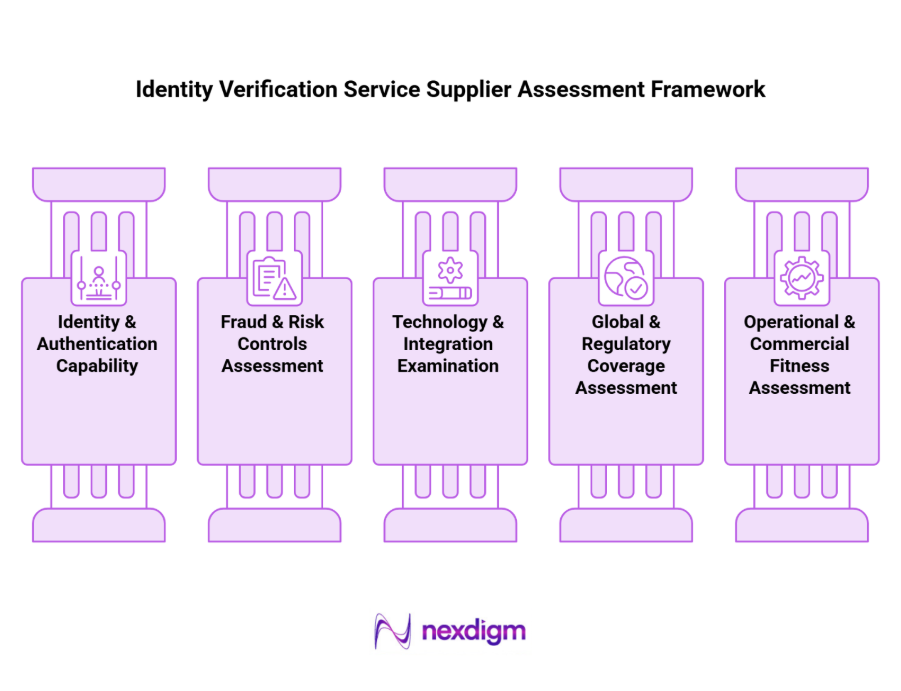
- Identity & Authentication Capability: Evaluate document verification, biometrics, liveness, authentication methods, identity databases, and adaptive authentication.
- Fraud & Risk Controls: Assess capabilities for detecting deepfakes, spoofing, injection attacks, synthetic identities, device risks, and suspicious behavioral patterns.
- Technology & Integration: Examine APIs, interoperability, workflow integration, implementation complexity, latency, automation, scalability, and compatibility with existing systems.
- Global & Regulatory Coverage: Compare geographic reach, document support, languages, localization, regulatory requirements, data considerations, and cross-border applicability.
- Operational & Commercial Fit: Consider service delivery, implementation requirements, support capabilities, pricing structures, scalability, and the provider’s ability to meet changing business needs.
This framework enables Nexdigm to create a consistent, comparable view of supplier strengths and limitations, helping institutions identify providers that best align with their identity, fraud, technology, and growth priorities.
Sustainable Value Delivered by Nexdigm’s Assessment Framework
Nexdigm’s framework creates longer-term value by helping institutions build scalable identity capabilities, strengthen fraud resilience, simplify supplier management, and adapt to changing regulatory and technology requirements. Our structured approach can support repeatable supplier reviews, better technology planning, and continuous identification of capability gaps, helping organizations maintain a more resilient and future-ready identity verification ecosystem.
Nexdigm’s Case
Nexdigm assessed identity verification suppliers against authentication, biometrics, fraud controls, integration, and scalability. The assessment considered market evidence showing 100.4 billion digital identity checks expected globally in 2026 and a 180% year-on-year increase in observed deepfake attacks. Findings supported supplier prioritization, technical validation, and longer-term identity strategy planning.
To take the next step, simply visit our Request a Consultation page and share your requirements with us.
Harsh Mittal
+91-8422857704