

Import and export statistics can help companies understand where demand is forming, which suppliers dominate a market and whether competitive positions are changing. Yet a country importing large quantities of a product is not necessarily an attractive destination for every exporter. Market attractiveness depends on the product being traded, the reason buyers source it internationally and the cost of competing against established suppliers.
A useful assessment interprets trade flows as evidence about market structure, not as a direct forecast of sales.
Imports Reveal Dependence, but Not Always Opportunity
High imports can indicate strong domestic demand, limited local production, or dependence on specialised foreign suppliers. These explanations have different commercial implications. A country importing industrial machinery because its manufacturing base is expanding may offer opportunities for equipment suppliers and service providers. A country importing a product because domestic production has temporarily stopped may offer a shorter-lived opening.
The first step is to compare imports with domestic production, consumption indicators, and relevant industrial activity. Where reliable data are available, apparent consumption can be estimated by combining domestic output and imports, then adjusting for exports and inventory changes. This provides a more complete view than import totals alone, although data limitations must be acknowledged.
Companies should also examine the mix of imported products. A market importing substantial quantities of a broad category may still have limited demand for the specific grade, quality or application the exporter offers.
Exports Reveal Supply Strength and Competitive Position
Export statistics provide a different perspective. They help identify the countries supplying a destination, the products in which those suppliers specialise and the markets where their positions are strongest. If a supplier consistently gains share across several destinations, it may have a structural advantage in cost, quality, production capacity, or market access.
However, export growth should not automatically be interpreted as stronger competitiveness. A country may gain share because another supplier faces temporary production constraints, because the traded product has become more expensive or because goods are being routed through a new intermediary.
The OECD’s 2026 research on global value chains found that international production remains highly interconnected, with recent changes reflecting shifts in sectoral and sourcing structures rather than a universal retreat from global supply chains. This reinforces the need to examine supplier relationships across multiple stages of production instead of viewing each country’s exports in isolation.
Compare the Market You Can Reach, Not Just the Market That Exists
An import export analysis should establish whether the company’s product is competitive in the target destination. This requires comparing supplier prices, product specifications, freight, duties, certification and customer requirements. It also requires identifying the buyers that can realistically be served.
Three distinctions are especially important:
- Market size versus accessible demand: Total imports may include products or customers outside the company’s target segment.
- Supplier presence versus supplier strength: A high market share does not reveal whether the advantage comes from price, quality, relationships or temporary disruption.
- Export growth versus local opportunity: A country’s rising exports may reflect production capacity, re-exporting or a change in its role within a regional supply chain.
These distinctions help management avoid treating every large or fast-growing market as an immediate entry candidate.
Read Competitive Pressure Through Trade Patterns
Trade data can help identify whether a market is becoming more concentrated or more open to alternative suppliers. If a small number of countries account for most imports, buyers may face supply concentration risk. This can create an opening for a qualified alternative supplier, although technical approvals and long-term contracts may make switching difficult.
If supplier shares are becoming more dispersed, the market may be diversifying its sourcing base. That can create opportunities for new entrants, but it may also indicate stronger price competition. The implication depends on why buyers are adding suppliers and whether they value resilience, cost reduction, or product differentiation.
Companies should compare market-share changes with quantities, unit values, policy developments, and evidence of new capacity. This gives a stronger basis for deciding whether to compete on price, target a specialised segment, or pursue a strategic supply relationship.
Questions That Separate Attractive Markets From Difficult Ones
Before selecting a destination, decision-makers should establish:
- Is import demand sustained and relevant to the company’s exact product?
- Does local production satisfy the market, or is there a structural supply gap?
- Which suppliers dominate, and what explains their position?
- Can the company meet technical, regulatory, and delivery requirements?
- Does the likely selling price support an acceptable margin after all entry costs?
Import and Export Market Attractiveness and Competition Framework
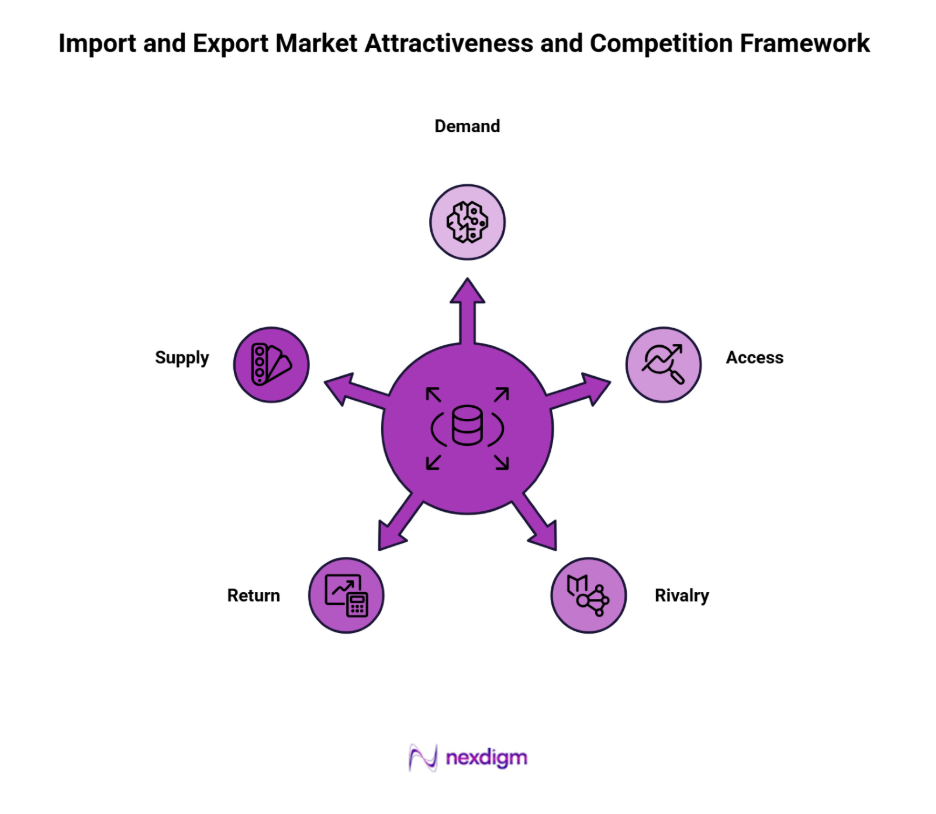
- Demand: Establish what the market buys and why imports are needed.
- Supply: Compare local production, import dependence, and the availability of substitutes.
- Rivalry: Identify dominant suppliers and the advantages behind their market positions.
- Access: Evaluate regulations, channels, logistics, and customer qualification requirements.
- Return: Determine whether the company’s achievable price and sales volume justify entry.
Nexdigm Case Study
A packaging materials producer evaluated an export market where imports had grown for 3 consecutive years, reaching an illustrative annual value of US$85 million. A product-level analysis found that specialised barrier materials accounted for 65% of import growth, while the company’s standard-grade products competed against established local suppliers.
Further assessment narrowed the opportunity to 2 buyer segments whose technical requirements could potentially justify a differentiated offering. Instead of committing to a broad export launch, the company prioritised product-development validation and buyer feedback before allocating resources to market entry
To take the next step, simply visit our Request a Consultation page and share your requirements with us.
Harsh Mittal
+91-8422857704