

Global trade is expanding while sourcing and demand patterns continue to shift. The WTO expects world merchandise trade volume to grow 3.9% in 2026, following stronger-than-expected growth in the first half of the year. Meanwhile, UN Trade and Development estimates that global goods trade reached around US$13.7 trillion in H1 2026, highlighting the scale of commercial activity that businesses can analyse for market and supply opportunities.
Yet aggregate trade growth does not reveal where a specific company should compete, source, or invest. Businesses need to identify which products are experiencing demand, which countries depend on imports, where supplier concentration creates gaps, and where competitors are gaining or losing position.
This is where import export data analysis can provide a more granular view of international markets. By examining products, companies, countries, trade values, volumes, suppliers, buyers, and pricing, businesses can convert trade movements into actionable commercial intelligence.
Where Is Demand Actually Concentrated?
A growing economy does not necessarily mean growing demand for every product. Import activity provides a more direct indication of purchasing requirements, particularly when analysed at product or HS-code level.
Businesses can examine import volumes, values, shipment frequency, growth rates, and destination markets to identify demand pools. Sustained increases may indicate structural market expansion, while sudden movements can point toward supply substitution, inventory cycles, or temporary disruptions.
Identifying the Existing Supply Chain Gaps
Supply gaps can emerge when demand grows faster than domestic production, when established suppliers lose competitiveness, or when buyers begin diversifying their sourcing.
Import-export data can reveal these gaps by comparing demand growth with supplier participation, country shares, shipment activity, and sourcing concentration. A market with growing imports and a fragmented supplier base may present a different opportunity from one dominated by a small number of established suppliers.
Nexdigm’s Approach to Identifying Existing Supply Chain Gaps
Identifying a supply gap requires more than observing rising imports. Nexdigm combines import-export data analysis, market research, and competitive intelligence to examine supplier concentration, country-level sourcing, shipment activity, pricing, and buyer patterns.
This approach helps businesses determine whether an apparent supply gap represents a sustainable commercial opportunity, a temporary disruption, or an underserved segment. By connecting trade movements with market-level insights, Nexdigm can help identify potential suppliers, markets, customers, and competitive opportunities that warrant further evaluation.
How Experts at Nexdigm Convert Supply Gaps into Commercial Opportunities
Identifying a supply gap is only the first step. Businesses must evaluate whether the opportunity is commercially viable, sustainable, and aligned with their growth objectives. Nexdigm helps organizations assess supply gaps through a structured trade intelligence approach that involves:
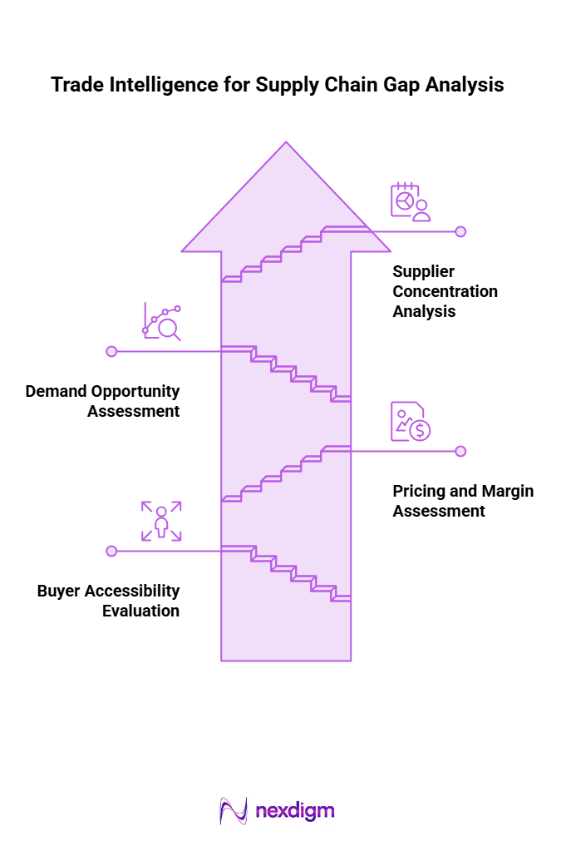
- Demand Opportunity Assessment: Analysis o import growth, consumption patterns, and demand trends to determine whether unmet market needs are substantial enough to support expansion.
- Supplier Concentration Analysis: Nexdigm evaluates supplier presence and market concentration to identify opportunities where buyer dependence on limited suppliers creates potential entry advantages.
- Buyer Accessibility Evaluation: Assessment of buyer activity, purchasing behavior, and importer networks to determine how accessible and commercially attractive target customers are.
- Pricing and Margin Assessment: Nexdigm examines trade pricing, unit values, and market dynamics to evaluate whether identified opportunities can support sustainable commercial margins.
By evaluating demand, supplier dynamics, buyer accessibility, pricing, and competition, Nexdigm helps businesses distinguish genuine commercial opportunities from temporary market gaps, enabling more informed investment and expansion decisions.
Nexdigm in Helping Businesses Prioritize the Right Import-Export Opportunities
Identifying supply gaps is only the first step. Businesses must understand which opportunities offer the strongest commercial potential and strategic fit. Nexdigm helps organizations focus on right opportunities through:
- Market White Space Identification: Nexdigm identifies underserved markets and product segments where demand exists but competitive participation remains limited, creating potential entry opportunities.
- Buyer Concentration Assessment: Evaluation of distribution of buyers across a market to determine whether demand is broad-based or dependent on a few key purchasers.
- Trade Route and Supply Chain Evaluation: Nexdigm examines trade corridors, sourcing patterns, and logistics flows to identify markets that can be served efficiently and competitively.
- Revenue Pool Assessment: Analysis of trade values, demand trends, and market size to estimate the commercial potential available within target markets.
With the structured assessment approach, Nexdigm helps businesses prioritize opportunities that offer the greatest potential for sustainable growth and commercial success.
Nexdigm’s Case
Nexdigm supported a manufacturing industry by analyzing near-real-time country-wise trade data to identify high-growth export markets. The assessment identified 3 priority countries with rising demand and favourable pricing. Focused market-entry efforts subsequently increased qualified export leads by 29% and improved price realization by 8%. The results show how trade intelligence can narrow a broad international opportunity set into targeted markets for commercial action.
To take the next step, simply visit our Request a Consultation page and share your requirements with us.
Harsh Mittal
+91-8422857704