

In a global marketplace, information means making the right business decision and finding a valuable opportunity. Whether a company is looking to enter a new market, identify reliable suppliers, expand its customer base, or understand competitor activity, access to accurate trade information has become essential.
One of the most powerful sources of such intelligence is an import-export database. These databases help organizations understand who is buying, who is selling, where products are moving, and how markets are evolving. As global trade becomes increasingly competitive, businesses are leveraging import-export databases to make more informed and strategic decisions.
What Is an Import–Export Database?
An import-export database is an international trade information that captures details about goods being imported and exported across countries. Depending on the database, information may include product categories, trade volumes, shipment values, trading countries, importers, exporters, suppliers, and buyers. By analyzing these records, businesses can move beyond assumptions and gain data-backed insights into market demand, supply trends, and competitive activity.
Finding New Buyers and Customers
One of the most valuable applications of an import-export database is identifying potential buyers in target markets. Rather than relying on traditional lead-generation methods, businesses can use trade data to identify companies that are actively importing products similar to their offerings. This provides a more targeted approach to business development, helping organizations focus on buyers.
Import-export databases can help businesses:
- Identify active importers: Trade data helps businesses identify companies actively importing specific products, enabling targeted outreach to buyers with proven purchasing requirements and market trends.
- Understand purchasing patterns and import frequencies: Analyzing shipment history and import volumes helps businesses understand buyer purchasing cycles, order frequency, and potential opportunities for long-term partnerships.
- Discover new geographic markets with growing demand: Import trends highlight regions experiencing increasing demand for specific products, helping businesses identify attractive markets for expansion and customer acquisition.
- Analyze buyer preferences and behavior: Trade records provide insights into product preferences, sourcing locations, supplier relationships, and purchasing decisions, helping businesses tailor their market strategies.
- Prioritize high-potential customer prospects: Import activity data helps businesses focus on buyers with consistent purchasing volumes and strong demand, improving sales efficiency and conversion opportunities.
Identifying Reliable Suppliers
Supplier identification has become a strategic step as businesses seek to build resilient and diversified supply chains. Import-export databases provide visibility into global supplier ecosystems, helping organizations discover manufacturers, exporters, and trading partners across different regions. This allows businesses to evaluate multiple sourcing options and reduce dependence on a single supplier. Trade data can help organizations:
- Identify leading suppliers within a product category
- Evaluate supplier export activity and consistency
- Discover alternative sourcing markets
- Compare supplier capabilities across regions
- Assess global supply availability
These insights enable businesses to make more informed sourcing decisions while improving supply chain flexibility and resilience.
Tracking Competitor Activity and Moves
Import-export databases are also powerful tools for competitive intelligence. By analyzing trade flows within an industry, businesses can gain insights into competitor strategies, market expansion efforts, and sourcing activities. Understanding where competitors are exporting, importing, or establishing commercial relationships can reveal valuable information about emerging opportunities and market dynamics. Organizations can use trade data to:
- Track competitor presence in global markets
- Identify key export and import destinations
- Analyze product movement trends
- Monitor market-entry activities
Such insights help businesses benchmark their performance and identify areas where they can strengthen their market position, in the highly competitive market.
The Growing Importance of Import–Export Intelligence
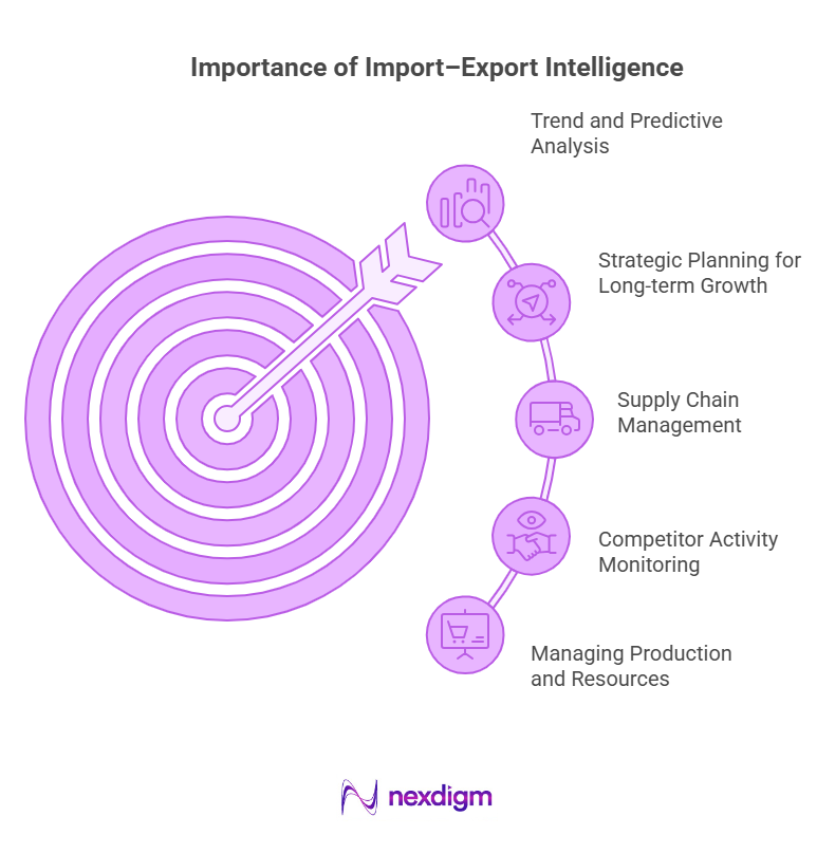
As international trade becomes more complex, businesses need more than basic market information to remain competitive. They need actionable insights that support better decision-making across sales, sourcing, supply chain management, strategic planning, and forecasting. Import-export databases provide a powerful foundation for understanding global market dynamics. Whether identifying buyers, evaluating suppliers, monitoring competitors, or assessing expansion opportunities, trade intelligence enables organizations to make decisions with accuracy.
How Nexdigm Helps Businesses Leverage Import–Export Data
The real value of any data lies in transforming information into actionable business insights. Nexdigm helps organizations unlock the full potential of import-export databases through comprehensive trade intelligence and market analysis services. By combining data-driven research with deep industry expertise, Nexdigm helps businesses:
- Identify prospective buyers across global markets: Leverage import-export data to identify active buyers, evaluate purchasing patterns, and target businesses with specific demand for products and services.
- Discover and evaluate supplier networks: Analyze supplier ecosystems, sourcing locations, and trade activity to identify reliable partners, sourcing options, and strengthen supply chain resilience.
- Monitor competitor activity and market positioning: Track competitor trade movements, market presence, and expansion patterns to understand competitive dynamics and identify opportunities for strategic growth.
- Assess product demand and trade trends: Evaluate import and export trends across markets to identify growing product categories, changing customer preferences, and emerging business opportunities.
- Mitigate trade, regulatory, and supply chain risks: Identify potential disruptions arising from regulatory changes, geopolitical developments, or supply chain dependencies, helping businesses to plan strategies accordingly.
Through a structured and insight-driven approach, Nexdigm enables organizations to make smarter trade decisions, strengthen supply chains, and experience sustainable global growth.
Nexdigm’s Case
Nexdigm supported a manufacturer in using import–export databases to identify qualified buyers, alternate suppliers, and emerging competitors across priority markets. The analysis strengthened partner targeting and sourcing decisions. Outcomes included 23% faster buyer identification, 18% broader supplier coverage, and a 15% improvement in competitive market visibility within eight months.
To take the next step, simply visit our Request a Consultation page and share your requirements with us.
Harsh Mittal
+91-8422857704