

Import logistics is becoming more complex as global trade grows, sourcing networks diversify, and companies manage changing consumer and industrial demand. Importers increasingly need reliable ports, warehouses, inland transport, customs processes, and distribution networks that can handle changing cargo volumes.
Global trade reached a record more than $35 trillion in 2025, while global goods trade was estimated at approximately $13.7 trillion in the first half of 2026, up 12.5% from the same period in 2025.
For importers, retailers, manufacturers, logistics providers, ports, warehouse developers, infrastructure investors, freight forwarders, and governments, the challenge is understanding where import demand is growing and whether supporting logistics capacity can keep pace.
An Import logistics demand assessment helps evaluate import volumes, ports, warehouse requirements, inland transportation, distribution networks, customs infrastructure, and future capacity needs.
Import Demand Is Changing
Import requirements are influenced by consumer spending, industrial production, manufacturing inputs, energy demand, infrastructure development, and changes in sourcing.
A market with strong consumer growth may require more distribution centers and last-mile capacity. An industrial market may need specialized warehouses, bulk handling, container facilities, and reliable inland transport.
This means import logistics planning needs to consider what is being imported, where it is entering, and where it ultimately needs to go.
New Import Markets Are Emerging
Import growth is increasingly visible across developing economies. UNCTAD reported that developing economies’ merchandise imports grew 7.8% in 2025, while developing Asia and Oceania recorded strong trade expansion.
Growing import markets can create demand for ports, inland terminals, warehouses, freight services, customs facilities, and regional distribution centers.
Nexdigm evaluates these changes to identify locations where import infrastructure may need to expand.
How Nexdigm Evaluates Import Infrastructure Requirements
As import markets evolve, infrastructure requirements can vary significantly across locations depending on cargo volumes, sourcing patterns, distribution needs, and supply chain complexity. Nexdigm assesses these factors to determine where additional logistics capacity may be required and where existing infrastructure can be optimized to support growing import demand. This is done through:
- Import Demand Analysis: Evaluation of import growth trends, commodity flows, and end-market requirements to understand the scale and nature of future logistics demand.
- Infrastructure Capacity Assessment: Reviewing capability of ports, warehouses, inland terminals, and customs facilities to support current and projected import volumes.
- Connectivity Evaluation: Assessment of transportation links between entry points and consumption or industrial centers to identify bottlenecks and network constraints.
- Distribution Requirements: Analysis of storage, handling, and distribution needs to determine the supporting infrastructure required for efficient cargo movement.
By evaluating demand, infrastructure, connectivity, and distribution requirements together, Nexdigm develops a comprehensive view of import logistics needs.
Nexdigm in Identifying Emerging Import Logistics Demand
Import growth can create logistics opportunities at multiple points across the supply chain, including ports, inland terminals, warehouses, transportation corridors, customs facilities, and regional distribution centers. However, not all markets require the same type of infrastructure or capacity expansion.
Nexdigm evaluates demand patterns, cargo characteristics, connectivity, and infrastructure readiness to identify where logistics requirements are evolving most rapidly and where future investment opportunities may emerge.
These insights help establish a clear understanding of import-driven logistics requirements and provide the foundation for Nexdigm’s Import Logistics Demand Assessment Framework.
Nexdigm’s Import Logistics Framework
Nexdigm conducts Import logistics demand assessment through its framework model. This assessment evaluates five major areas which provide a structured view of how import growth translates into physical logistics requirements. These areas are:
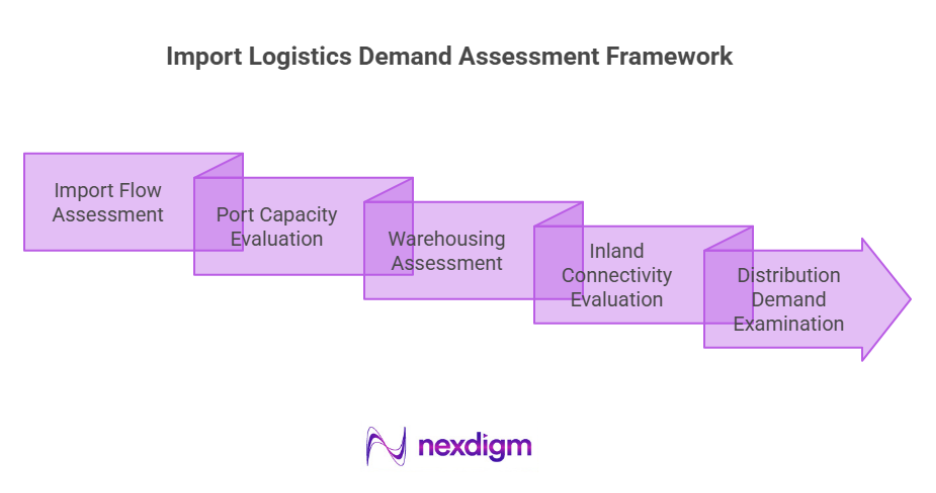
- Import Flow Assessment: Nexdigm maps import volumes, commodities, origins, destinations, and growth patterns to identify major entry points and changing cargo requirements.
- Port Capacity: The assessment evaluates terminal capacity, berth availability, handling efficiency, vessel activity, congestion, and expansion plans to identify potential import bottlenecks.
- Warehousing: Nexdigm assesses warehouse supply, occupancy, storage types, location, rental economics, and future demand to identify markets requiring additional capacity.
- Inland Connectivity: The framework evaluates roads, railways, inland terminals, freight corridors, and travel times to determine how efficiently imported goods can reach their destinations.
- Distribution Demand: Nexdigm examines population, consumption, retail activity, industrial demand, and customer locations to estimate future distribution requirements and logistics network needs.
The framework connects these areas, helping organizations identify where capacity should expand to support growing import demand.
Nexdigm’s Outlook on Future Import Demand
The Import Logistics Demand Assessment Framework helps Nexdigm evaluate how future import growth may impact logistics infrastructure, transportation networks, warehousing capacity, and distribution operations. By analyzing projected trade volumes, evolving sourcing patterns, infrastructure readiness, and connectivity requirements, experts at Nexdigm identify areas that may require additional capacity, operational enhancements, or strategic investments.
These insights help organizations prepare for future demand shifts, strengthen supply chain resilience, and ensure that logistics networks remain aligned with long-term growth requirements.
Nexdigm’s Case
An importer engaged Nexdigm to assess port capacity, warehouse requirements, inland connectivity, and distribution demand. The assessment supported a network redesign that reduced logistics costs by 15%, improved warehouse utilization by 23%, shortened inland transit times by 18%, and strengthened overall supply-chain reliability. The changes enabled faster cargo movement, better capacity utilization, and improved readiness for future import growth.
To take the next step, simply visit our Request a Consultation page and share your requirements with us.
Harsh Mittal
+91-8422857704