
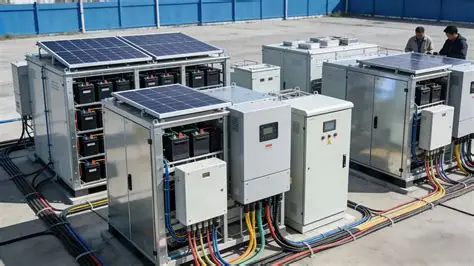
India’s Battery Energy Storage for Microgrids Market is witnessing rapid growth, driven by increasing renewable-energy deployment, rural electrification needs, grid reliability challenges, and decarbonization objectives. Battery Energy Storage Systems (BESS) play a critical role in microgrids by balancing renewable power generation, providing backup energy, improving grid resilience, and reducing dependence on diesel generators. With a population exceeding 1.4 billion, renewable-energy capacity surpassing 230 GW, and a national target of 500 GW of non-fossil fuel capacity by 2030, demand for battery-backed microgrids is increasing across rural communities, industrial facilities, commercial campuses, telecom towers, and remote infrastructure projects.
Key Market Drivers for India’s Battery Energy Storage for Microgrids Market
Renewable Energy Expansion and Grid Stability Requirements Accelerate Demand
India has installed more than 230 GW of renewable energy capacity, including over 120 GW of solar power and approximately 60 GW of wind energy. As renewable generation continues to expand, microgrids equipped with battery storage systems are increasingly deployed to stabilize power supply, manage intermittency, and improve energy reliability in both grid-connected and off-grid applications. Growing solar microgrid adoption in rural and semi-urban regions is further strengthening storage demand.
Rural Electrification and Energy Access Create Significant Opportunities
Despite major electrification progress, many remote communities, islands, mining sites, and agricultural regions continue to require reliable distributed energy solutions. Battery-powered microgrids provide a cost-effective alternative to diesel-based generation while improving energy access and reducing fuel costs. The expansion of decentralized renewable-energy systems is creating strong opportunities for lithium-ion, sodium-ion, and other advanced battery technologies.
Industrial Decarbonization and Commercial Energy Resilience Support Growth
Industrial facilities, data centers, manufacturing plants, hospitals, educational institutions, and commercial complexes increasingly seek energy resilience and lower electricity costs. Battery-integrated microgrids enable peak-shaving, backup power, renewable integration, and improved energy management, making them an attractive solution for energy-intensive sectors facing rising power demand and sustainability requirements.
Government Initiatives Supporting India’s Battery Energy Storage for Microgrids Market
The Government of India is actively promoting battery energy storage and microgrid deployment through programs led by the Ministry of Power, Ministry of New and Renewable Energy (MNRE), and various state-level renewable-energy agencies. The country has announced plans for tens of gigawatt-hours of battery energy storage deployment alongside its 500 GW non-fossil fuel capacity target by 2030. Initiatives supporting solar parks, rural electrification, distributed renewable energy systems, viability-gap funding (VGF) for storage projects, and domestic battery manufacturing under the Production Linked Incentive (PLI) scheme are creating favorable conditions for market expansion.
Competitive Landscape of India’s Battery Energy Storage for Microgrids Market
India’s Battery Energy Storage for Microgrids Market is becoming increasingly competitive, supported by strong participation from renewable-energy developers, battery manufacturers, energy service providers, and technology firms. Competition is centered on battery performance, storage duration, lifecycle costs, energy-management software, and microgrid integration capabilities. Major participants including Tata Power, Adani Green Energy, ReNew Power, Amara Raja Energy & Mobility, Exide Industries, Waaree Energies, Loom Solar, Fluence, Hitachi Energy, and Schneider Electric are actively investing in microgrid and battery-storage projects. The growing focus on localized manufacturing, lithium-ion battery production, and smart energy-management platforms continues to intensify market competition.
Major Challenges Facing India’s Battery Energy Storage for Microgrids Market
High Initial Capital Costs
Battery energy storage systems require significant upfront investment, particularly for large-scale microgrid applications. Although battery prices continue to decline, financing remains a key challenge for many rural and distributed energy projects.
Supply Chain and Battery Material Dependency
India remains dependent on imports for several critical battery materials and components. Securing long-term supply chains and expanding domestic manufacturing capabilities remain important priorities for sustainable market growth.
Future Outlook
India’s Battery Energy Storage for Microgrids Market is expected to witness strong growth through 2035, supported by a renewable-energy portfolio exceeding 230 GW, ambitious plans to achieve 500 GW of non-fossil fuel capacity, and increasing investments in battery manufacturing and distributed energy systems. The country has already announced multiple battery energy storage projects totaling several GWh of capacity, with future demand expected to accelerate across rural electrification, commercial facilities, industrial campuses, telecom infrastructure, and smart cities. Growing adoption of lithium-ion batteries, battery management systems (BMS), AI-enabled energy management platforms, and hybrid renewable-storage microgrids is expected to create substantial opportunities for technology providers, project developers, and battery manufacturers.
Consultants at Nexdigm, in their latest publication “India Battery Energy Storage for Microgrids Market Outlook to 2035” analyse the sector By Battery Chemistry Type (Lithium Iron Phosphate (LFP), Nickel Manganese Cobalt (NMC) and Lithium Titanate (LTO)), By Microgrid Application (Off-Grid Remote Clusters and Agricultural Processing Hubs) and By Power Capacity Rating (Micro-Scale (<50kW), Small-Scale (50-250 kW) and Medium-Scale (250-1000 kW)).
Nexdigm suggests that businesses in India’s Battery Energy Storage for Microgrids Industry prioritize lithium-ion and next-generation battery technologies, AI-enabled energy-management platforms, hybrid solar-plus-storage microgrids, and localized battery manufacturing strategies to capitalize on the country’s 500 GW non-fossil energy ambitions, expanding distributed renewable-energy ecosystem, increasing battery-storage deployment, and growing demand for resilient and sustainable power solutions across rural, commercial, industrial, and utility applications.
To take the next step, simply visit our Request a Consultation page and share your requirements with us.
Harsh Mittal
+91-8422857704