
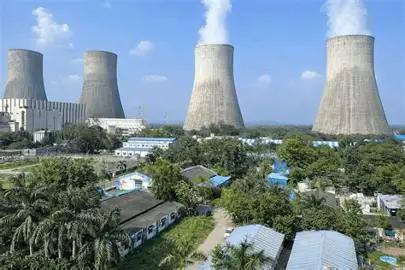
India’s Nuclear Reactor Construction Market is witnessing strong growth as the country focuses on energy security, decarbonization, and long-term power reliability. India currently operates more than 8 GW of nuclear power capacity across 24 reactors, while national electricity demand has surpassed 2,000 TWh annually and peak power demand has exceeded 250 GW. To support its net-zero ambitions and rapidly growing industrial economy, the government has outlined a vision to expand nuclear capacity to approximately 100 GW in the long term. Rising electricity requirements from manufacturing, data centers, electric mobility, green hydrogen production, and urban infrastructure are increasing the need for reliable baseload power, positioning nuclear reactor construction as a critical component of India’s future energy strategy.
Key Market Drivers for India’s Nuclear Reactor Construction Market
Rising Electricity Demand and Energy Security Concerns Support Reactor Development
India is one of the world’s fastest-growing electricity markets, with annual power demand increasing steadily due to industrial growth, urbanization, and digital transformation. The country’s electricity consumption has surpassed 2,000 TWh annually, while peak power demand has crossed 250 GW. To ensure long-term energy security and reduce dependence on imported fossil fuels, India is increasingly investing in nuclear energy as a stable and carbon-free source of electricity generation. Nuclear reactors provide high-capacity-factor power generation, often exceeding 85–90% operational availability, making them an important component of the country’s future energy strategy.
Government Expansion Plans Create Significant Construction Opportunities
India aims to expand nuclear power capacity beyond its current levels through a pipeline of new reactor projects and indigenous reactor technologies. Multiple pressurized heavy water reactors (PHWRs) and advanced reactor projects are planned or under development across various states. The government’s long-term vision of achieving approximately 100 GW of nuclear capacity by 2047 is expected to create substantial opportunities for reactor construction, engineering services, equipment manufacturing, and supply chain development.
Industrial Growth and Clean Energy Transition Accelerate Market Demand
As India pursues its target of 500 GW of non-fossil fuel energy capacity by 2030, nuclear power is expected to complement renewable energy sources such as solar and wind. Increasing electricity demand from data centers, electric mobility, green hydrogen projects, steel production, and semiconductor manufacturing facilities is strengthening the need for dependable round-the-clock power generation, further supporting investment in nuclear infrastructure.
Government Initiatives Supporting India’s Nuclear Reactor Construction Market
The Government of India continues to promote nuclear power development through long-term capacity expansion programs, indigenous reactor manufacturing initiatives, and strategic energy security measures. Public-sector investments in reactor construction, fuel supply chains, and nuclear research remain key priorities. In addition, government energy plans supporting 500 GW of non-fossil fuel capacity by 2030 and long-term decarbonization objectives are creating favorable conditions for nuclear infrastructure development. Policy support for domestically developed PHWR technology and advanced reactor programs is expected to accelerate future construction activity.
Competitive Landscape of India’s Nuclear Reactor Construction Market
India’s Nuclear Reactor Construction Market is characterized by a strong focus on indigenous technology development, local manufacturing capabilities, and large-scale engineering expertise. Competition is increasingly centered on reactor efficiency, project execution capabilities, construction timelines, safety standards, and localization of critical components. Growing investments in engineering services, nuclear-grade equipment manufacturing, digital plant management systems, and advanced reactor technologies are supporting the evolution of the domestic nuclear ecosystem. Demand for skilled engineering and construction services is expected to increase significantly as new nuclear projects enter development phases.
Major Challenges Facing India’s Nuclear Reactor Construction Market
High Capital Requirements and Long Development Timelines
Nuclear reactor construction projects require substantial capital investment and can involve development timelines extending beyond a decade. Financing, regulatory approvals, land acquisition, and project management complexity can impact implementation schedules and project economics.
Supply Chain and Skilled Workforce Constraints
The expansion of nuclear infrastructure requires highly specialized engineering capabilities, nuclear-grade manufacturing facilities, and skilled technical personnel. Scaling domestic supply chains while maintaining stringent safety and quality standards remains an important challenge for future market development.
Future Outlook
India’s Nuclear Reactor Construction Market is expected to witness robust growth through 2035, supported by rising electricity consumption, increasing industrial power demand, and long-term decarbonization goals. With operational nuclear capacity exceeding 8 GW, annual electricity demand surpassing 2,000 TWh, and a long-term vision of achieving approximately 100 GW of nuclear capacity by 2047, significant reactor construction activity is anticipated over the coming decades. Additional opportunities are likely to emerge from advanced reactor technologies, small modular reactor (SMR) initiatives, hydrogen production, and energy-intensive manufacturing sectors. Companies investing in nuclear engineering, domestic equipment manufacturing, modular construction techniques, and advanced reactor technologies will be well-positioned to benefit from India’s expanding nuclear energy landscape.
Consultants at Nexdigm, in their latest publication “India Nuclear Reactor Construction Market Outlook to 2035,” analyse the sector By Reactor Technology (PHWR-220 MWe Units, PHWR-540 MWe Units and PHWR-700 MWe Fleet), By Construction Phases (Site Preparation and Civil Works) and By Containment Material Grade (High-Density Reinforced Concrete, Nuclear Grade Structural and District Heating and Desalination).
Nexdigm suggests that businesses in India’s Nuclear Reactor Construction Industry prioritize indigenous reactor technologies, nuclear-grade manufacturing capabilities, modular construction techniques, and advanced engineering solutions to capitalize on the country’s 8 GW+ operational nuclear capacity, 100 GW nuclear energy vision by 2047, growing electricity demand exceeding 2,000 TWh annually, and increasing requirement for reliable low-carbon baseload power generation.
To take the next step, simply visit our Request a Consultation page and share your requirements with us.
Harsh Mittal
+91-8422857704