
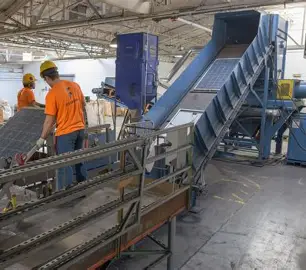
India’s solar panel recycling market is gaining significant momentum as the country strengthens its position among the world’s leading solar energy producers. With installed solar capacity exceeding 110 GW, supported by large-scale utility projects, rooftop solar adoption, and government clean-energy initiatives, the future volume of retired photovoltaic (PV) modules is expected to increase substantially. India is targeting 500 GW of non-fossil fuel energy capacity by 2030, which will further expand the solar asset base and create significant recycling demand over the coming decades. As solar panels typically have a lifespan of 25–30 years, industry estimates suggest that cumulative solar PV waste could reach hundreds of thousands of tonnes by the mid-2030s. This growing waste stream is driving investments in advanced recycling technologies, high-value material recovery, and sustainable end-of-life management solutions, positioning the sector for robust growth through 2035.
Key Market Drivers for the India Solar Panel Recycling Market
Rapid Expansion of Solar Installations Creates Future Recycling Demand
India’s aggressive renewable energy expansion is a major driver for the solar panel recycling market. The country has surpassed 110 GW of installed solar capacity and continues adding new projects across utility-scale and distributed solar segments. Government programs such as the National Solar Mission and large solar parks have significantly increased the installed solar asset base. As these systems age and early-generation panels are gradually replaced by higher-efficiency alternatives, the volume of decommissioned modules requiring proper recycling and disposal is expected to rise substantially, creating long-term opportunities for recycling providers.
Growing Value of Recoverable Materials Strengthens Recycling Economics
Solar panels contain valuable materials including glass, aluminum, silicon, copper, and silver, which can be recovered and reintroduced into manufacturing supply chains. With global demand for critical minerals increasing and raw material costs remaining volatile, recovering these resources is becoming economically attractive. Advanced recycling technologies are enabling higher recovery rates and improved material purity, encouraging investments in specialized recycling infrastructure. The potential to recover valuable materials while reducing dependence on imported raw materials is strengthening the business case for solar panel recycling across India.
Increasing Focus on Circular Economy and Sustainable Waste Management
India is placing greater emphasis on circular economy practices and responsible management of renewable energy waste. As solar deployment accelerates nationwide, policymakers and industry stakeholders are increasingly focused on reducing landfill disposal and maximizing resource recovery. Rising environmental awareness, corporate sustainability commitments, and ESG requirements are encouraging solar developers and asset owners to adopt structured end-of-life management strategies. This transition is expected to support long-term growth for recycling, refurbishment, and material recovery businesses through 2035.
Government Support and Initiatives Supporting the India Solar Panel Recycling Market
The Indian solar panel recycling market is benefiting from strong government support for renewable energy deployment and domestic manufacturing. India has established a target of 500 GW of non-fossil fuel energy capacity by 2030, with solar expected to account for a significant share of this expansion. Programs such as the National Solar Mission, Production Linked Incentive (PLI) Scheme, and increasing emphasis on waste management frameworks are encouraging sustainable end-of-life practices. As solar capacity continues to expand beyond 110 GW, policymakers are expected to strengthen recycling regulations and promote investments in photovoltaic waste management infrastructure.
Competitive Landscape of the India Solar Panel Recycling Market
The Indian solar panel recycling market is becoming increasingly competitive as specialized recyclers, waste management companies, solar developers, and technology providers expand their presence. Competition is centered on material recovery efficiency, processing capacity, recycling costs, and technological innovation. Market participants are investing in advanced mechanical, thermal, and chemical recycling processes to recover high-value materials such as silicon, silver, copper, aluminum, and glass. Strategic partnerships between solar manufacturers, EPC contractors, recycling firms, and renewable energy operators are also emerging to secure end-of-life panel supply and strengthen circular economy initiatives within India’s rapidly expanding solar ecosystem.
Major Challenges Facing the India Solar Panel Recycling Market
Limited Dedicated Recycling Infrastructure
Despite rapid solar deployment, India currently has relatively limited photovoltaic-specific recycling capacity. Processing infrastructure must expand significantly to manage the anticipated increase in solar panel waste volumes over the next decade.
High Recycling Costs and Technology Constraints
Recovering valuable materials from photovoltaic modules remains technically complex and cost-intensive. Recycling companies must improve material recovery rates, operational efficiency, and process scalability while maintaining economic viability and environmental compliance.
Future Outlook
Looking ahead to 2035, India’s solar panel recycling market is expected to experience robust growth as solar deployment continues to accelerate nationwide. With installed solar capacity already exceeding 110 GW and significant additions expected over the coming years, the volume of end-of-life solar panels entering the waste stream will increase substantially. Future market growth is likely to be driven by advanced material recovery technologies, automated recycling facilities, AI-enabled waste tracking systems, and stronger regulatory frameworks governing photovoltaic waste management. Companies investing in recycling innovation, circular economy solutions, and valuable material recovery capabilities will be well-positioned to capitalize on India’s expanding solar energy ecosystem through 2035.
Consultants at Nexdigm, in their latest publication “India Solar Panel Recycling Market Outlook to 2035,” analyse the sector By Panel Technology (MonoCrystalline PERC, PolyCrystalline and N-Type TOPCon), By End-User Application (Utility-Scale Solar Parks and Residential Solar Installations) and By Collection Channel (OEM Take-back Programs, Authorized Dismantlers, E-Waste Aggregators).
Nexdigm suggests that businesses in India’s Solar Panel Recycling Industry prioritize advanced recycling technologies, high-value material recovery capabilities, and efficient collection networks to capitalize on rising end-of-life solar panel volumes, expanding renewable energy deployment, and increasing demand for sustainable waste management and circular economy solutions across the country’s growing solar sector.
To take the next step, simply visit our Request a Consultation page and share your requirements with us.
Harsh Mittal
+91-8422857704