
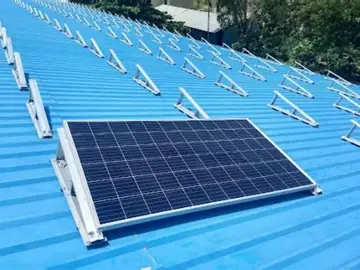
India’s solar energy sector is witnessing unprecedented growth, creating substantial opportunities for Solar PV mounting system providers. As solar installations continue to expand across utility-scale, commercial, industrial, and residential segments, demand for reliable mounting structures that enhance panel performance, durability, and land utilization is increasing significantly. India has surpassed 110 GW of installed solar power capacity, making it one of the world’s largest solar markets. Furthermore, the government’s target of achieving 500 GW of non-fossil fuel power capacity by 2030 is expected to accelerate solar project deployment. These developments are strengthening demand for fixed-tilt, rooftop, elevated, and solar tracking mounting systems across the country.
Key Market Drivers for India’s Solar PV Mounting Systems Market
Utility-Scale Solar Expansion Fuels Demand for Ground-Mounted Structures
India continues to deploy utility-scale solar projects at a rapid pace, with installed solar capacity exceeding 110 GW and annual additions remaining among the highest globally. Large solar parks in states such as Rajasthan, Gujarat, and Karnataka require durable mounting systems capable of withstanding harsh environmental conditions while maximizing energy generation. Ground-mounted fixed-tilt structures and single-axis tracking systems are increasingly being adopted to improve project efficiency and return on investment.
Commercial and Industrial Solar Adoption Creates Growth Opportunities
The commercial and industrial (C&I) sector is emerging as a major driver for rooftop solar installations across manufacturing facilities, warehouses, data centers, and commercial buildings. Rising electricity tariffs and corporate sustainability commitments are encouraging businesses to invest in captive solar generation. Solar PV mounting systems designed for rooftops, carports, and industrial facilities are witnessing growing demand as organizations seek efficient and space-optimized solar deployment solutions.
Government-Led Renewable Energy Targets Support Market Expansion
India’s ambitious renewable energy roadmap continues to drive investments across the solar value chain. The country’s objective of achieving 500 GW of non-fossil fuel capacity by 2030, combined with ongoing solar tender programs and transmission infrastructure development, is creating sustained demand for mounting systems. Additionally, the increasing adoption of solar-plus-storage projects is generating requirements for specialized mounting and support structures.
Government Initiatives Supporting India’s Solar PV Mounting Systems Market
The Government of India continues to support solar power development through initiatives such as the PM Surya Ghar: Muft Bijli Yojana, the National Solar Mission, and various utility-scale solar park programs. In addition, Production Linked Incentive (PLI) schemes and domestic manufacturing incentives are strengthening the local solar supply chain. With India targeting 500 GW of non-fossil fuel capacity by 2030 and significant investments being directed toward solar manufacturing and grid infrastructure, demand for advanced mounting systems is expected to rise steadily across utility, commercial, and residential projects.
Competitive Landscape of India’s Solar PV Mounting Systems Market
India’s Solar PV Mounting Systems Market is characterized by growing innovation in structural engineering, lightweight materials, corrosion-resistant designs, and solar tracking technologies. Competition is increasingly centered on product durability, installation efficiency, cost optimization, and compatibility with diverse geographic conditions. Market participants are focusing on galvanized steel, aluminum structures, and tracker-based solutions to improve energy output and project economics. Growing investments in utility-scale solar parks, rooftop solar systems, floating solar projects, and solar-powered infrastructure are further intensifying market competition.
Major Challenges Facing India’s Solar PV Mounting Systems Market
Raw Material Price Volatility Impacts Project Economics
Fluctuations in steel, aluminum, and other construction material prices can significantly impact mounting system manufacturing costs and overall solar project budgets. Manufacturers must continuously optimize sourcing strategies and production efficiencies to maintain competitiveness.
Land and Site-Specific Engineering Complexities
India’s diverse climatic and geographic conditions require customized mounting solutions capable of handling high wind speeds, heavy rainfall, coastal corrosion, and uneven terrain. Designing site-specific structures while maintaining cost-effectiveness remains a key challenge for industry participants.
Future Outlook
India’s Solar PV Mounting Systems Market is expected to witness strong growth through 2035, supported by continued solar capacity expansion, increasing rooftop solar adoption, and government-backed clean energy initiatives. With solar installations already exceeding 110 GW and annual renewable energy investments continuing to rise, demand for advanced mounting technologies will grow substantially. Emerging opportunities in solar tracking systems, floating solar projects, agrivoltaics, solar carports, and integrated energy storage facilities are expected to further strengthen market potential. Companies investing in lightweight materials, automated installation techniques, and high-efficiency mounting solutions will be well-positioned to capitalize on India’s evolving solar energy landscape.
Consultants at Nexdigm, in their latest publication “India Solar PV Mounting Systems Market Outlook to 2035,” analyse the sector By Mounting Structure Configuration Ground Mount, Roof-Integrated and BIPV), By Material Composition (Pre-Galvanized and Hot-Dip Galvanized) and By Project Application (Solar Parks, Independent Power Producers and State Utility Projects).
Nexdigm suggests that businesses in India’s Solar PV Mounting Systems Industry prioritize advanced tracking technologies, corrosion-resistant mounting structures, lightweight engineering solutions, and localized manufacturing capabilities to capitalize on the country’s 110 GW+ solar capacity, 500 GW non-fossil energy target, expanding rooftop solar installations, and growing demand for high-performance solar infrastructure across utility-scale, commercial, and industrial projects.
To take the next step, simply visit our Request a Consultation page and share your requirements with us.
Harsh Mittal
+91-8422857704