
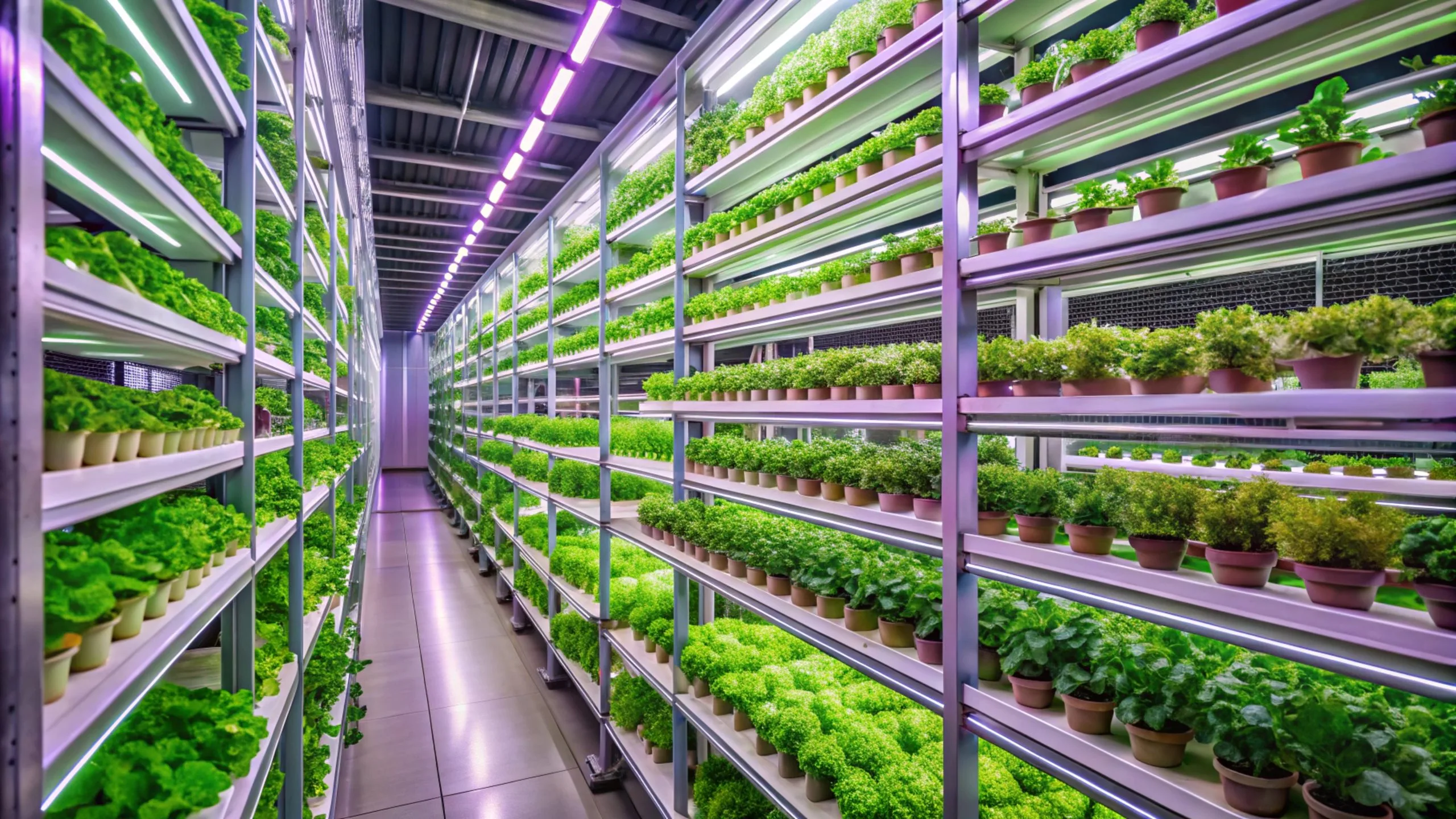
The India vertical farming market is expanding as growers, agritech startups, retailers, hotels, restaurants, and urban consumers look for cleaner, fresher, and more reliable food production models. Vertical farming uses stacked growing systems, hydroponics, aeroponics, LED lighting, climate control, sensors, automation, and nutrient management to grow crops in controlled environments. India’s vertical farming market is projected to move from USD 62.21 million to USD 200.14 million at 21.50% CAGR. Demand is being supported by urbanization, water scarcity, pesticide-free produce demand, shrinking cultivable land near cities, and rising interest in climate-resilient agriculture.
Key market drivers are strengthening vertical farming demand in India
Urban food demand is encouraging local and pesticide-light production
India’s large urban centers are creating stronger demand for fresh, traceable, and residue-conscious produce. Cities such as Mumbai, Delhi NCR, Bengaluru, Hyderabad, Pune, Chennai, and Kolkata have growing consumer segments that are willing to pay for leafy greens, herbs, microgreens, and premium vegetables produced closer to consumption points. Vertical farms can help reduce dependence on long-distance logistics, lower spoilage risk, and improve freshness for retail and foodservice buyers. For restaurants, hotels, modern grocery stores, and health-focused consumers, indoor farms offer more predictable quality and year-round availability. This makes vertical farming especially relevant for high-value crops where consistency and freshness matter.
Hydroponics is improving water-use efficiency in food production
Water scarcity is a major concern for Indian agriculture, and vertical farming offers a way to produce crops with more controlled water use. Hydroponics, one of the leading soilless farming methods, can use only 10% to 20% of the water required in traditional farming, making it attractive for urban and semi-urban growers. The India vertical farming market is also estimated in another outlook to move from USD 42.2 million to USD 187.9 million at 20.5% CAGR, reflecting rising interest in hydroponics, aeroponics, and controlled-environment farming. These systems allow growers to manage nutrients, lighting, humidity, and crop cycles more precisely.
Automation and controlled environments are improving crop consistency
LED lighting, sensors, climate-control systems, farm management software, and AI-based monitoring are helping vertical farms improve yield consistency and reduce manual errors. These tools are important as operators work to scale production and maintain quality across multiple crop cycles.
Government agriculture and innovation initiatives are supporting controlled farming adoption
Government priorities around agricultural modernization, water conservation, urban farming, food security, startup innovation, and sustainable production are creating a supportive environment for vertical farming in India. Public interest in protected cultivation, hydroponics, agri-tech entrepreneurship, and efficient resource use is helping build awareness around soilless farming models. State-level horticulture schemes, startup support programmes, skill development initiatives, and research institutions can also support adoption through training, demonstrations, and technical guidance. While the market is still largely private-sector driven, stronger policy focus on climate-resilient and resource-efficient farming can improve long-term growth prospects.
Competitive landscape is shaped by agritech startups, growers, and technology providers
The India vertical farming market includes indoor farm operators, hydroponic system suppliers, aeroponic technology firms, LED lighting providers, climate-control companies, nutrient solution suppliers, automation platforms, seed companies, restaurants, retailers, and agritech startups. Competition is shaped by production cost, crop quality, system reliability, energy efficiency, water savings, yield consistency, training support, and distribution access. Companies are targeting leafy greens, herbs, microgreens, exotic vegetables, strawberries, and premium fresh produce. Operators that combine affordable systems, strong crop science, reliable local service, and clear buyer partnerships are better positioned to scale.
Market challenges continue to affect profitability and wider adoption
High setup and energy costs can pressure margins
Vertical farms require investment in structures, racks, lighting, pumps, sensors, climate control, nutrient systems, skilled labor, and backup power. Electricity costs can significantly affect profitability, especially when selling into price-sensitive fresh produce markets.
Technical knowledge gaps can slow adoption
Successful vertical farming requires expertise in crop nutrition, lighting, humidity, pest prevention, seed selection, water quality, and system maintenance. Without proper training, yields and quality can vary.
Future outlook
The future outlook for the India vertical farming market remains positive, supported by urban food demand, water efficiency, pesticide-light produce, agritech investment, and controlled-environment agriculture. A separate India outlook projects controlled farming growth at 23.5% CAGR, while urban agriculture and controlled-environment farming growth is cited at 13.2% CAGR. Opportunities are expected across hydroponic farms, aeroponic systems, container farms, leafy greens, herbs, microgreens, strawberries, AI-based crop analytics, LED lighting optimization, nutrient management, automated harvesting, and retail-linked production. Businesses that improve affordability, energy efficiency, crop economics, technical training, and distribution partnerships will be better positioned for long-term growth.
Consultants at Nexdigm, in their latest publication “India vertical farming market outlook to 2035,” analyze the sector By Crop Type (Lettuce, Spinach, Herbs (Basil, Mint, Cilantro, Parsley), Microgreens), By Farming Structure (Building-Based Vertical Farms,Shipping Container Farms, Greenhouse Vertical Farms)
Nexdigm suggests that businesses in the India vertical farming market should focus on affordable, energy-efficient, and technology-enabled indoor farming solutions that support demand for fresh, pesticide-light, water-efficient, and year-round produce across urban retail, foodservice, and premium consumer channels.
To take the next step, simply visit our Request a Consultation page and share your requirements with us.
Harsh Mittal
+91-8422857704