

Automation is becoming central to manufacturing as businesses pursue higher productivity, consistent quality, flexible production, and greater resilience. The latest International Federation of Robotics data shows that 603,000 industrial robots were installed globally in 2025, an 11% increase, while the global operational stock reached 5.079 million robots.
Electronics and automotive each recorded 10% growth in robot installations, while metal and machinery increased by 22%, highlighting broadening industrial adoption. Collaborative robots also reached 66,000 installations, representing 11% of industrial robot deployments.
In India, installations rose 15% to almost 10,500 units, with annual installations growing at an average 27% CAGR between 2020 and 2025. These trends are increasing the importance of robotics, cobots, machine vision, automated material handling, CNC automation, and digitally connected production systems.
The Changing Automation Equipment Priorities
The latest adoption trends indicate that automation is becoming a broader manufacturing capability rather than a standalone technology investment. As robot deployment expands across industries, manufacturers are evaluating equipment based on productivity, flexibility, precision, labor availability, and integration with existing production systems.
This is creating demand for solutions that can automate individual processes while also connecting machines, operators, and production data. As a result, the most relevant automation opportunities increasingly depend on where operational bottlenecks exist, which processes require greater consistency, and how quickly manufacturers need to scale capacity.
Where Automation Investment Is Becoming Essential
Automation demand is increasingly tied to specific manufacturing challenges rather than technology adoption alone. High-volume production favors robotics and automated handling, while precision-intensive operations increasingly require machine vision and advanced control systems.
Flexible manufacturers are also turning to collaborative robots and connected equipment to support shorter production runs and faster changeovers. These differences make it important to assess automation requirements by process, application, production scale, and operational objective rather than treating automation as a single equipment category.
Nexdigm’s Expertise in Industrial and Automation Markets
Nexdigm is a global professional services organization supporting businesses with market intelligence, strategic advisory, and data-driven insights across industrial and technology-driven sectors. Its experience in analyzing evolving markets through Industrial automation equipment market study helps manufacturers understand changing demand, competitive landscapes, technology adoption, and emerging commercial opportunities.
For automation-focused businesses, Nexdigm brings together industry research, market assessment, competitive intelligence, customer analysis, and strategic evaluation to provide a practical view of where automation is gaining traction and what those shifts mean for business growth.
This expertise provides the foundation for a structured approach to evaluating automation opportunities and making better-informed decisions on investments, market expansion, product strategy, and capability development.
Nexdigm’s Approach to Automation Opportunity Evaluation
Nexdigm helps manufacturers evaluate automation opportunities by conducting Industrial automation equipment market study that connects technology adoption with application demand, operational priorities, competitive dynamics, and investment requirements. This approach focuses on the following areas:
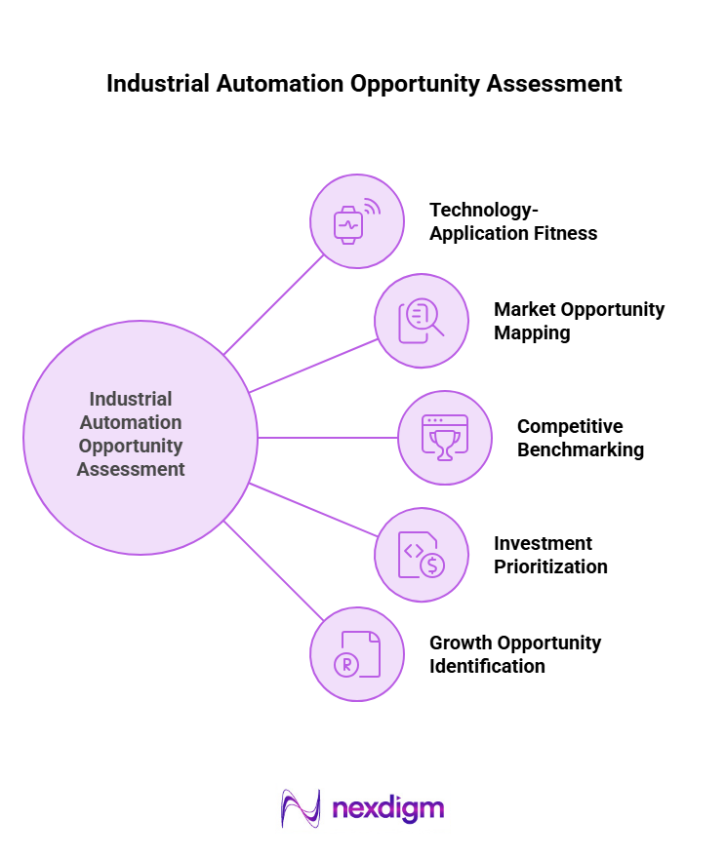
- Technology-Application Fitness: Assess which automation technologies best address specific production processes, throughput requirements, precision needs, labor challenges, and operational objectives across manufacturing environments.
- Market Opportunity Mapping: Identify industries, applications, and customer segments where automation adoption is accelerating and where equipment providers can develop stronger commercial opportunities.
- Competitive Benchmarking: Evaluate competing technologies, suppliers, capabilities, product positioning, and adoption patterns to identify market gaps and potential areas for differentiation.
- Investment Prioritization: Compare automation opportunities based on business impact, implementation requirements, scalability, customer demand, and alignment with broader manufacturing investment priorities.
- Growth Opportunity Identification: Translate automation trends into opportunities for product development, partnerships, market expansion, and new revenue streams across attractive manufacturing segments.
This helps businesses move from tracking automation trends to identifying specific opportunities where technology adoption can support measurable commercial and operational growth.
Nexdigm’s Opportunity Assessment Supporting in Automation Investment Decisions
Automation decisions often involve significant capital, technology choices, and long-term capability commitments. Nexdigm supports manufacturers by bringing together market intelligence, application-level demand, competitive insights, and technology trends to create a structured basis for decision-making. This is done through:
- Assessing the Right Opportunity: Evaluate where automation demand is emerging across industries, applications, production processes, and customer segments.
- Comparing Technology Options: Examine automation technologies against operational requirements, scalability, integration needs, and expected business value.
- Evaluation of Market Attractiveness: Assess demand potential, competitive intensity, customer adoption, and market accessibility before pursuing specific opportunities.
- Prioritizing Investments: Rank automation initiatives according to strategic relevance, commercial potential, implementation requirements, and capability fit.
- Supporting Strategic Actions: Translate findings into decisions around product development, partnerships, market entry, capacity, and technology investments.
Through this approach, Nexdigm helps businesses make more informed automation decisions, allocate resources more effectively, and focus on investments with stronger long-term potential.
Nexdigm’s Case
Nexdigm supported an industrial manufacturer in evaluating automation opportunities across production processes. The assessment reviewed 25+ automation applications, identified 7 priority opportunities, and helped reduce the potential investment shortlist by 32%, enabling more focused technology investments and a clearer roadmap for productivity, capacity, and operational improvement.
To take the next step, simply visit our Request a Consultation page and share your requirements with us.
Harsh Mittal
+91-8422857704