

Industrial clusters compete on more than proximity to factories or low operating costs. Their attractiveness increasingly depends on the combined strength of supplier ecosystems, skilled talent, infrastructure, customer access, logistics, and connectivity.
Recent data highlights the scale of this competition: UNIDO estimates that manufacturing accounted for approximately 16.7% of global GDP in 2024, underscoring the importance of industrial ecosystems to economic growth.
Meanwhile, global foreign direct investment reached approximately $1.6 trillion in 2025, according to OECD data, reflecting continued cross-border competition for productive investment.
As manufacturers diversify supply chains and evaluate new production locations, clusters that offer reliable infrastructure, specialized capabilities, efficient logistics, and access to major customers can create stronger advantages. Understanding how these factors interact is therefore critical when assessing industrial cluster competitiveness and investment potential.
What Is Industrial Cluster Competitiveness
Industrial clusters rarely compete on a single attribute. A location with strong infrastructure may lack specialized suppliers, while an established manufacturing hub may face talent shortages or rising operating costs. As investment decisions become increasingly complex, businesses must evaluate the overall ecosystem supporting production, innovation, and supply chain performance. A holistic assessment helps identify clusters that can deliver sustainable advantages, operational resilience, and long-term growth opportunities.
Understanding the Building Blocks of Cluster Competitiveness
The competitiveness of an industrial cluster is influenced by multiple interconnected factors that collectively shape business performance and investment attractiveness. Rather than evaluating locations based on a single criterion, organizations increasingly examine the broader ecosystem that supports manufacturing efficiency, supply chain resilience, innovation, and long-term growth. A structured evaluation helps identify clusters that can deliver sustainable operational and strategic advantages in an increasingly competitive global environment.
Evaluating Industrial Cluster Potential With Nexdigm
Assessing industrial cluster competitiveness requires a comprehensive understanding of the factors that influence manufacturing success and investment attractiveness. With expertise in market intelligence, location analysis, industrial ecosystem evaluation, and strategic advisory, Nexdigm helps businesses assess the strengths and limitations of industrial clusters across regions and markets. Through a structured assessment approach, Nexdigm enables organizations to identify locations that align with operational requirements, supply chain strategies, growth objectives, and long-term investment priorities.
How Nexdigm Evaluates Industrial Cluster Potential
A comprehensive Industrial cluster market assessment helps businesses evaluate the ecosystem factors that influence manufacturing efficiency, investment attractiveness, and long-term competitiveness. Nexdigm focuses on the following areas that best support their operational and growth objectives:
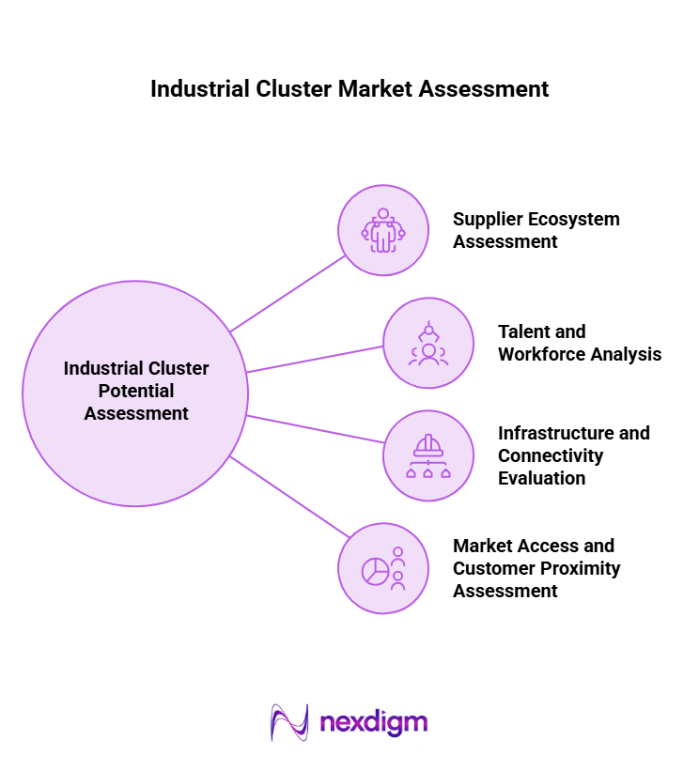
- Supplier Ecosystem Assessment: Evaluation of the depth, maturity, and reliability of supplier networks to understand sourcing efficiency, collaboration opportunities, and overall supply chain resilience.
- Talent and Workforce Analysis: Assessment of labor availability, skill specialization, wage competitiveness, and workforce scalability to support current operations and future business growth.
- Infrastructure and Connectivity Evaluation: Reviewing transportation networks, utilities, industrial facilities, and logistics connectivity to determine a cluster’s operational readiness and efficiency.
- Market Access and Customer Proximity Assessment: Examination of access to customers, key demand centers, and regional markets to support revenue growth and improved responsiveness.
Through this assessment, Nexdigm helps businesses identify competitive industrial ecosystems, optimize location strategies, strengthen supply chain performance, and support long-term investment and growth decisions.
Business Impact of Nexdigm’s Industrial Cluster Market Assessment
Selecting the right industrial cluster can influence far more than manufacturing operations. It can affect supply chain efficiency, market responsiveness, cost competitiveness, talent access, and long-term scalability. A structured evaluation helps businesses identify locations that not only meet current operational requirements but also support future growth and resilience.
- Enhanced Supply Chain Performance: Strong industrial ecosystems improve supplier access, reduce lead times, strengthen collaboration, and support greater supply chain reliability and responsiveness.
- Improved Operational Efficiency: Access to quality infrastructure, skilled labor, and established industrial networks helps manufacturers optimize productivity and resource utilization.
- Greater Market Reach: Proximity to key customers, distribution channels, and growth markets enables faster delivery, improved customer service, and stronger market penetration.
- Reduced Investment Risk: Evaluating ecosystem strengths and constraints helps organizations identify potential challenges before making long-term location commitments.
A well-informed industrial cluster strategy enables businesses to move beyond location selection and build a stronger foundation for operational excellence, supply chain resilience, and long-term competitive advantage.
Nexdigm in Supporting Smarter Industrial Cluster Decisions
Choosing the right industrial cluster is a strategic decision with long-term operational and financial implications. Nexdigm combines market intelligence, ecosystem analysis, and industry expertise to help businesses make confident, data-driven location decisions.
Through its industrial cluster market assessment consulting, Nexdigm evaluates infrastructure, supply chains, workforce availability, market access, and investment risks to identify clusters best aligned with business objectives.
This structured approach enables organizations to make informed decisions that support sustainable growth, operational efficiency, and long-term competitiveness.
Nexdigm’s Case
Nexdigm supported an industrial company evaluating cluster competitiveness across multiple locations. The assessment compared 18+ cluster attributes, including suppliers, talent, infrastructure, logistics, and customer access, and identified 3 priority locations, helping narrow the location shortlist by 40% and improve investment decision clarity.
To take the next step, simply visit our Request a Consultation page and share your requirements with us.
Harsh Mittal
+91-8422857704