
An industrial equipment purchase can begin with a price comparison and end with a very different calculation.
For a production business, the machine affects throughput, downtime, maintenance, labour requirements, quality, energy consumption and service availability. A lower acquisition price can therefore become less attractive if the equipment creates higher operating costs or production risk.
Understanding industrial equipment demand requires examining how buyers actually make that trade-off.
The Purchase Decision Is Becoming More Operational
Recent buyer research shows that industrial purchasing is closely tied to operating performance.
A 2025 survey of 600 manufacturing executives found that 49% identified operational benefits as the primary value sought from smart manufacturing investments, while 44% identified financial benefits as the second-most sought value. Respondents reported average improvements of 10% to 20% in production output and 10% to 15% in unlocked capacity from implemented initiatives.
This changes what equipment suppliers need to demonstrate.
The question is no longer simply whether a machine performs its technical function. Buyers increasingly need evidence that it can improve the economics of the production process.
That makes productivity, uptime, maintenance and integration part of the demand equation.
Reliability Carries an Economic Value
Reliability is difficult to capture in a catalogue specification, but it can materially influence procurement.
An ABB survey found that reliability was rated as the top priority when respondents were purchasing new equipment. Ninety-two percent reported that maintenance had increased uptime, while 60% expected to increase investment in reliability and maintenance over the following three years.
For equipment buyers, reliability can influence several costs simultaneously:
- Production losses from downtime.
- Maintenance and repair expenditure.
- Product quality and scrap.
- Delivery commitments.
- Workforce productivity.
- Customer service performance.
The commercial implication is that equipment demand cannot be understood through purchase price alone. A machine that reduces downtime or increases throughput may justify a higher initial investment if the resulting operating economics are sufficiently strong.
Productivity Is Measured Against the Existing Process
Industrial buyers rarely evaluate a machine in isolation.
They compare what it will change within the existing production system. That can include output per hour, labour requirements, changeover time, energy consumption, quality consistency and integration with upstream or downstream equipment.
Deloitte’s 2025 survey found that manufacturers prioritised advanced production scheduling, execution systems and quality management among their technology investments, while 40% ranked data analytics among their first- or second-highest investment priorities for the following 24 months.
For equipment suppliers, this creates a broader competitive field. The competing solution may not be another machine. It may be an automation upgrade, software layer, process redesign or additional labour.
Service Becomes Part of the Product
Industrial equipment often remains operational for years, making after-sales support economically significant. Maintenance availability, response times, spare-parts access, technical expertise and remote monitoring can affect the total value delivered by a machine.
Research on industrial service purchasing also indicates that buyers are reassessing service relationships. McKinsey found that 80% of respondents planned significant changes to service purchases over the following two years, while quality, cost and speed emerged as the leading purchasing factors across the industries and regions studied.
This creates room for equipment suppliers to differentiate beyond hardware.
Service contracts, predictive maintenance, operator training, remote diagnostics and uptime guarantees can all become part of the commercial proposition.
A Buyer-Centric View of Equipment Demand
Industrial equipment demand can be understood through five purchasing lenses:
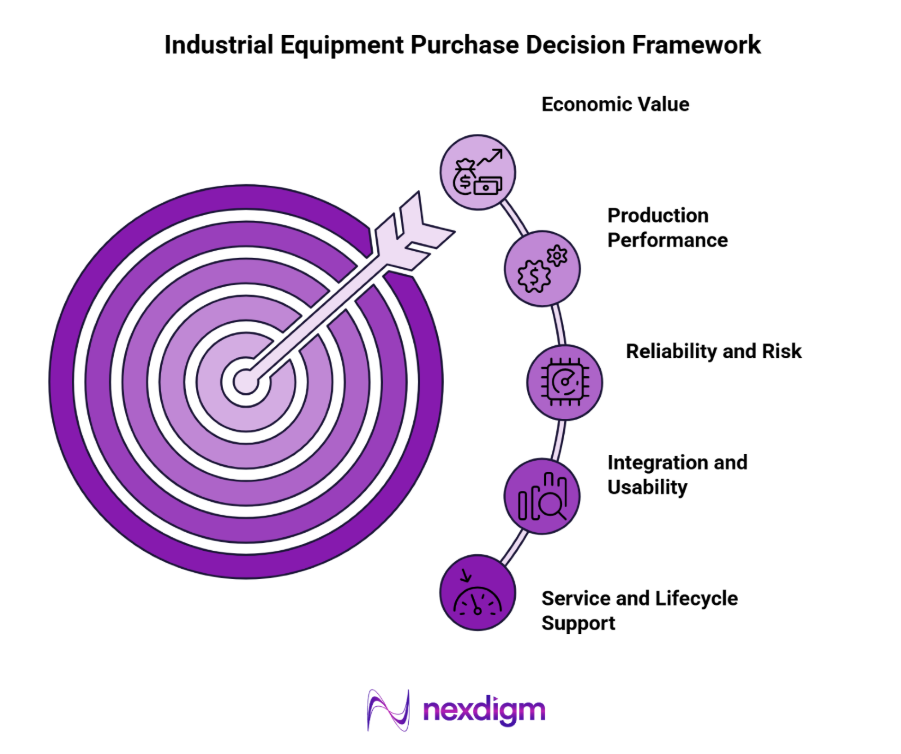
- Economic Value: Compare acquisition price with operating cost, energy consumption, maintenance and expected lifetime economics.
- Production Performance: Assess throughput, productivity, quality, cycle time and capacity gains.
- Reliability and Risk: Measure uptime, failure frequency, maintenance requirements and production disruption exposure.
- Integration and Usability: Evaluate compatibility with existing production systems, workforce capabilities, software and plant infrastructure.
- Service and Lifecycle Support: Assess technical support, spare-parts availability, response time, warranties and aftermarket capability.
Nexdigm can support industrial equipment customer demand analysis through buyer segmentation, purchase-driver assessment, willingness-to-pay analysis, competitor benchmarking, customer interviews and demand forecasting.
These dimensions reveal why two equipment suppliers with similar technical specifications may experience very different market demand.
Nexdigm Case Study: Decoding Industrial Equipment Buying Priorities
Nexdigm supported an industrial equipment provider assessing buyer priorities across manufacturing segments. The analysis found operational benefits ranked as the primary value sought by 49% of surveyed executives, alongside strong emphasis on reliability, service and lifecycle economics.
The findings helped the client refine its value proposition, prioritize target customer segments and align equipment and aftermarket offerings with the factors influencing purchase decisions.
To take the next step, simply visit our Request a Consultation page and share your requirements with us.
Harsh Mittal
+91-8422857704