

Factory investment creates several layers of equipment demand. A new facility may require core production machinery, utilities, controls, inspection systems, material handling, installation and service. But project announcements do not translate directly into orders: funding, permits, construction schedules and specifications all affect timing.
The opportunity is particularly visible in semiconductor equipment. Global semiconductor manufacturing equipment sales are forecast at USD 165.9 billion in 2026, up 23.2% year over year. Wafer fabrication equipment is projected to rise 23.1% to USD 143.9 billion, while test equipment is forecast to grow 31% to USD 15.3 billion. This is a concentrated investment wave, not evidence that all industrial equipment categories are accelerating.
Find where the project creates a bottleneck
The most valuable supplier opportunity may be outside the headline machine. A production line can be constrained by testing capacity, cleanroom infrastructure, power quality, process control, or the ability to commission and maintain equipment. Suppliers that map the whole project can find gaps that are missed by tracking only top-line capital expenditure.
For each planned factory or expansion, identify:
- What process step is being added, upgraded or relocated?
- Which equipment package has already been specified?
- Where are bottlenecks in throughput, quality, energy or labor?
- When will procurement decisions be made?
- What local installation, qualification and service are required?
Nexdigm’s industrial equipment market assessment separates equipment “spend” from addressable sales. A large project may have limited opportunity for a new entrant if specifications are locked and incumbent suppliers control integration. A smaller project may be more attractive if it has an unresolved bottleneck and a shorter supplier qualification path.
Automation demand is broadening, but unevenly
Robotics orders show why sector detail matters. In North America during Q1 2026, total robot orders were nearly flat year over year, while automotive OEM orders fell 35.1% in units. Several non-automotive segments grew: life sciences orders rose 54.1%, electronics 31.7%, food and consumer goods 16%. Collaborative robot orders increased 55.6%.
The implication is not simply “automation is growing.” Demand is shifting by application and deployment model. Suppliers should identify where flexible automation fits production tasks with labor, quality or changeover constraints, and then verify that the customer has budget and integration capacity.
Rank opportunities by project maturity and service economics
Estimate potential demand from the equipment list, project stage, procurement calendar and supplier position. Weight projects by probability of execution rather than counting every announced facility equally. Include recurring service, spare parts, upgrades and retrofit revenue, but avoid assuming all installed capacity converts into aftermarket sales.
A practical commercial priority is where project timing, technical fit and customer access align. In fast-moving sectors, the ability to deliver, install and qualify on schedule can be as important as product performance.
Framework: Factory-to-Order Opportunity Screen
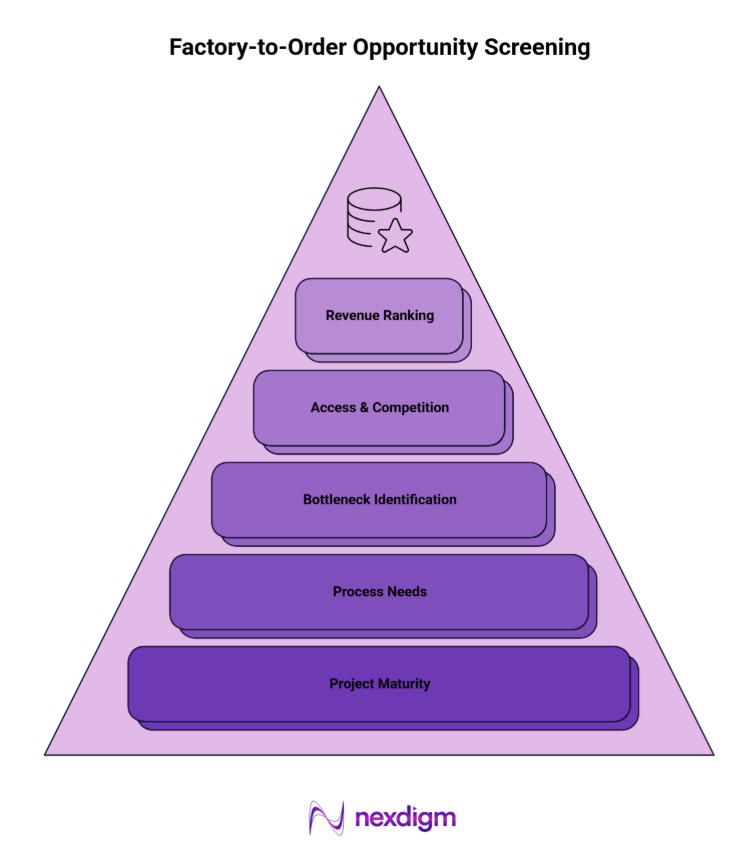
- Verify project maturity
Classify investments by funding, permits, engineering, construction and procurement status. - Map process and equipment needs
Translate production design into machinery, automation, utilities, inspection and service requirements. - Identify open bottlenecks
Test throughput, quality, energy, labor and commissioning constraints with plant and engineering teams. - Assess access and competition
Check specifications, approved vendors, integrators, import exposure, lead times and service requirements. - Rank by executable revenue
Weight equipment value by order probability, timing, win access, margin and aftermarket potential.
Nexdigm Case Study
Nexdigm assessed equipment demand across 36 planned factory investments, matching project maturity to machinery, automation and service requirements. Our model identified eight near-term pursuits; we recommended focusing sales resources on projects with confirmed procurement windows and local commissioning gaps.
To take the next step, simply visit our Request a Consultation page and share your requirements with us.
Harsh Mittal
+91-8422857704