

A domestic manufacturer can produce at a lower factory cost and still be uncompetitive in an export market. The difference emerges after freight, financing, compliance, distribution, and service are included. Global buyers also evaluate suppliers on consistency: a low-cost producer that misses delivery windows or struggles to maintain specifications may be more expensive to work with over the life of a contract.
The question is therefore not whether a manufacturer is efficient by domestic standards. It is whether its operating model can meet the requirements of a specific international buyer at a commercially sustainable price.
Cost Competitiveness Extends Beyond the Factory Gate
The first comparison should separate production costs from delivered cost. Labour, energy, materials, yield loss, tooling, maintenance and overhead allocation shape factory economics. Packaging, inland transport, customs handling, freight, insurance, financing and distributor margins determine what the buyer ultimately pays.
Manufacturers should benchmark costs at a common product specification and shipment size. Comparing a domestic producer’s cost per unit with a competitor’s export price without adjusting for quality, order volume or delivery terms can produce misleading conclusions.
Currency movements complicate the picture further. Imported raw materials may become more expensive when the domestic currency weakens, partly offsetting any advantage on export revenue. Similarly, a large buyer demanding extended payment terms can increase working-capital costs even when the nominal selling price appears attractive.
The right test is a margin bridge: begin with the current factory cost, add the full cost of serving the target market, and compare the result with prevailing competitor prices. Then test how margins respond to changes in input costs, exchange rates, freight, and order volumes.
Quality and Delivery Determine Whether Buyers Return
Price can secure a trial order. Repeat business depends on performance. Buyers often evaluate defect rates, process capability, traceability, certification, responsiveness to corrective actions and the supplier’s ability to maintain specifications across production runs.
Quality costs also appear in places that factory accounts may not be captured cleanly. Rework, rejected shipments, warranty claims, expedited replacement orders, and customer audits can erode margins after the sale. Export readiness therefore requires quality systems that provide evidence of control, not merely a certificate on the wall.
Delivery performance deserves equal scrutiny. A manufacturer with a longer production cycle may compensate through reliable planning, inventory buffers, or proximity to a port. But those measures tie up cash. The analysis should compare on-time-in-full performance, order-to-shipment lead time, production flexibility, and the cost of meeting urgent orders.
The World Bank’s Logistics Performance Index evaluates the ability of economies to move goods across borders with speed and reliability. Country-level logistics conditions matter, but individual manufacturers still need to measure their own performance from order confirmation to customer receipt. A strong national logistics score cannot rescue weak production planning.
Scale is a Capability, not Just Installed Capacity
Global contracts can require larger volumes, tighter delivery windows and sustained production over multiple quarters. Installed capacity does not automatically translate into export-ready capacity. Changeover time, supplier reliability, equipment downtime, labour availability and product-mix complexity all affect usable output.
Manufacturers should determine the volume at which export orders become profitable, then check whether that volume is realistic without disrupting domestic customers. A large contract can create an attractive revenue headline while requiring new tooling, extra shifts, certification, inventory, and extended receivables. The financial model should include these requirements before a price is committed.
An Industrial export competitiveness analysis should also assess where scale can be built through contract manufacturing, strategic suppliers, shared distribution or a phased ramp-up rather than a large upfront capacity expansion.
Four Dimensions of Export Readiness
Cost, quality, scale, and delivery reinforce one another, but weaknesses in one dimension can undermine the others. A manufacturer should compare its performance with the requirements of target buyers, rather than with a generic industry average.
A practical diagnostic includes:
- Cost: Delivered cost per unit, contribution margin, break-even volume and sensitivity to input or freight changes.
- Quality: Defect and rework rates, process capability, traceability, certification and corrective action closure.
- Scale: Available capacity, yield, changeover time, supplier capacity and working capital required for larger orders.
- Delivery: On-time-in-full performance, lead-time variability, export documentation and recovery plans for disruptions.
The resulting gaps should be ranked by commercial impact. Reducing scrap may improve both cost and delivery reliability; better production planning may increase usable capacity without capital expenditure. Conversely, a product requiring expensive redesign or a certification the company cannot obtain may not justify further investment.
Export Competitiveness Readiness Framework
The assessment follows four stages:
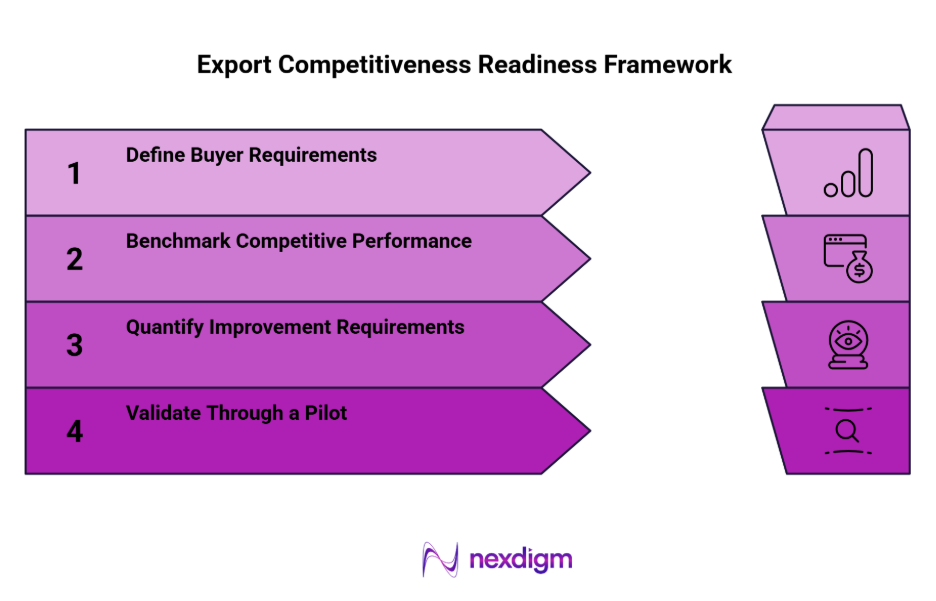
- Define Buyer Requirements: Establish the required product specifications, order volumes, delivery schedules, and service expectations in the target market.
- Benchmark Competitive Performance: Compare the manufacturer’s delivered cost, quality consistency, production capacity and delivery reliability against credible competitors.
- Quantify Improvement Requirements: Estimate the investment needed to close performance gaps and model how operational changes affect unit costs, contribution margins, and export pricing.
- Validate Through a Pilot: Test the product with a target buyer against agreed quality, delivery and profitability thresholds before committing to a wider rollout.
The framework distinguishes operational weaknesses that can be corrected from structural disadvantages that may make a market commercially unattractive. It also ensures that export pricing reflects the full cost of serving the buyer, rather than factory production cost alone.
Nexdigm Case Study: Closing the Gap Between Factory Cost and Export Performance
Nexdigm evaluated export readiness for an Indian precision-engineering manufacturer targeting buyers in Europe and Southeast Asia. The review covered 18 product lines, production capacity, material costs, quality losses, shipment history, logistics, and working-capital requirements.
The assessment found that 6 product lines could meet target market pricing with limited operational changes. Across the reviewed range, avoidable scrap and rework were adding 4.2% to manufacturing cost, while schedule variation was creating recurring expedited shipment expenses. 3 additional lines required tooling or process improvements before they could meet buyer specifications at the required margin.
To take the next step, simply visit our Request a Consultation page and share your requirements with us.
Harsh Mittal
+91-8422857704