

Efficient management of heavy industrial goods requires highly coordinated supply chains to support production, distribution, and project timelines. Companies face challenges such as oversized shipments, specialized handling, and multi-site coordination. Leveraging industrial logistics intelligence provides critical competitive insights, enabling firms to benchmark operational performance, track competitors’ distribution strategies, and identify efficiency gaps.
By analyzing routing, fleet utilization, and storage practices, organizations can optimize industrial logistics operations, reduce costs, improve delivery reliability, and maintain a competitive edge in complex heavy-supply networks.
The global industrial logistics market was estimated at around USD 1.28 trillion, driven by complex distribution needs across manufacturing, energy and construction sectors. It is projected to grow at roughly 5.7 % CAGR through 2033, reaching more than USD 2.1 trillion as global production networks expand and demand for specialized handling, storage and transport services increases. Advanced logistics intelligence and technology adoption are becoming key competitive levers in this segment.
Obstacles in Industrial Logistics Distribution for Heavy Equipment
Obstacles in Industrial Logistics Distribution of Heavy Equipment include managing oversized shipments, coordinating multi-site deliveries, ensuring timely transport, handling specialized vehicles, and mitigating delays, risks, or damages across complex heavy supply chains:
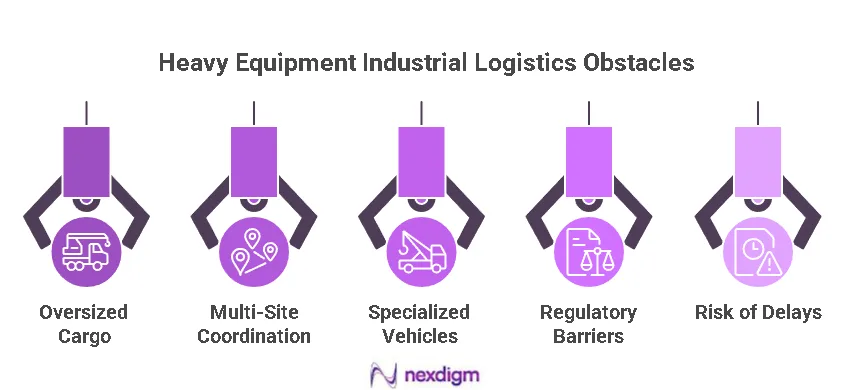
- Oversized Cargo Handling Challenges – Managing transportation, loading, and unloading of large, heavy equipment while minimizing damage and maintaining safety standards.
- Multi-Site Delivery Coordination – Synchronizing shipments across multiple locations, production sites, or construction projects to ensure timely delivery and operational continuity.
- Specialized Vehicle and Equipment Requirements – Ensuring availability and proper use of cranes, flatbeds, and other specialized vehicles for heavy industrial transport.
- Regulatory and Compliance Barriers – Navigating permits, weight restrictions, safety regulations, and local laws affecting heavy equipment transport and distribution.
- Risk of Delays and Operational Disruptions – Managing scheduling conflicts, traffic congestion, weather events, and supply chain interruptions that impact delivery timelines.
Nexdigm Competitive Intelligence and Benchmarking for Industrial Supply Chains
Nexdigm Competitive Intelligence and Benchmarking for Industrial Supply Chains helps companies evaluate and compare heavy logistics networks against industry peers. By analyzing inbound and outbound flows, handling efficiency, fleet utilization, and partner performance, Nexdigm identifies operational gaps, best practices, and improvement opportunities. This approach enables data-driven decision-making, cost optimization, risk mitigation, and enhanced competitiveness in complex industrial supply chains.
How Nexdigm Helps You Overcome Heavy Equipment Handling Challenges?
How Nexdigm Helps You Overcome Heavy Equipment Handling Challenges guides companies in safely managing oversized shipments, optimizing loading and unloading processes, reducing damage risks, and ensuring efficient, reliable operations across industrial logistics networks.
- Optimized Loading and Unloading Processes – Nexdigm designs procedures to safely handle oversized equipment, reducing damage, delays, and operational risks.
- Specialized Handling Equipment Guidance – Recommendations on cranes, forklifts, and transport vehicles for efficient movement of heavy industrial goods.
- Workforce Training and Safety Protocols – Equipping staff with skills and safety practices to manage large shipments effectively and minimize accidents.
- Real-Time Monitoring and Tracking – Implementing IoT and digital tools to track shipments, ensuring accountability and proactive issue resolution.
- Process Standardization and Best Practices – Establishing repeatable handling workflows aligned with industry benchmarks for consistent operational efficiency.
Nexdigm’s case:
Nexdigm supported a consumer healthcare company facing high freight costs and supply delays by reshaping its supply chain strategy. Through supplier transition and inventory planning, Nexdigm helped the client avoid approximately USD 0.56 million in air freight costs, secure USD 192 million in protected net trade sales, and create 30 days of safety stock to improve resilience and reduce disruption risk. These interventions strengthened operational efficiency and reduced logistics exposure.
To take the next step, simply visit our Request a Consultation page and share your requirements with us.
Harsh Mittal
+91-8422857704