

Industrial logistics is becoming more complex as manufacturing expands, infrastructure projects increase, supply chains diversify, and businesses move larger, heavier, and more specialized cargo.
Global manufacturing value added reached approximately $17.3 trillion in 2023, according to World Bank data, demonstrating the enormous scale of industrial activity generating freight, storage, and logistics requirements.
At the same time, global merchandise trade reached approximately $33 trillion in 2024, according to UN Trade and Development, creating continued demand for transportation and supporting logistics infrastructure.
For manufacturers, industrial distributors, logistics providers, freight forwarders, investors, and specialized cargo companies, the priority is understanding where industrial freight is growing, what infrastructure is required, and where logistics capacity can generate commercial value.
An Industrial logistics market analysis connects freight activity with warehousing, project cargo, specialized handling, infrastructure, transportation, and market opportunity.
Industrial Logistics Is Moving Rapidly
Industrial supply chains often involve fewer shipments than consumer logistics but significantly greater complexity per shipment.
A single project may require oversized machinery, heavy equipment, specialized packaging, temporary storage, multimodal transportation, customs coordination, and carefully planned delivery schedules.
Manufacturing supply chains also require consistent movement of raw materials, components, finished goods, and maintenance equipment. This makes industrial logistics highly dependent on infrastructure quality, cargo characteristics, network connectivity, and handling capabilities.
The Forces Reshaping Industrial Logistics
Several trends are influencing industrial logistics demand.
- Manufacturing expansion: New factories increase requirements for inbound materials, component storage, plant logistics, and finished-goods distribution.
- Infrastructure investment: Construction, energy, utilities, and transportation projects generate demand for project cargo and specialized handling.
- Supply-chain diversification: Companies adding suppliers or production locations create additional freight movements and inventory requirements.
- Industrial clustering: Concentrated manufacturing zones can generate demand for shared warehouses, consolidation centers, freight services, and specialized logistics infrastructure.
Role of Nexdigm in Assessing the Shifting Logistics Value
The strongest opportunities emerge where industrial production, freight growth, project activity, specialized cargo, infrastructure gaps, and favorable operating economics intersect.
Nexdigm connects these signals to identify opportunities across freight transportation, industrial warehousing, project logistics, specialized handling, staging facilities, and multimodal infrastructure through a structured framework model.
How Nexdigm Analyzes the Right Industrial Logistics Opportunity
Industrial growth often creates diverse logistics requirements that extend beyond traditional warehousing and transportation. Nexdigm maps logistics opportunities to support efficient movement and storage of goods through:
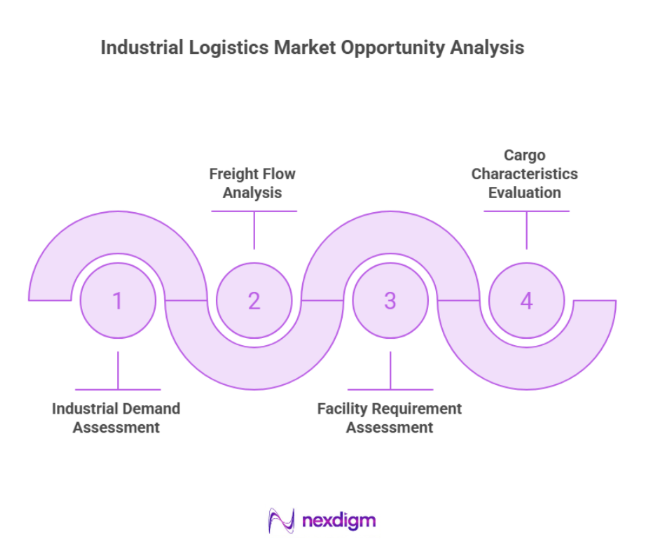
- Industrial Demand Assessment: Evaluate manufacturing activity, construction projects, energy developments, and industrial expansion trends to understand where logistics demand is emerging and growing.
- Freight Flow Analysis: Assess the movement of raw materials, equipment, finished goods, and project cargo to identify transportation requirements and supply chain dependencies.
- Facility Requirement Assessment: Review the need for supplier warehouses, consolidation centers, staging areas, distribution facilities, and specialized storage infrastructure across industrial sectors.
- Cargo Characteristics Evaluation: Analyze cargo size, weight, handling complexity, and storage requirements to determine the logistics capabilities and infrastructure needed to support operations.
By combining these elements, Nexdigm develops a comprehensive view of where logistics value is shifting across the industrial ecosystem. These insights form the foundation of Nexdigm’s Industrial Logistics Framework, which provides a structured approach to evaluating demand drivers and market opportunities across industrial logistics markets.
Nexdigm’s Industrial Logistics Framework
Nexdigm’s framework conducts Industrial logistics market analysis to connects industrial activity with the logistics capabilities required to move, store, handle, and distribute complex cargo efficiently. This analysis focuses on the following major areas:
- Freight Flows: Nexdigm examines industrial production, supplier networks, trade corridors, shipment volumes, cargo origins, and destinations to identify where freight demand is building.
- Warehousing Requirements: The assessment evaluates storage demand, facility specifications, inventory profiles, location, utilization, and expansion needs to identify markets requiring additional industrial warehousing capacity.
- Project Cargo: Nexdigm assesses infrastructure projects, oversized equipment movements, construction activity, staging requirements, transport routes, and delivery schedules to identify project-logistics opportunities.
- Specialized Handling: The framework evaluates heavy lifting, oversized cargo, hazardous materials, specialized equipment, packaging, loading, unloading, and technical capabilities required for complex industrial shipments.
- Infrastructure Economics: Nexdigm compares transportation costs, land, facility investment, labor, connectivity, utilization, competing capacity, and project pipelines to determine whether industrial logistics opportunities can support sustainable returns.
The framework connects freight demand with storage, project activity, specialized handling, and infrastructure economics, helping organizations identify where logistics capacity can create the greatest operational and commercial value.
Nexdigm’s Case
An industrial logistics operator used Nexdigm’s Industrial logistics market analysis to optimize freight flows and warehouse capacity. Within 12 months, asset utilization increased 24%, freight handling efficiency improved 21%, logistics costs declined and project cargo turnaround times fell 19%, supporting stronger operations and scalable regional expansion.
To take the next step, simply visit our Request a Consultation page and share your requirements with us.
Harsh Mittal
+91-8422857704