

Industrial logistics parks are becoming important infrastructure assets as manufacturing expands, 3PL activity increases, supply chains diversify, and businesses seek locations combining warehousing, transportation, utilities, and industrial services.
India’s industrial and logistics market illustrates the momentum. During H1 2026, 3PL and engineering & manufacturing occupiers accounted for 31% and 26% of leasing activity, respectively, while Delhi-NCR, Chennai, and Bengaluru represented approximately 60% of total leasing.
These trends show why an industrial logistics park requires more than available land. It needs the right combination of industrial demand, tenant depth, connectivity, infrastructure, land economics, and development scalability.
For developers, investors, manufacturers, 3PL providers, logistics operators and infrastructure companies, an Industrial logistics park market study helps determine whether a proposed park can attract tenants, achieve sustainable utilization, and generate long-term commercial value.
Industrial Logistics Parks Are Becoming Integrated Ecosystems
An industrial logistics park can combine warehouses, manufacturing facilities, distribution centers, truck terminals, cross-docking operations, storage yards, utilities, and supporting services within one connected location.
This integrated model can reduce transportation distances, simplify supplier access, and allow multiple businesses to share infrastructure.
A manufacturing-led park may require heavier floor loads, production support, worker access, and industrial utilities. A 3PL-focused park may prioritize large warehouses, loading capacity, highway connectivity, and scalable distribution space.
The commercial opportunity therefore depends on matching park design with the needs of the target tenant base.
Nexdigm in Connecting Market Demand With Park Viability
Industrial logistics park development cannot be evaluated through land availability or headline rental rates alone. Nexdigm connects the following factors to assess whether a proposed park can support sustainable occupancy across tenant demand, industrial clusters, freight flows, transportation connectivity and development pipelines.
The approach identifies what type of park the market requires. This allows developers and investors to move from site identification to commercially grounded development planning.
How Nexdigm Assesses Factors Behind Park Viability
Nexdigm’s industry-led expertise assesses several factors that determine whether an industrial logistics park can perform successfully. These factors are:
- Tenant demand: A strong pipeline of manufacturers, 3PLs, retailers, distributors, and industrial businesses provides the foundation for occupancy.
- Connectivity: Access to highways, ports, airports, railways, and freight corridors determines how efficiently tenants can move goods.
- Land economics: Land acquisition and development costs must support commercially competitive rents and long-term investment returns.
- Infrastructure: Reliable utilities, roads, drainage, telecommunications, security, and common facilities influence tenant attractiveness.
- Tenant diversification: A broad occupier base can reduce dependence on one industry or customer segment.
Nexdigm’s Industrial Logistics Assessment Framework
The Industrial logistics park market study focuses on the following major areas to help developers and investors evaluate whether a proposed industrial logistics park can attract the right occupiers and maintain sustainable commercial performance.
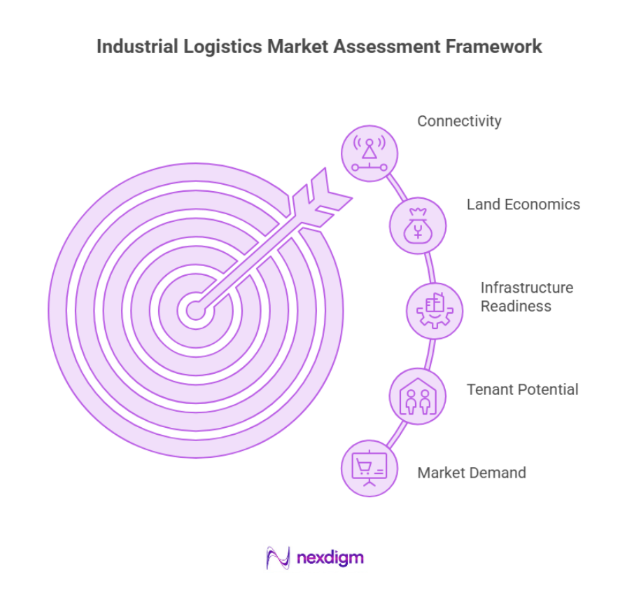
- Market Demand: Nexdigm assesses manufacturing growth, 3PL activity, warehousing demand, trade flows, e-commerce, and industrial expansion to determine whether sufficient demand exists for new park capacity.
- Connectivity: The assessment evaluates highway, rail, port, airport, freight-corridor, and intermodal access to determine how efficiently the park can serve suppliers, customers, and regional markets.
- Tenant Potential: Nexdigm identifies potential occupier segments, tenant requirements, industry clusters, lease demand, facility preferences, and diversification opportunities to estimate the park’s achievable tenant base.
- Land Economics: The framework compares land prices, development costs, facility specifications, rental potential, infrastructure expenses, and expansion opportunities to determine whether the project can achieve attractive economics.
- Infrastructure Readiness: Nexdigm evaluates utilities, internal roads, drainage, telecommunications, security, loading infrastructure, and supporting services to determine whether the site can support modern industrial operations.
The framework connects the following areas to determine whether an industrial logistics park can achieve occupancy, operational efficiency, and sustainable returns.
Strategic Applications of the Nexdigm’s Logistics Park Framework
The framework can be applied across the industrial logistics park lifecycle, helping businesses move from market evaluation and site selection to development, leasing, and long-term optimization.
- Site Selection: Nexdigm uses demand, connectivity, land, and infrastructure factors to compare potential locations and identify sites with stronger long-term industrial logistics potential.
- Development Planning: The framework helps developers determine appropriate park size, facility specifications, development phases, infrastructure requirements, and expansion potential based on expected tenant demand.
- Tenant Targeting: Businesses can identify the most relevant tenant segments, including manufacturers, 3PLs, retailers, distributors, and e-commerce companies, based on local market requirements.
- Investment Assessment: Investors can evaluate demand visibility, land economics, competing supply, rental potential, infrastructure costs, and utilization prospects before committing capital.
Overall, the framework helps reduce site-selection risk, improve tenant targeting, support better capital allocation, increase utilization, and build industrial logistics parks around measurable market demand rather than assumptions.
Nexdigm’s Case
A logistics developer used Nexdigm’s Industrial logistics park market study to assess site viability, tenant demand, and infrastructure planning. Within 12 months, occupancy improved 27%, asset utilization increased 23%, operating costs declined 15%, and tenant acquisition accelerated 21%, supporting stronger returns and scalable park development.
To take the next step, simply visit our Request a Consultation page and share your requirements with us.
Harsh Mittal
+91-8422857704