

Industrial machinery demand rarely moves as one market. Equipment requirements emerge from what factories are producing, how efficiently they are operating, which technologies are changing, and where capacity is being added or replaced.
That makes end-use analysis more revealing than looking at machinery revenues in isolation.
A semiconductor fab, pharmaceutical plant, food-processing facility, automotive factory, and steel producer can all increase machinery spending while requiring completely different equipment, specifications, service models, and investment cycles.
The opportunity lies in identifying where those underlying industrial changes intersect with an equipment category’s capabilities.
Follow the Factory Before Following the Machinery Market
Machinery demand is fundamentally derived demand.
When downstream production expands, factories need additional equipment. When utilization rises, bottlenecks become more expensive. When equipment ages, replacement demand increases. When labour becomes scarce or quality requirements tighten, automation and retrofit opportunities emerge.
The supplied market framework expresses this relationship as three demand pools: replacement demand, capacity expansion demand, and productivity retrofit demand.
Each should be modelled separately.
Replacement demand depends on installed equipment and useful life. Expansion demand depends on downstream output growth and utilization. Retrofit demand depends on the economic case for improving existing production assets.
Together, they create a more defensible machinery demand forecast.
End-Use Industries Create Different Opportunity Profiles
Automotive manufacturing may support demand for high-throughput forming, welding, machining, and battery-related equipment. Food processing places greater emphasis on hygiene, continuous throughput, packaging speed, and cleaning requirements.
Pharmaceutical manufacturing introduces stringent validation and contamination-control requirements. Semiconductor production requires precision at increasingly narrow process tolerances.
The opportunity is therefore not simply “machinery demand in pharmaceuticals” or “automation demand in automotive.”
It is the intersection between a specific industrial application and a specific equipment requirement.
For example, a machine that addresses a high-cost bottleneck in aseptic filling can have a stronger commercial position than a broader machine category with significantly higher aggregate revenue but intense price competition.
Technology Transitions Can Reallocate Machinery Spending
Technology changes can create new equipment categories while reducing demand for established ones.
Industrial automation is one of the clearest examples. The International Federation of Robotics reported that industrial robot installations in the United States increased 11% in 2025 to 38,000 units. Food-industry installations increased 30%, demonstrating how automation demand can spread beyond traditional automotive applications.
Semiconductor manufacturing provides another example. SEMI forecasts global semiconductor manufacturing equipment sales of $165.9 billion in 2026, with AI infrastructure, advanced memory, leading-edge logic, and advanced packaging supporting the investment cycle.
These shifts create opportunities for equipment suppliers across the value chain, including process machinery, testing, packaging, robotics, precision tooling, and supporting systems.
Market Size Alone Can Hide Weak Opportunities
A large equipment category may still be unattractive when technology is mature, replacement cycles are long, products are heavily commoditized, or incumbent suppliers control most customer relationships.
Conversely, a smaller application may offer stronger economics if customers face urgent operational problems and few suppliers can meet the required specifications.
The supplied industrial machinery framework places opportunities across market demand and technology-transition exposure. Mature technologies in high-demand markets can provide established cash flows, while high-demand categories undergoing rapid technological change may offer greater strategic expansion potential.
The evaluation therefore needs to distinguish market volume from addressable opportunity.
Where the Commercial Opportunity Can Be Isolated
An industrial machinery opportunity evaluation connects five layers:
- Downstream Growth: Identifying which industries are expanding production, adding facilities, or increasing capital expenditure.
- Application Intensity: Determining which production processes require more equipment per unit of output.
- Installed-Base Exposure: Assessing the age of the existing equipment base and when replacement becomes economically rational.
- Technology Transition: Tracking shifts from manual to automated, hydraulic to servo-electric, conventional inspection to machine vision, or legacy production to digitally integrated systems.
- Competitive Structure: Evaluating how many credible suppliers can address the application and what barriers prevent customers from switching.
This structured evaluation produces a more precise view of where machinery demand translates into revenue.
Nexdigm’s Industrial Machinery Opportunity Evaluation Framework
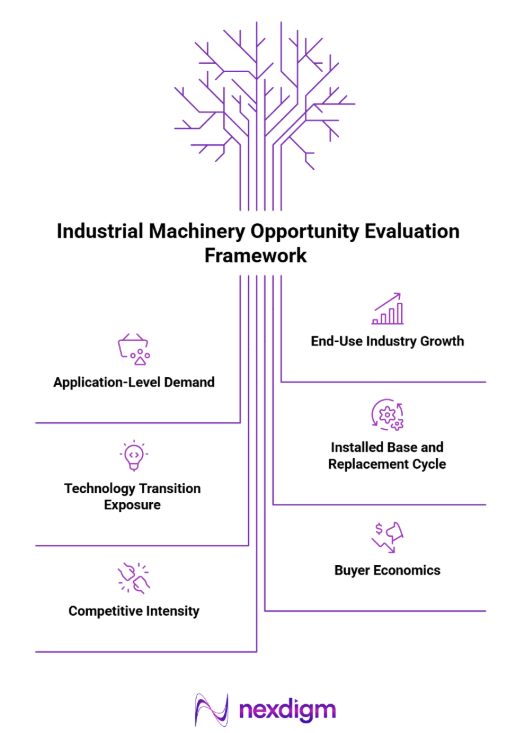
- End-Use Industry Growth
Map production growth, capacity additions, utilization, investment cycles, and customer expansion across target industries. - Application-Level Demand
Identify the specific production processes, equipment classes, and technical requirements generating procurement demand. - Installed Base and Replacement Cycle
Assess equipment population, age, useful life, maintenance intensity, and replacement timing. - Technology Transition Exposure
Evaluate automation, digitalization, energy efficiency, precision requirements, and emerging production technologies that could change equipment demand. - Buyer Economics
Measure throughput improvement, labour savings, scrap reduction, energy efficiency, downtime reduction, and expected payback. - Competitive Intensity
Assess OEM concentration, product differentiation, switching costs, pricing pressure, distribution networks, and aftermarket coverage. - Opportunity Prioritization
Rank applications internally by market growth, technology exposure, customer economics, competitive accessibility, and achievable revenue potential.
Case Study: Industrial Machinery Opportunity Evaluation
A machinery supplier assessed three end-use sectors and found food processing had the largest equipment volume, while pharmaceutical applications delivered 24% higher gross margins and an 18-month faster payback, redirecting product-development focus toward specialized processing systems.
To take the next step, simply visit our Request a Consultation page and share your requirements with us.
Harsh Mittal
+91-8422857704