

Machining demand is evolving as manufacturers adopt automation, work with advanced materials, and pursue increasingly tighter tolerances. The latest World Robotics 2026 report shows that the global operational stock of industrial robots reached a record 5 million units in 2025, up 9%, while more than 600,000 new robots were installed during the year.
Global installations are forecast to rise another 9% to 655,000 units in 2026. India installed nearly 10,500 industrial robots in 2025, up 15% year over year. These trends are reshaping machining requirements, increasing demand for automated production, precision capabilities, process consistency, and flexible manufacturing.
Automation Is Raising the Precision Bar
Machining automation is increasing expectations for speed, consistency, and repeatability. Global industrial robot installations exceeded 600,000 units in 2025, while India’s installations rose 15% year over year. As automated production expands, machining suppliers increasingly need advanced CNC capabilities, reliable process control, and tighter quality management to remain competitive.
What Is Reshaping Machining Requirements
Machining is evolving beyond conventional production as manufacturers respond to automation, advanced materials, tighter tolerances, and increasing expectations for consistent, high-volume output.
- Automation & Throughput: Automated CNC systems, robotics, and digital monitoring are helping manufacturers increase productivity while maintaining consistent machining quality across production runs.
- Advanced Materials: Harder alloys, composites, and engineered materials are increasing demand for specialized tooling, machining strategies, and process-control capabilities.
- Tighter Tolerances: More demanding applications require greater dimensional accuracy, repeatability, inspection capability, and process stability throughout manufacturing operations.
These shifts encourage machining businesses to invest in automation, precision technologies, advanced tooling, and flexible production capabilities to remain competitive.
How Nexdigm Helps Manufacturers Navigate the Future of Machining
The next phase of machining will be shaped by the convergence of automation, material innovation, precision requirements, and changing customer expectations. Nexdigm helps manufacturers understand these shifts and assess their implications by focusing on:
- Technology Readiness: Assessing how automation, CNC advancements, digital monitoring, and inspection technologies may influence future manufacturing requirements.
- Material Readiness: Identifying emerging material trends and determine their implications for tooling, machining processes, quality, and production economics.
- Market Readiness: Evaluating which industries and applications are likely to generate sustained demand for increasingly precise and complex components.
- Capability Roadmapping: Translating market shifts into priorities for technology investment, capacity development, skills, and operational capabilities.
This forward-looking perspective helps machining businesses prepare their capabilities for emerging demand and build strategies that remain relevant as manufacturing requirements continue to evolve.
Nexdigm’s Industrial Machining Market Assessment Approach
Nexdigm’s Industrial machining market assessment helps manufacturers understand how demand, technology, customer requirements, and competitive dynamics are reshaping the machining landscape. The assessment focuses on areas such as:
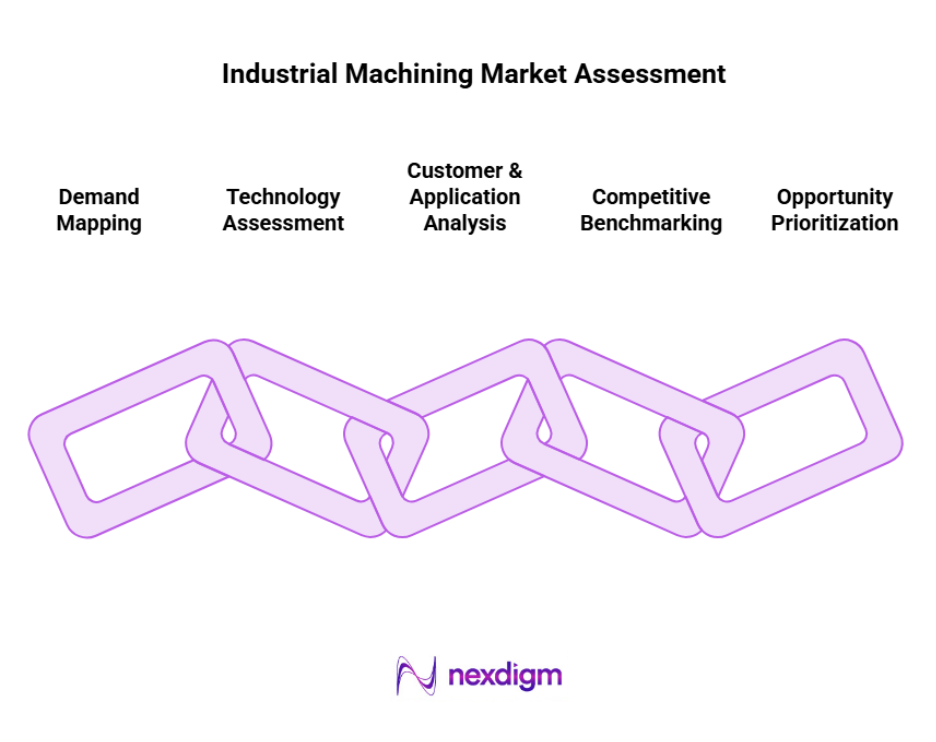
- Demand Mapping: Assessment of demand across industries, applications, component types, and geographies to identify high-potential growth areas.
- Technology Assessment: Evaluation of CNC automation, advanced tooling, inspection systems, and manufacturing technologies influencing production capabilities.
- Customer & Application Analysis: Understanding tolerance requirements, material needs, volumes, quality expectations, and purchasing priorities across target applications.
- Competitive Benchmarking: Comparison of suppliers on capabilities, capacity, technology, certifications, specialization, and market positioning.
- Opportunity Prioritization: Ranking applications and markets according to demand potential, capability fit, competitive intensity, and commercial attractiveness.
The assessment helps machining businesses make evidence-based decisions on capability development, market targeting, technology investment, and long-term growth.
Why Businesses Choose Nexdigm as a Strategic Partner
For manufacturers navigating automation, tighter tolerances, advanced materials, and changing customer expectations, market intelligence needs to translate into practical business decisions. Nexdigm combines industry understanding with research and analytical capabilities to help businesses with:
- Industry-Centric Perspective: Connect manufacturing trends with specific applications, customer requirements, technologies, and competitive dynamics.
- Decision-Oriented Intelligence: Translate complex market information into actionable insights supporting investment, capability development, sourcing, and expansion decisions.
- Integrated Market View: Bring demand, competition, technology, supplier, and customer intelligence together rather than evaluating each factor independently.
- Forward-Looking Analysis: Identify emerging demand patterns and capability requirements to help businesses prepare for future changes in machining markets.
This combination makes Nexdigm a strategic partner for businesses seeking to understand changing machining markets, strengthen competitive positioning, and convert emerging demand into sustainable growth opportunities.
Nexdigm’s Market Insights For Stronger Machining Outcomes
For machining businesses, the value of market analysis lies in how effectively insights translate into commercial and operational decisions. Nexdigm’s analysis can help manufacturers turn changing market conditions into focused actions across growth, capabilities, customers, and investments.
- Sharper Market Focus: Prioritize industries, applications, and customer segments with stronger demand and better capability alignment.
- Smarter Investments: Direct technology, capacity, and capability investments toward opportunities supported by market evidence.
- Stronger Customer Alignment: Match manufacturing capabilities with evolving tolerance, material, quality, delivery, and customization requirements.
- Improved Growth Planning: Identify opportunities for new customers, applications, partnerships, and geographic expansion.
The result is a more focused decision-making process that helps manufacturers allocate resources effectively, respond to changing demand, and build sustainable growth in precision machining markets.
Nexdigm’s Case
Nexdigm helped a precision engineering firm benchmark its manufacturing capabilities, identifying gaps and improvement opportunities. The engagement delivered a 22% improvement in CNC tolerance accuracy and a 14% reduction in defect rates, strengthening the company’s competitiveness in high-performance component manufacturing and supporting more consistent production outcomes.
To take the next step, simply visit our Request a Consultation page and share your requirements with us.
Harsh Mittal
+91-8422857704