

An emerging industrial market often draws substantial attention long before it can support a viable manufacturing footprint. Subsidies, infrastructure commitments, and pilot deployments signal future demand, but they do not guarantee commercial viability. Converting early interest into revenue still requires localized supplier networks, certified distribution channels, and dependable customer retention.
This disconnect between pipeline projections and realized revenue is particularly acute in high-technology manufacturing. According to UNIDO, global manufacturing exports expanded by 6.1% quarter on quarter in Q2 2026, driven by a 7.1% increase in high-tech goods. While these figures indicate strong global momentum, top-line trade growth does not assure market access for individual suppliers or protect operating margins in commoditizing product categories.
Ultimately, commercial scale is determined by how quickly an enterprise can establish an efficient route to market and convert initial purchase orders into long-term contract value.
What Prevents Emerging Demand from Becoming Revenue?
Several constraints can delay market development even when the underlying need is genuine.
Customers may require product certification, local testing, factory audits or extended performance trials before approving a new supplier. Distribution partners may lack the technical capability to support installation and maintenance. Imported components may create long lead times, while inconsistent local supply can undermine delivery commitments.
Financing is another constraint. Industrial buyers often approve equipment purchases through capital budgets and formal procurement cycles. A supplier may have a promising pipeline but insufficient working capital to fund inventory, production and receivables while orders mature.
The barriers differ by product and market:
- Technical readiness: Certification, performance validation, product adaptation and customer qualification.
- Supply-chain readiness: Reliable inputs, component availability, production capacity and logistics.
- Commercial access: Distributor coverage, local partnerships, tender eligibility and customer relationships.
- Financial readiness: Working capital, payment terms, inventory exposure and the cost of servicing customers.
- Market confidence: Reference installations, after-sales support and evidence that the product performs reliably.
Market development plans should identify these barriers before committing to a large production footprint. A technically attractive product can remain commercially marginal if the cost of qualification and customer acquisition is too high.
Build the Route from First Customer to Repeat Orders
- Establish a focused beachhead: Target an initial, high-conviction customer segment with an urgent operational requirement. A disciplined entry strategy allows a manufacturer to calibrate technical specifications, test price tolerance, and secure defensible reference accounts without the heavy capital burden of supporting an unproven product portfolio across multiple segments.
- Stress-test the operating model early: Treat initial transaction volume as a test of unit economics rather than confirmed demand. Leadership must rigorously track pipeline conversion velocity, average order sizes, on-time delivery performance, scrap and rejection rates, post-sale service costs, and repeat-order intervals to verify whether purchasing patterns are sustainable or merely driven by isolated projects.
- Scale capacity behind verified demand: The International Energy Agency’s Energy Technology Perspectives 2026 demonstrates the risk of building ahead of customer absorption. Clean-tech manufacturing investment dropped below US$200 billion in 2024, as widespread overcapacity in solar modules and batteries depressed utilization rates and curbed the capital required to meet stated policy targets.
- Commit capital to evidence, not momentum: Production footprint and capital expenditures must follow verified purchase commitments, demonstrable customer economics, and stable margins rather than industry excitement alone.
For Industrial market development analysis, Nexdigm can connect demand sizing with customer segmentation, route-to-market assessment, supplier readiness and scale-up economics to identify what must happen between market entry and sustainable commercial performance.
Scaling Requires Evidence, Not Just a Larger Sales Target
Manufacturers should expand only when early market results demonstrate that the business can deliver profitable, repeatable orders. The relevant signals include improving customer conversion, repeat purchases, stable product quality, predictable lead times and sufficient contribution margin after distribution and service costs.
Scaling can take several forms. A company may expand direct sales, appoint additional distributors, establish a local assembly operation or invest in owned production. The appropriate model depends on sales density, technical support requirements, customer concentration and the economics of serving each location.
The decision should also account for the cost of failure. A distributor agreement is generally easier to reverse than a dedicated factory, while contract manufacturing can offer a route to test demand before committing to fixed assets. These alternatives provide flexibility while the market develops.
Industrial Market Scale-Up Framework
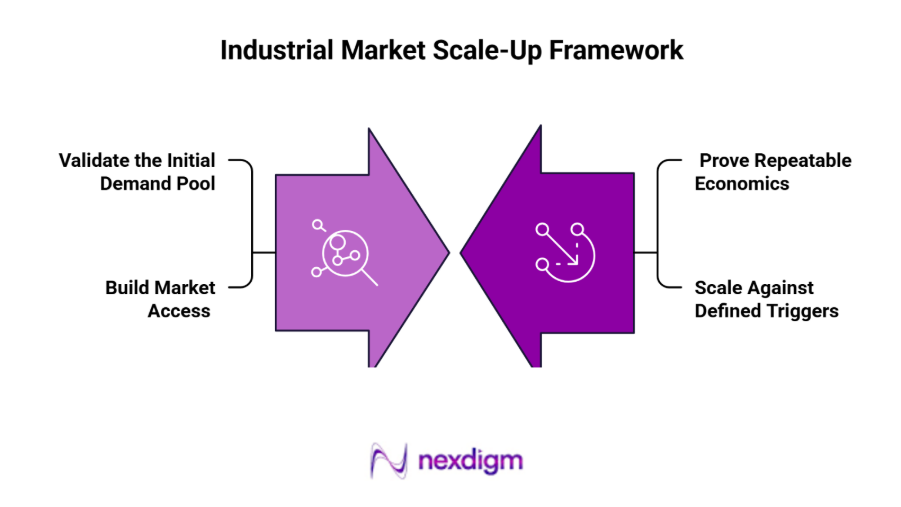
- Validate the Initial Demand Pool
Identify priority customer segments, confirm purchasing requirements and establish the commercial problem the product solves. - Build Market Access
Secure channel partners, customer approvals, local technical support and supply arrangements needed to convert interest into orders. - Prove Repeatable Economics
Track order conversion, repeat purchasing, margins, service costs, quality and working-capital requirements. - Scale Against Defined Triggers
Expand distribution, assembly or production when customer commitments, utilisation and contribution margins meet agreed thresholds.
Nexdigm Case Study: Converting Emerging Demand into Scalable Sales
Nexdigm assessed market entry for an industrial equipment manufacturer targeting three emerging regional markets. The team screened 42 prospective customers, evaluated 12 channel partners and modelled sales conversion, service costs and working-capital requirements over three years. The assessment prioritised two markets where 16 customers represented a qualified first-wave pipeline worth approximately ₹38 crore.
To take the next step, simply visit our Request a Consultation page and share your requirements with us.
Harsh Mittal
+91-8422857704