

Industrial parks are becoming increasingly important as manufacturers seek locations that can support scale, reliable utilities, efficient logistics, and access to established supplier ecosystems. Global manufacturing output continued to expand in 2025, while greenfield investment remained concentrated in strategic sectors requiring substantial industrial infrastructure.
UNCTAD reported that international project finance deals fell 16% in 2025, highlighting the need for careful project and infrastructure assessment, while global greenfield investment continued to favor capital-intensive industries. Industrial park developers therefore need to understand where manufacturing clusters are expanding, how much land and utility capacity future tenants require, and what infrastructure can support long-term operations.
A structured assessment can connect cluster strength, land availability, power and water requirements, connectivity, tenant demand, development costs, incentives, and investment potential, helping developers prioritize viable industrial park opportunities.
Understanding Manufacturing Cluster Dynamics
Manufacturing activity often concentrates in regions that offer strong supplier ecosystems, skilled labor availability, logistics connectivity, and supporting infrastructure. As industries expand, these clusters can create advantages through operational efficiency, reduced procurement challenges, and closer collaboration across value chains. Evaluating cluster strength helps industrial park developers identify locations with greater potential to attract and retain manufacturing tenants.
Assessing Infrastructure and Future Tenant Requirements
Successful industrial parks must align infrastructure development with the evolving needs of target industries. Factors such as land availability, power reliability, water access, transportation networks, and utility scalability play a critical role in site attractiveness. Understanding future tenant requirements helps developers plan infrastructure investments that support occupancy, operational performance, and long-term industrial growth.
Nexdigm’s Approach to Industrial Park Development Assessment
An effective Industrial park development assessment requires a clear understanding of manufacturing demand, infrastructure readiness, tenant requirements, and long-term investment potential. Nexdigm helps developers identify industrial park opportunities with stronger growth prospects by:
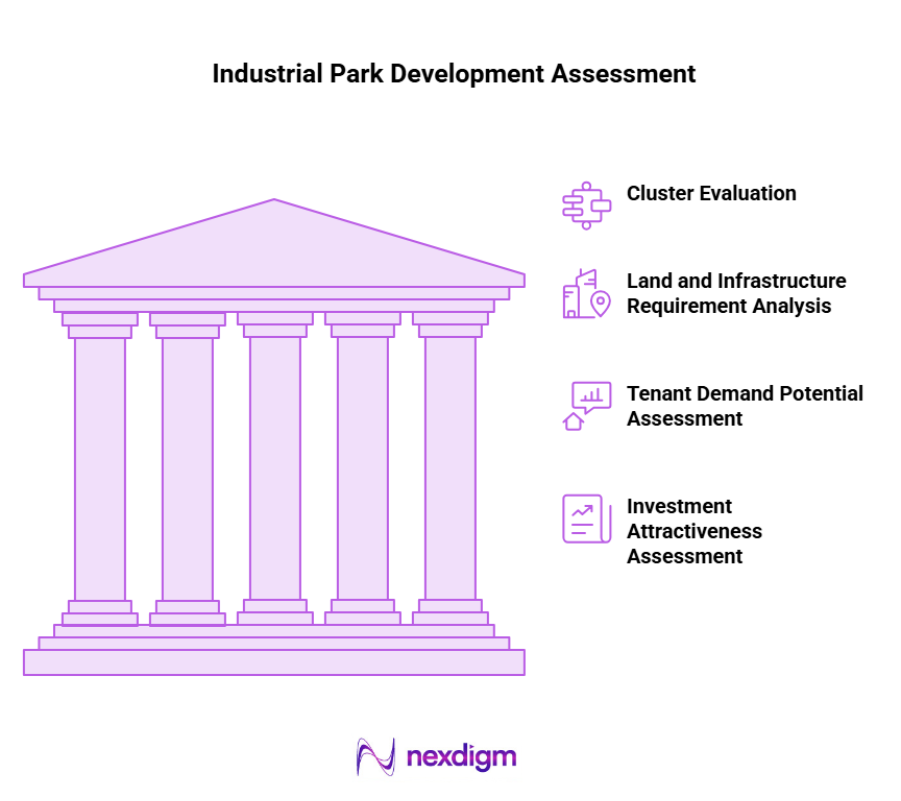
- Evaluating Manufacturing Clusters: Assessing industrial ecosystems, supplier networks, workforce availability, and sector concentration to identify locations capable of attracting and supporting manufacturers.
- Analyzing Land and Infrastructure Requirements: Examining land suitability, utility capacity, transportation access, and infrastructure readiness to align development plans with tenant expectations.
- Assessing Tenant Demand Potential: Evaluating target industries, investment trends, occupancy drivers, and future manufacturing requirements to understand potential demand for industrial space.
- Measuring Investment Attractiveness: Analyzing development costs, incentives, market opportunities, and operational considerations to identify industrial park projects with stronger commercial viability.
Through a structured approach, Nexdigm helps developers make informed decisions that support successful industrial park development, sustainable tenant growth, and long-term investment value.
Nexdigm’s Key Focus Areas in Industrial Park Development Assessment
A successful Industrial park development assessment requires balancing market demand, infrastructure readiness, investment feasibility, and long-term growth potential. Nexdigm focuses on several critical dimensions to provide a comprehensive evaluation of industrial park opportunities. Such as:
- Industrial Cluster Competitiveness: Assess manufacturing concentration, supplier ecosystems, workforce availability, and sector growth trends to understand the attractiveness of potential development locations.
- Infrastructure and Utility Readiness: Evaluate power, water, transportation, logistics, and digital infrastructure required to support current and future tenant operations.
- Tenant and Industry Demand Analysis: Examine target industries, investment activity, expansion plans, and occupancy drivers to estimate future demand for industrial space.
- Investment and Commercial Viability: Analyze development costs, incentives, revenue potential, market positioning, and risk factors to support sustainable investment decisions.
By evaluating these interconnected factors, Nexdigm helps developers identify industrial park opportunities that are commercially viable, operationally sustainable, and aligned with long-term market demand.
Nexdigm’s Insights for Strategic Industrial Park Development Decisions
Nexdigm’s assessment helps developers move beyond site evaluation to understand how industrial parks can create long-term value for tenants, investors, and regional industrial ecosystems, by focusing on:
- Prioritizing High-Potential Locations: Identifying locations where manufacturing activity, infrastructure readiness, and market demand create stronger opportunities for successful industrial park development.
- Aligning Infrastructure with Tenant Needs: Matching utility capacity, logistics infrastructure, and land planning with the operational requirements of target industries and future occupants.
- Reducing Development Risk: Evaluating market demand, cluster competitiveness, investment conditions, and infrastructure constraints before committing significant development resources.
Through data-driven insights, Nexdigm helps industrial park developers make informed decisions that improve project viability, attract quality tenants, and support sustainable industrial growth.
Why Businesses Choose Nexdigm
Businesses choose Nexdigm for its ability to combine market intelligence, industry understanding, and strategic advisory into practical, decision-oriented insights. By evaluating industrial clusters, infrastructure readiness, tenant demand, and investment viability, Nexdigm helps developers identify opportunities, reduce development risks, and make informed industrial park investment decisions that support long-term growth and competitiveness.
Nexdigm’s Case
Nexdigm supported an industrial developer assessing a proposed park across manufacturing clusters and infrastructure requirements. The assessment reviewed 10+ potential tenant segments, mapped 30+ infrastructure factors, and identified priority opportunities, helping improve tenant targeting by 32% and sharpen development priorities.
To take the next step, simply visit our Request a Consultation page and share your requirements with us.
Harsh Mittal
+91-8422857704