

A site may have inexpensive land, attractive incentives, and access to a major highway. Yet the economics can deteriorate quickly if critical materials are difficult to source, power supply is unreliable, or customers are too far away.
For a new industrial plant, location is only one part of the decision. The facility must be able to manufacture at a competitive cost, obtain inputs reliably and serve customers without tying up excessive cash in inventory and logistics.
Industrial Plant Feasibility Study: Is There Enough Demand?
The starting point is the market the proposed facility will actually serve. National industry growth figures provide useful context, but they do not establish how much business a new entrant can win.
Demand analysis should identify target customers, their purchasing requirements, existing suppliers, and the reasons they might consider switching. It should distinguish recurring purchases from demand tied to individual infrastructure projects or temporary investment cycles.
Competitor capacity is equally important. If established manufacturers have spare capacity, a new plant may face price pressure even in a growing market. The business case needs a realistic estimate of achievable market share, not an assumption that the entrant will capture a convenient percentage of total demand.
Customer qualifications can also delay revenue. In industries where buyers require audits, testing, or product approvals, the plant may incur operating costs well before it reaches commercial production volumes.
Industrial Plant Location Analysis: What Does the Site Really Cost?
India’s National Industrial Corridor Development Programme is built around transport corridors, ports, airports and multimodal connectivity. The programme recognises that industrial competitiveness depends partly on the infrastructure connecting factories with suppliers and customers.
For an individual investment, the comparison needs to be more specific than distance to a highway. Each candidate location should be evaluated on its actual inbound and outbound transport costs, utility availability, labour pool, regulatory requirements, and supplier network.
Key cost considerations include:
- Land and construction: Acquisition, site preparation, buildings, and supporting infrastructure.
- Utilities and labour: Power reliability, water availability, fuel, wages and specialised technical skills.
- Inputs and logistics: Freight, supplier lead times, inventory buffers and access to critical raw materials.
- Operating requirements: Environmental approvals, waste management, maintenance support and time to commissioning.
A site with a higher initial cost may offer lower long-term operating expenses. Conversely, a low-cost location can become expensive if materials travel long distances, or disruptions force the plant to hold additional inventory.
Industrial Plant Entry Feasibility Research Services: Testing the Investment Case
The economics of a new facility changes during its first years of operation. Commissioning delays, training, trial production, and customer qualification can push revenue beyond the original forecast. Meanwhile, salaries, utilities, interest, and other costs continue to accumulate.
The financial model should include these pre-operating expenses and estimate the working capital required before customer payments begin. Incentives should be assessed against their eligibility conditions and expected timing rather than treated as guaranteed funding.
A useful analysis tests lower utilisation, delayed commissioning, higher input costs and weaker selling prices. It should also compare a fully owned plant with alternatives such as contract manufacturing, leased industrial space, or a phased production setup. The best route may be to establish demand and operational reliability before committing to a larger facility.
Industrial Plant Site Selection Framework
The Industrial Plant Location and Feasibility Framework connects market demand with the realities of operating a new facility.
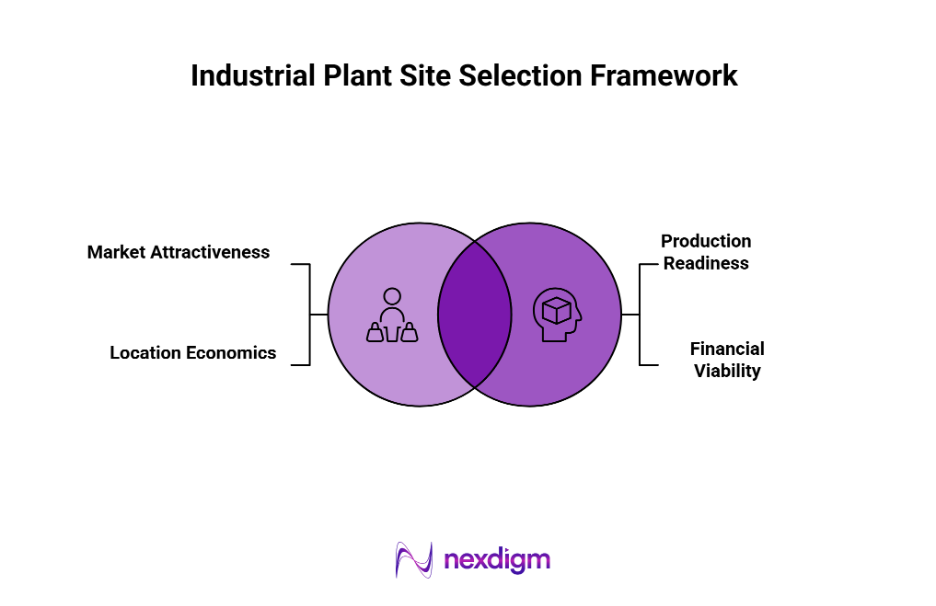
- Market Attractiveness: Assess customer demand, incumbent capacity, achievable market share, and competitive pricing.
- Location Economics: Compare land, utilities, labour, logistics, supplier access and regulatory requirements.
- Production Readiness: Define technology, process capacity, staffing, quality systems, and commissioning timelines.
- Financial Viability: Model investment, working capital, break-even utilisation, project returns, and downside scenarios.
The preferred location should perform well across the full operating model, not merely on land cost or the value of available incentives. If the plant is competitive only under optimistic assumptions, the company may need to reconsider its scale, location, or entry route.
Nexdigm Case Study: Comparing Industrial Plant Locations
Nexdigm compared 3 locations for an Indian industrial-products manufacturer, examining customer access, logistics, utilities, labour and critical inputs. The lowest-land-cost option carried higher inbound freight expenses and a thinner supplier base. A second location offered a stronger balance of customer proximity, input access and operating reliability, making it the preferred candidate for detailed project validation.
To take the next step, simply visit our Request a Consultation page and share your requirements with us.
Harsh Mittal
+91-8422857704