

Industrial consumption is being reshaped by three forces at once: production technology, pressure to lower operating costs and tighter resource requirements. This changes not only how much a factory buys, but what it buys and how often.
Industry accounts for nearly 40% of global final energy consumption. It also contributed about two-thirds of the increase in energy demand since 2019. Yet efficiency gains have slowed: global industrial energy intensity improved by about 0.2% annually from 2019 to 2023, compared with 1.8% in 2010 to 2019. The implication for suppliers is two-sided. Higher output still creates demand, but customers increasingly scrutinize energy, material and maintenance costs per unit produced.
Consumption is shifting from replacement to performance
Technology can increase demand for precision components, controls, sensors and monitoring, while reducing consumption of some conventional inputs. A line upgrade may use fewer parts overall but require higher-specification components and tighter tolerances. Predictive maintenance can extend the life of an asset while increasing demand for condition-monitoring systems and service.
Efficiency also creates a retrofit market. Motors, drives, heat systems, insulation and process controls can be upgraded without replacing an entire plant. For suppliers, this can mean shorter sales cycles and smaller orders than a new facility, but a much larger installed base to pursue.
A strong industrial product consumption trends assessment should separate three effects:
- Output effect: more production raises the number of operating hours and input requirements.
- Efficiency effect: lower material or energy per unit reduces some demand.
- Technology and mix effect: new processes shift demand toward different specifications, components and services.
Net consumption depends on which effect dominates in each application. A product can gain market share while total units per factory decline if it enables a larger cost or quality improvement.
Sustainability changes the bill of materials and the buying case
Circularity and emissions requirements affect product demand through material substitution, repairability, recycled content and traceability. These changes can reduce demand for virgin inputs, but create requirements for sorting, testing, reprocessing and quality control. The commercial opportunity may move from selling more material to helping customers recover value from the material already in the system.
Buyers increasingly evaluate products on delivered operating cost and lifecycle performance. For an industrial supplier, this means being able to quantify energy use, maintenance intervals, scrap rates, durability and end-of-life handling. Sustainability claims become commercially useful when they affect a procurement requirement, customer cost or regulatory exposure.
Forecast consumption by application, not by headline output
For each end use, estimate physical product demand per unit of production, then test how that intensity changes with new technology, efficiency projects and material substitution. Track specifications and order frequency alongside volume. This reveals when a product category is growing in value but not in units, or when a smaller unit market is shifting toward higher-margin grades.
Framework: Output-to-Consumption Shift Analysis
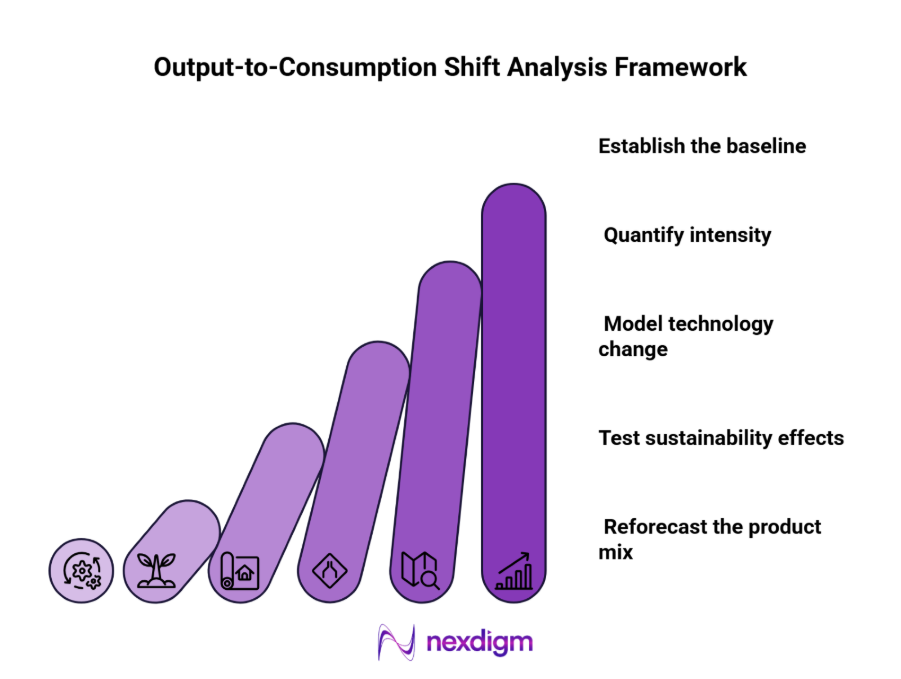
- Establish the baseline
Measure current product use by application, plant type, operating hours and production volume. - Quantify intensity
Estimate product, energy and material consumed per unit of output, including scrap and maintenance. - Model technology change
Assess automation, process redesign, product substitution and retrofit adoption. - Test sustainability effects
Map recycled content, repairability, emissions requirements and recovery infrastructure to purchasing needs. - Reforecast the product mix
Translate output and intensity changes into unit volumes, specifications, service demand and revenue.
Nexdigm Case Study
Nexdigm assessed consumption for 11 industrial product categories across three manufacturing applications, modelling output growth, efficiency upgrades and recycled-content requirements. Our analysis identified four categories where demand was shifting toward higher-specification products, and we recommended repositioning the offer around lifecycle cost and service.
To take the next step, simply visit our Request a Consultation page and share your requirements with us.
Harsh Mittal
+91-8422857704