

Top-down sizing often starts with a broad industry total and applies an assumed product share. That can produce a large number without showing who buys the product, how many units are required or whether a supplier can qualify and reach those buyers.
The gap between broad growth and product demand is visible in recent manufacturing data. Global production grew 1.5% in Q2 2026, but higher-technology production grew 2.0% and exports rose 7.1%. A supplier serving a specific process or grade may grow much faster or slower than the headline market, depending on its use in the product mix and customer qualification.
Build the market from physical demand
For an installed-base product, estimate:
Annual unit demand = eligible installed units × annual replacement rate × units per replacement event.
Then add demand from new capacity and upgrades. Deduct refurbished units, reuse, substitution and purchases covered by existing contracts. Convert units to revenue only after applying the realistic product mix and net selling price.
For a product used in new production, estimate customer output by application and multiply it by the product content per finished unit. Then adjust for scrap, yield, customer inventory and the portion supplied by competing technologies.
This reveals whether the opportunity is driven by:
- A large installed base with predictable replacement.
- New factories or production-line expansion.
- A technology shift that changes product content.
- A shortage, import substitution or specification change.
- Higher-value grades replacing commodity products.
Show the funnel from total to obtainable
A decision-grade market model should report three separate numbers:
- Total demand: all units used across relevant applications.
- Serviceable demand: applications and geographies the product can technically serve.
- Obtainable demand: the share accessible through qualification, channels, price and capacity.
The obtainable market is not simply a conservative percentage of the total. It should be built from customer counts, buying cycles, expected share, distributor reach, qualification timelines and production capability.
Avoid double counting. Imports are part of market supply, not additional demand. A component installed in an asset and its replacement purchase should not both be counted in the same period.
New plant capacity should be weighted by project stage and commissioning date. Revenue growth should also be separated from unit growth, since price increases can make a flat market appear to expand.
Stress-test the assumptions that move the answer
The largest uncertainty is often not the market total. It is the rate at which customers replace, the product content per application, or the share a new supplier can win. Show low, base and high cases for those variables and identify which evidence would narrow the range: invoices, maintenance logs, customs data, distributor sell-through or customer production plans.
Industrial product market potential study ends with a commercial decision: which segment to enter, which buyers to qualify, what product to offer, and what sales or service investment is required.
Framework: Bottom-Up Product Market Potential
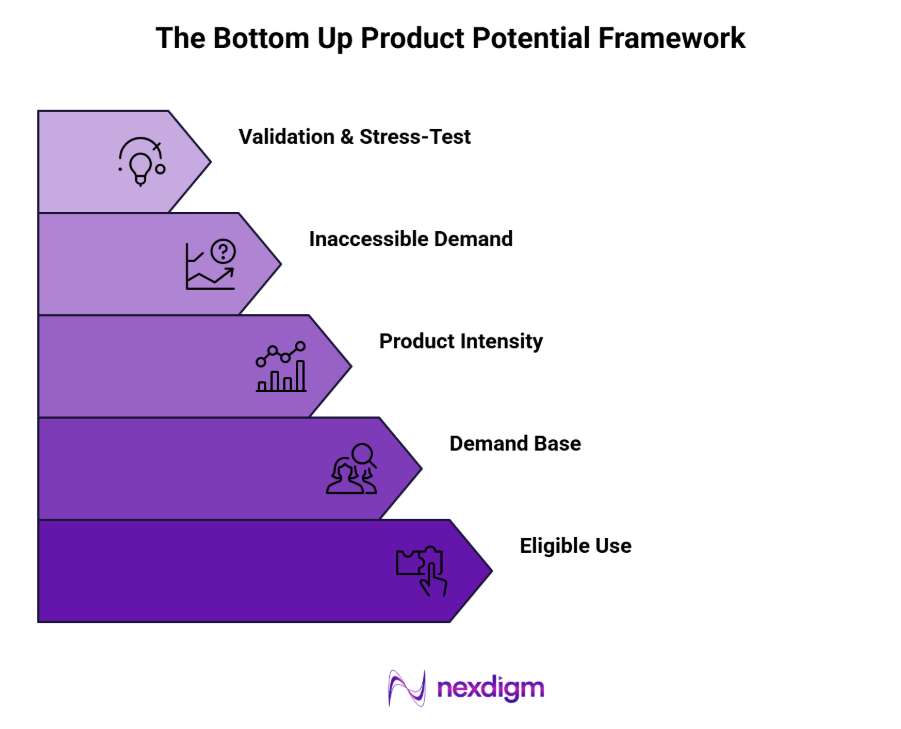
- Define eligible use
Specify applications, product variants, substitutes, customer types and geographies. - Count the demand base
Estimate installed units, production volumes, new capacity and replacement events. - Apply product intensity
Use units per asset, per production cycle or per finished product, with yield and scrap adjustments. - Deduct inaccessible demand
Adjust for qualification, contracts, channel reach, competitor lock-in and supply constraints. - Validate and stress-test
Triangulate the estimate with buyers, service records, trade data and sensitivity cases.
Nexdigm Case Study
Nexdigm sized demand for an industrial component across 620 addressable plants, separating replacement, new-line and upgrade purchases. Our bottom-up model reduced the initial top-down estimate by 43% and identified two customer segments where qualification and service coverage could support a credible entry plan.
To take the next step, simply visit our Request a Consultation page and share your requirements with us.
Harsh Mittal
+91-8422857704