
The strongest business case for industrial robots emerges where a specific production constraint can be improved enough to justify the cost of automation. High wages may strengthen the economics, but they are only one variable. Cycle time, production volume, defect rates, equipment utilisation, safety requirements and the cost of integration determine whether a robot generates an acceptable return.
The global market continues to expand. The International Federation of Robotics reported that annual installations reached 603,000 units in 2025, with the global operational stock exceeding five million robots. Yet the economics vary substantially by application. A robot used for continuous welding in a high-volume line has a different utilisation profile from one deployed for short production runs or irregular material handling.
The Best Applications Share a Measurable Constraint
Industrial robots tend to offer stronger economics where tasks are repetitive, cycle times are predictable and production volumes support consistent utilisation.
- Welding and fabrication: Repeatable joints, consistent positioning and demanding throughput requirements can support robotic welding, particularly when labour availability or quality variation constrains output.
- Machine tending: Loading and unloading CNC machines can increase productive equipment time where manual tending limits utilisation or requires operators to manage multiple machines.
- Assembly: Robots can improve consistency in repetitive assembly tasks, although product variation and frequent changeovers may increase tooling and programming costs.
- Palletising and material handling: High movement frequency, heavy loads and repetitive lifting can strengthen both productivity and workplace-safety cases.
- Inspection: Vision-guided robots and automated testing can improve repeatability where inspection volumes are high and defects are costly.
The relevant comparison is between the cost and performance of the existing process and the complete automated alternative. Equipment price alone omits integration, tooling, guarding, programming, maintenance, training and production downtime during commissioning.
Utilisation Often Decides the Return
A robot that is technically capable of replacing a manual task may still deliver weak returns if production volumes are too low. The business case should model productive hours, cycle time, changeover frequency, planned downtime and demand variability.
The payback calculation should include measurable benefits such as additional saleable output, reduced scrap, lower overtime, improved equipment utilisation and reduced exposure to hazardous tasks. It should avoid counting theoretical labour savings if workers will simply be reassigned and no cash cost is removed.
Regional adoption patterns also matter. In 2025, China accounted for 59% of global industrial robot installations, while India recorded 10,500 installations, up 15% year on year. These figures show how automation demand differs by manufacturing scale, industry mix and investment environment. They do not imply that the same applications will offer the strongest returns in every market.
For an Industrial robotics market opportunity assessment, Nexdigm can compare applications by achievable utilisation, customer economics, integration complexity and repeatability across plants. This identifies where robot suppliers and integrators can build a scalable commercial proposition.
Industrial Robotics Business Case Framework
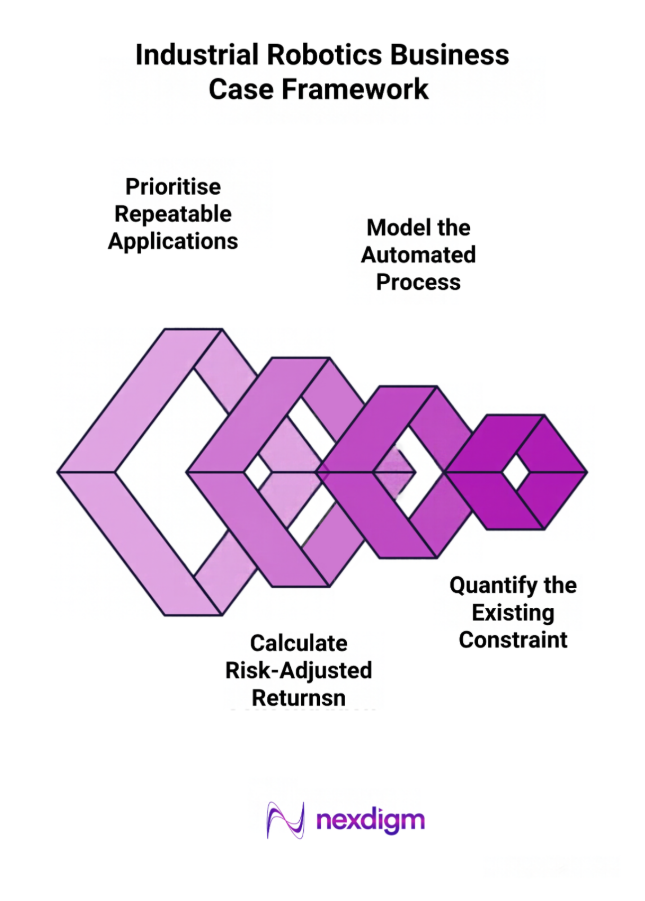
- Quantify the Existing Constraint
Measure cycle time, downtime, defect rates, labour requirements, safety exposure and lost production in the current process. - Model the Automated Process
Estimate system cost, integration requirements, productive hours, changeover time, maintenance and achievable throughput. - Calculate Risk-Adjusted Returns
Compare payback and operating savings under realistic volume, downtime and demand scenarios. - Prioritise Repeatable Applications
Focus on applications with strong economics, proven technical suitability and potential for replication across similar production lines.
Nexdigm Case Study: Screening Robot Investment Opportunities
Nexdigm assessed 52 robot applications across 21 plants operated by an industrial components group. The analysis compared welding, machine tending, assembly and palletising on cycle time, utilisation, integration cost and payback. Fourteen applications met the client’s target payback of 30 months or less, with machine tending and robotic welding accounting for the largest share.
To take the next step, simply visit our Request a Consultation page and share your requirements with us.
Harsh Mittal
+91-8422857704