

Industrial production is expanding, but supply chains must keep pace with rising volumes, changing demand, and increasingly complex sourcing requirements. Recent indicators point to continued momentum: global manufacturing output increased in September 2026, with production rising across 22 of 33 economies tracked by S&P Global.
In the U.S., the September 2026 ISM Manufacturing PMI reached 54.5, indicating expansion, while the New Orders Index stood at 55.3. These conditions are increasing pressure on manufacturers to secure adequate supplier capacity, raw materials, logistics infrastructure, and production flexibility. The ability to scale supply networks efficiently will increasingly determine whether industrial growth can be sustained.
What Determines Supply Chain Readiness for Growth
Production growth does not automatically translate into a scalable supply chain. Manufacturers need sufficient supplier capacity, dependable raw-material availability, efficient logistics, and flexibility across their network. At the same time, concentrated supplier bases, long lead times, infrastructure constraints, and limited backup sources can restrict expansion. Assessing these factors together helps businesses identify where supply chains are prepared for higher volumes and where targeted interventions may be required before production scales further.
Growth Is Increasing Pressure on Supply Capacity
Recent indicators suggest that manufacturers are entering a period where supply capacity needs closer attention. In the U.S., the ISM Manufacturing New Orders Index reached 55.3 in September 2026, signaling expanding demand, while the Prices Index rose to 77.9, reflecting continued input-cost pressure.
These conditions can put additional strain on supplier capacity, raw-material availability, production scalability, and logistics networks. As manufacturers plan for higher output, understanding where capacity constraints may emerge becomes increasingly important for maintaining delivery performance, controlling costs, and supporting sustainable production growth.
Nexdigm’s Role in Assessing Supply Chain Readiness
As manufacturers prepare for higher production volumes, Nexdigm helps businesses evaluate whether their supply networks can support future growth. Its Industrial supply chain capacity analysis and advisory expertise helps to identify potential constraints before they affect operations, through:
- Capacity Assessment: Evaluation of supplier capacity, utilization, expansion plans, and scalability against projected production requirements.
- Supply Network Analysis: Mapping suppliers, raw-material sources, logistics routes, and critical dependencies to identify potential bottlenecks.
- Gap Identification: Highlighting capacity shortfalls, supplier concentration, geographic dependencies, and infrastructure constraints that could restrict production growth.
- Growth Readiness: Assessment of alternative sourcing, supplier development, localization, and capacity-expansion opportunities to strengthen the supply network.
This enables manufacturers to understand where their supply chains are ready to scale, where gaps exist, and what actions can support sustainable production growth.
Nexdigm’s Industrial Supply Chain Capacity Analysis Framework
Nexdigm applies a structured Industrial supply chain capacity analysis to assess whether existing supply networks can support projected production growth. The framework moves from understanding current capacity to identifying gaps and prioritizing actions through:
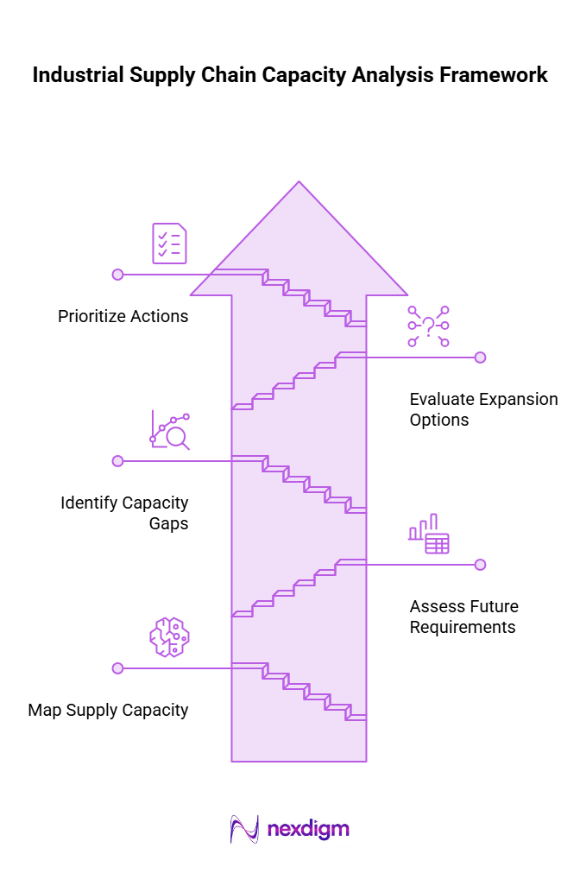
- Map Supply Capacity: Assess supplier locations, production capabilities, current capacity, utilization, and critical supply dependencies across the network.
- Assess Future Requirements: Compare projected production volumes and demand scenarios with available supplier and manufacturing capacity.
- Identify Capacity Gaps: Highlight potential shortfalls, bottlenecks, supplier concentration, infrastructure constraints, and areas where additional capacity may be required.
- Evaluate Expansion Options: Assess supplier expansion, alternative sourcing, localization, supplier development, and internal capacity opportunities to address identified gaps.
- Prioritize Actions: Rank interventions according to feasibility, cost, supply risk, scalability, and their potential contribution to sustained production growth.
This framework enables manufacturers to move from understanding current capacity to making targeted decisions that strengthen supply readiness, resilience, and scalability.
Nexdigm’s Strategies for Closing Supply Chain Gaps
Identifying supply-chain constraints is only the first step. Nexdigm helps manufacturers translate these findings into practical actions that can improve scalability, resilience, and production readiness by focusing on:
- Supplier Diversification: Identify qualified alternative suppliers and sourcing markets to reduce dependency on single sources, improve sourcing flexibility, mitigate disruption risks, and strengthen long-term supply continuity.
- Capacity Expansion: Evaluation of supplier expansion plans, additional production lines, and capacity-development opportunities against projected manufacturing requirements.
- Localization Opportunities: Assessment of regional sourcing and production options that can shorten lead times, reduce logistics exposure, and strengthen supply continuity.
- Supplier Development: Identification of supplier capability and performance gaps, then design improvement strategies that enhance quality, reliability, compliance, and long-term strategic value.
- Investment Prioritization: Comparison of potential interventions based on commercial value, feasibility, risk reduction, and expected contribution to future production growth.
These strategies help manufacturers move from identifying supply-chain gaps to building the capacity, flexibility, and resilience required for sustained production expansion.
Nexdigm’s Case
Nexdigm supported a heavy industrial equipment manufacturer managing 210 Tier-1 suppliers and 4,200 component SKUs. The assessment identified 14 critical component families with an average 118-day recovery time versus 14 days of inventory. Targeted dual sourcing and safety stocks reduced disruption vulnerability by 72%, with working-capital costs increasing only 1.8%.
To take the next step, simply visit our Request a Consultation page and share your requirements with us.
Harsh Mittal
+91-8422857704