

Industry 4.0 adoption is not progressing at the same pace across manufacturing. Plants facing labour shortages, complex product mixes, demanding quality requirements or unreliable equipment have strong incentives to digitise production. Others may have less immediate reason to invest, particularly where margins are thin and production processes are relatively stable.
The World Economic Forum’s Global Lighthouse Network illustrates the gap between experimentation and scaled adoption. By September 2025, it included 201 industrial sites using advanced technologies across production and supply chains. The newest cohort reported a 41% reduction in product defects and a 28% reduction in energy consumption, alongside improvements in labour productivity and lead times.
These outcomes do not establish that every Industry 4.0 programme will achieve similar gains. They show that technology adoption becomes more valuable when manufacturers connect it to defined operational problems and implement it across processes rather than isolated workstations.
The Manufacturers Advancing Fastest Share Three Characteristics
- They have a measurable production problem. Manufacturers facing unplanned downtime, high scrap rates, frequent changeovers or poor delivery performance can link digital investment to an identifiable operating cost. Predictive maintenance, machine vision and production analytics become easier to justify when the baseline problem is quantified.
- They have the data and systems to act. Sensors and connected equipment create visibility, but the information must be reliable, accessible and linked to operating decisions. Plants with inconsistent data or disconnected systems often need foundational work before advanced AI applications can scale.
- They can change the way work is done. Technology deployment requires operators, maintenance teams, engineers and managers to adopt new processes. Without clear ownership and workforce training, a successful pilot can remain confined to one production line.
These characteristics help explain why adoption varies even among manufacturers with similar capital budgets. Readiness and execution capacity can be more important than the number of technologies a company has purchased.
Why Industry 4.0 Investment Stalls After the Pilot
A pilot can demonstrate that a model detects defects or predicts equipment failure. Scaling the solution introduces harder questions: Can it operate across different machines? Will it remain reliable as product specifications change? Who is accountable when an automated recommendation conflicts with an operator’s judgement?
Cybersecurity and operational continuity add further constraints. Connecting production equipment to enterprise networks can increase exposure to cyber threats, while changing control systems may introduce downtime or quality risks. Manufacturers need to establish access controls, data governance, system ownership and recovery procedures alongside the technology deployment.
The financial case must also account for integration and maintenance. A solution that improves one line’s performance may not justify its cost if replication requires extensive custom engineering. The strongest adoption cases use repeatable architectures, clear performance measures and a plan for maintaining the system after deployment.
For Industry 4.0 adoption market analysis, Nexdigm can assess adoption by sector, plant size, operational maturity and investment driver, distinguishing technology interest from funded deployments and scalable demand.
Adoption Priorities Differ by Manufacturing Segment
- Automotive and electronics: High product complexity and quality requirements can support investment in automated inspection, traceability, robotics and real-time process control.
- Food and consumer goods: Frequent changeovers, packaging requirements and demand variability can strengthen the case for scheduling, machine vision and connected production data.
- Heavy industry: Asset reliability, energy intensity and worker safety can make condition monitoring and process optimisation particularly relevant.
- Small and mid-sized manufacturers: Limited engineering resources and tighter capital budgets may favour modular automation, managed services and focused applications with short payback periods.
These are directional patterns, not fixed industry rankings. Adoption still depends on the individual plant’s economics, equipment base and customer requirements.
Industry 4.0 Adoption Readiness Framework
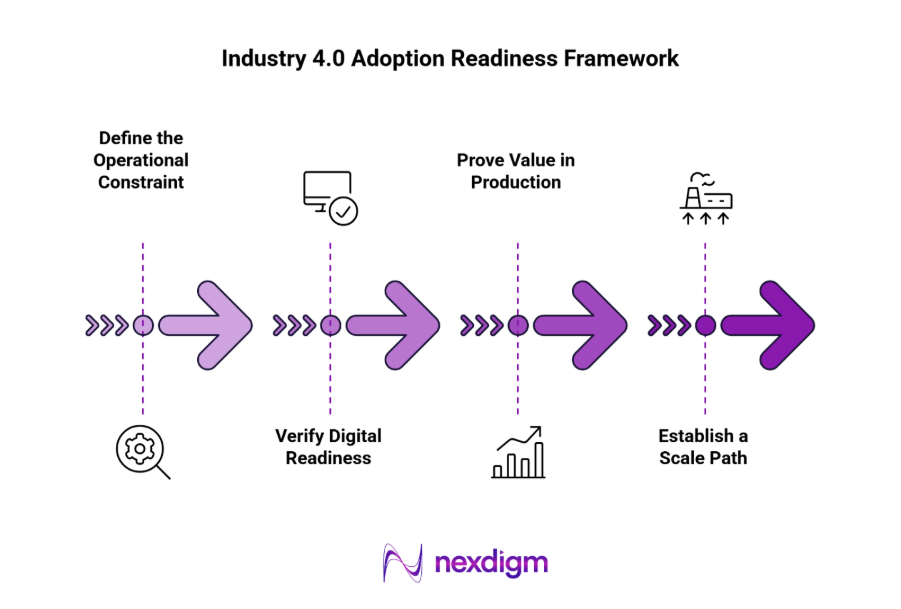
- Define the Operational Constraint
Establish the cost of downtime, defects, low throughput, excessive energy use or poor delivery performance before selecting a technology. - Verify Digital Readiness
Assess equipment connectivity, data quality, cybersecurity, system integration and workforce capability. - Prove Value in Production
Measure operational improvements against a baseline and test reliability across shifts, products and operating conditions. - Establish a Scale Path
Standardise deployment, assign ownership, train users and confirm that benefits remain attractive when the solution is replicated.
Nexdigm Case Study: Identifying the Barriers to Industry 4.0 Adoption
Nexdigm assessed 75 manufacturing plants across automotive components, industrial equipment and consumer products to identify barriers to digital adoption. The team evaluated equipment connectivity, data maturity, cybersecurity, workforce readiness and investment priorities. Twenty-nine plants had defined business cases for near-term deployment, but only 17 had the data and integration foundations required to scale advanced applications.
To take the next step, simply visit our Request a Consultation page and share your requirements with us.
Harsh Mittal
+91-8422857704