

Industry-specific market entry research helps companies understand the unique demand patterns, customer expectations, competitive pressures, and regulatory conditions within a target sector before expansion. A generic market view may miss sector-level barriers such as specialized distribution networks, pricing norms, technology standards, compliance rules, or buyer preferences.
By using detailed industry-specific market entry research, businesses can identify unmet demand, assess competitor strengths, evaluate market gaps, and understand risks that may affect execution. These insights strengthen market entry strategy by helping companies choose the right positioning, entry model, investment plan, and go-to-market approach for successful and sustainable expansion.
The need for industry-specific market entry research is clear, as nearly 70% of cross-border expansions face execution challenges, while 42% of startups fail due to no market need, showing the risk of unanalyzed demand. Research also shows that companies using data-driven decision-making are 23 times more likely to acquire customers and 19 times more likely to be profitable. These figures highlight why sector-level insights are essential for a stronger market entry strategy.
How Market Entry Strategy Helps Companies Navigate Sector-Specific Challenges?
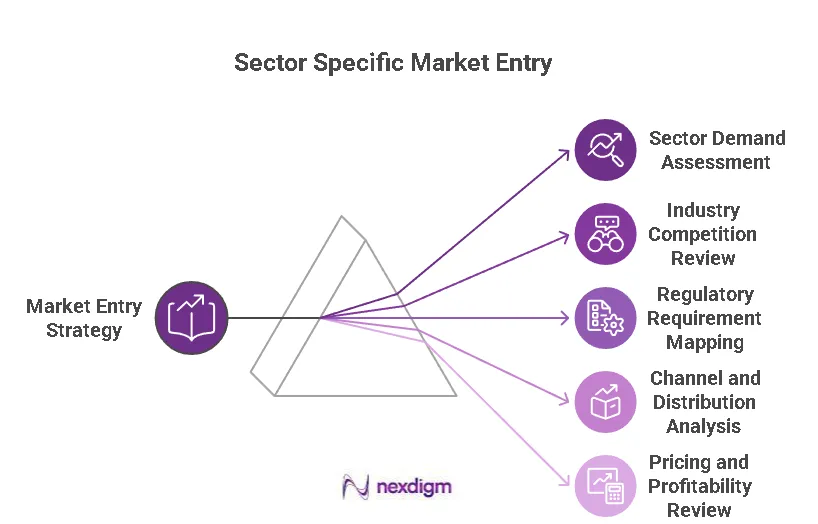
Market Entry Strategy Helps Companies Navigate Sector-Specific Challenges means using industry-level research to understand demand, competition, regulations, pricing, channels, and customer behavior before entering a new market:
-
Sector Demand Assessment
Market entry strategy helps companies evaluate industry-specific demand, customer needs, adoption trends, and unmet market gaps.
-
Industry Competition Review
Companies assess key competitors, pricing models, product strengths, and market positioning to identify barriers and differentiation opportunities.
-
Regulatory Requirement Mapping
Sector-specific rules, licenses, standards, and compliance obligations are reviewed to reduce approval delays and legal risks.
-
Channel and Distribution Analysis
Businesses study industry sales channels, distributor networks, procurement systems, and customer access routes before market entry.
-
Pricing and Profitability Review
Market entry strategy evaluates industry pricing norms, cost structures, margins, and customer willingness to pay.
Nexdigm’s Competitive Barrier Assessment for Stronger Market Entry Strategy
Nexdigm’s Competitive Barrier Assessment for Stronger Market Entry Strategy helps companies understand competitor strength, pricing models, product positioning, distribution networks, customer loyalty, and market gaps before expansion. By identifying barriers such as dominant local players, channel control, price pressure, and differentiated offerings, Nexdigm supports a sharper market entry strategy that reduces risk and improves positioning.
Nexdigm’s Industry-Specific Market Entry Research for Sector Expansion Planning
Nexdigm’s Industry-Specific Market Entry Research for Sector Expansion Planning helps companies assess demand, competition, regulations, pricing, customer behavior, and industry barriers before entering a new market or sector.
-
Industry Trend Mapping
Nexdigm tracks sector trends, innovation shifts, demand drivers, and market disruptions to identify future expansion opportunities.
-
Product-Market Fit Review
Nexdigm assesses whether the company’s offering matches local industry needs, customer expectations, and usage conditions.
-
Entry Barrier Identification
Nexdigm identifies sector-specific barriers such as certifications, distribution control, technical standards, and established competitor advantages.
-
Stakeholder Interview Insights
Nexdigm gathers feedback from customers, distributors, experts, and industry participants to validate market assumptions.
-
Value Chain Assessment
Nexdigm studies suppliers, manufacturers, distributors, buyers, and service providers to understand industry structure and market access points.
Nexdigm’s case:
In a Nexdigm industry-specific market entry case, a Japan-based chemicals and materials company evaluated India’s Engineering Plastic and Polypropylene compound market before expansion. Nexdigm analyzed demand, segmentation, value chains, competitors, pricing, and stakeholder inputs. The study found India’s compound demand was projected to grow at an 8.5% CAGR from 2020 to 2025, with organized players contributing nearly 70%–80% of demand, supported by 25+ stakeholder interviews.
To take the next step, simply visit our Request a Consultation page and share your requirements with us.
Harsh Mittal
+91-8422857704