

Insurance analytics is moving from experimentation toward more embedded decision-making across underwriting, claims, fraud, and portfolio management. A 2026 global insurance study found that insurers that fully align AI with business priorities report at least a 5% profit uplift, while 67.4% of AI leaders use centralized governance to scale AI with greater control.
The opportunity extends across core insurance workflows. Industry research indicates that 68% of insurers implementing advanced underwriting technology reported improved loss ratios and profits, while 35% of underwriters said AI/ML and predictive models enhance risk understanding. At the same time, documented insurance AI deployments show 49 claims-processing applications, 30 underwriting-automation applications, and 13 fraud-detection applications across 147 recorded deployments.
As analytics becomes more embedded in insurance decisions, insurance analytics platform supplier research can help carriers distinguish platforms by functionality, use-case maturity, integration, scalability, and practical business value.
Analytics Is Moving Closer to Core Insurance Decisions
Analytics is increasingly influencing decisions rather than simply generating reports. Underwriters can use predictive models to assess risk, claims teams can prioritize suspicious or complex cases, and portfolio managers can identify concentration and profitability trends. This shift makes platform selection more consequential, as insurers need solutions that connect analytical insight with existing workflows, data environments, and human decision-making.
Platform Value Depends on the Decision It Supports
Different analytics platforms may be stronger in different parts of the insurance value chain. A useful market view should therefore examine the specific decisions each supplier can support:
- Underwriting & Pricing: Assess predictive risk models, pricing analytics, segmentation, and decision-support capabilities that can improve risk selection and pricing consistency.
- Claims & Fraud: Examine anomaly detection, fraud scoring, claims triage, severity prediction, and investigation capabilities for improving claims outcomes and controlling leakage.
- Portfolio & Risk Decisions: Evaluate exposure analysis, profitability monitoring, forecasting, concentration analysis, and scenario modelling to support portfolio-level decisions.
These distinctions create a stronger foundation for insurance analytics platform supplier research, helping insurers compare providers according to where their capabilities can deliver the greatest practical relevance.
Platform Fit Depends on More Than Analytical Functionality
Strong analytics functionality alone does not determine platform suitability. Insurers also need to consider the following dimensions to understand how well each platform fits the insurer’s technology environment and operating priorities:
- Data Compatibility: Assess whether the platform can work with the insurer’s policy, claims, customer, financial, and risk data across different formats and sources.
- Integration With Policy and Claims Systems: Examine whether the platform can connect with core insurance systems so analytical insights can flow into underwriting, claims, pricing, and servicing processes.
Thus, understanding these dimensions helps Nexdigm’s experts to determine whether a platform is practically deployable and strategically relevant, rather than simply feature-rich and follow a structured approach to assess fitness.
Nexdigm’s Comparative Assessment of Insurance Analytics Platforms
Nexdigm can use a structured, multi-step assessment to compare insurance analytics platforms against the insurer’s specific priorities:
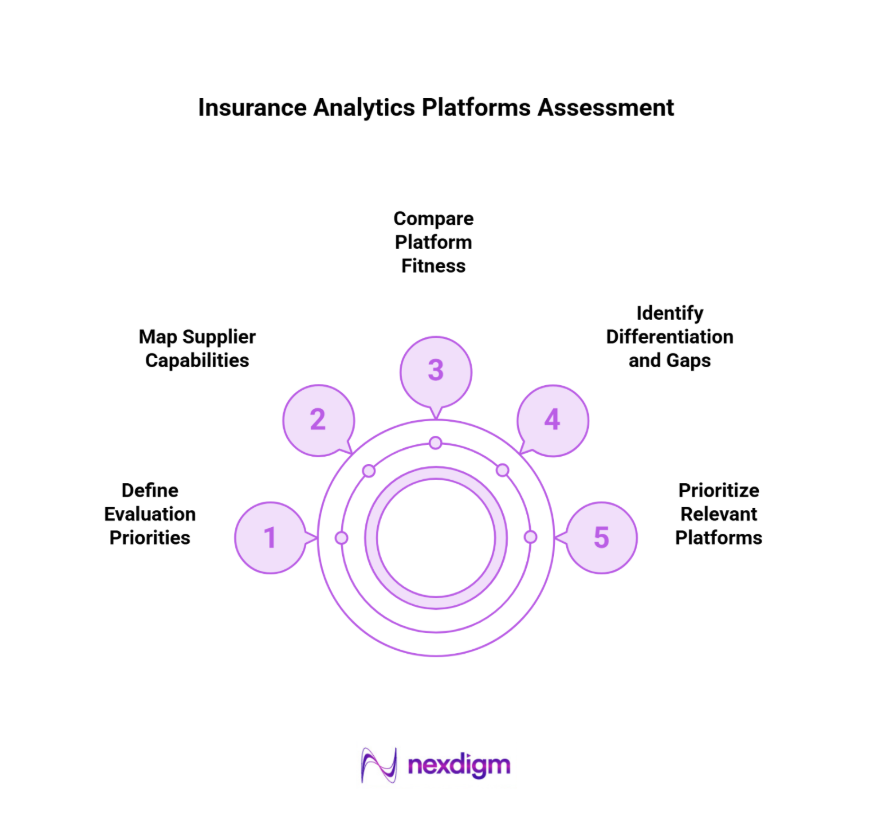
- Define Evaluation Priorities: Establish the most relevant criteria across underwriting, pricing, claims, fraud, portfolio analytics, integration, scalability, and governance.
- Map Supplier Capabilities: Assess each platform’s functionality, technology maturity, insurance use cases, implementation capabilities, and domain experience.
- Compare Platform Fit: Evaluate suppliers against the insurer’s existing data environment, technology architecture, operating model, and transformation objectives.
- Identify Differentiation and Gaps: Highlight relative strengths, capability limitations, specialist areas, integration constraints, and potential trade-offs across suppliers.
- Prioritize Relevant Platforms: Use the comparative findings to identify providers that warrant deeper technical validation, proof-of-concept assessment, or commercial evaluation.
This structured approach helps insurers move from a broad supplier universe to a focused view of platforms with stronger strategic and practical relevance, supporting more informed analytics technology decisions.
How Nexdigm’s Assessment Supports Better Supplier Decisions
Nexdigm’s assessment can help insurers translate supplier comparisons into practical decisions across technology and business functions. By connecting platform capabilities with priority use cases and strategic requirements, the analysis can support:
- Focused Vendor Selection: Narrow the supplier universe to platforms with stronger alignment to underwriting, claims, fraud, pricing, or portfolio priorities.
- Better Investment Decisions: Identify where existing analytics capabilities are sufficient, where gaps remain, and where additional platform investment may create value.
- Reduced Evaluation Complexity: Provide a structured basis for technical due diligence, proof-of-concept selection, RFP development, and commercial discussions.
Overall, the assessment helps insurers move from understanding the supplier market to making more targeted analytics platform decisions, with greater visibility into capability, fit, and potential business relevance.
Nexdigm’s Case
Nexdigm assessed 39 insurance analytics platform suppliers across underwriting, pricing, claims, fraud, portfolio analytics, integration, and scalability. Some showed strong alignment with priority use cases, 17% demonstrated differentiated fraud and risk capabilities, and 12% required further integration validation. The assessment helped the insurer narrow its supplier universe and prioritize platforms for detailed technical and commercial evaluation.
To take the next step, simply visit our Request a Consultation page and share your requirements with us.
Harsh Mittal
+91-8422857704