

Claims management sits at the intersection of underwriting economics and customer experience. Claims costs directly affect insurer profitability, while settlement speed and transparency influence retention and satisfaction. The operational challenge is to accelerate legitimate claims without creating additional exposure to fraud, overpayment, or indemnity leakage.
Manual workflows, fragmented documentation, inconsistent vendor practices, and disconnected claims systems can create costs throughout the process. These weaknesses are particularly visible in motor and health insurance, where repair estimates, medical bills, provider charges, and supporting documentation require substantial validation.
Claims Leakage Often Starts Outside the Core Claims System
Leakage can arise from both deliberate fraud and inefficient claims administration. Duplicate claims inflated medical invoices, staged accidents, unnecessary procedures, and exaggerated repair estimates can increase indemnity costs.
Operational friction adds another layer. Physical paperwork, inconsistent medical records, manual invoice reviews, and fragmented repair documentation can increase processing time and create errors. Weak vendor controls can compound the problem when garages, hospitals, or other service providers operate without standardized tariffs or performance monitoring.
The result is a claims function where cost control depends as much on the surrounding ecosystem as on the insurer’s adjudication process.
Automation Is Reshaping the Claims Workflow
Claims automation is moving beyond basic straight-through processing. Insurers are increasingly applying digital tools at multiple stages of the lifecycle:
- Intake and triage: Digital portals and automated intake route claims and validate basic information.
- Document processing: Intelligent document processing extracts information from medical bills, repair invoices, and supporting records.
- Damage assessment: Computer vision can support vehicle damage estimation and repair-versus-replace decisions.
- Fraud detection: Analytical models can identify duplicate claims, abnormal billing patterns, and connections across suspicious cases.
- Adjudication and payment: Rules engines and digital payment infrastructure can accelerate low-risk claims.
A focused insurance claims management market analysis can identify which parts of the claims lifecycle are suitable for automation, where system integration remains a constraint, and where human intervention continues to be necessary.
Repair and Provider Networks Influence Claims Economics
Claims technology cannot fully control costs when insurers lack visibility into the service providers fulfilling the claim. Motor insurers, for example, can influence repair costs through accredited garages, negotiated labour rates, standardized parts pricing, and digital estimates.
Health insurers face a similar requirement across hospital and diagnostic networks. Preferred providers agreed procedure packages, digital billing integration, and provider performance monitoring can improve cost predictability while supporting faster claims processing.
Vendor scorecards can track turnaround times, billing deviations, supplement requests, customer satisfaction, and other indicators. Integrating these networks with claims systems creates greater visibility from the initial claim through final settlement.
Nexdigm’s Claims Management Assessment Framework
Nexdigm examines claims performance across the full operating chain, connecting process efficiency with leakage, vendor economics, technology readiness, and customer outcomes.
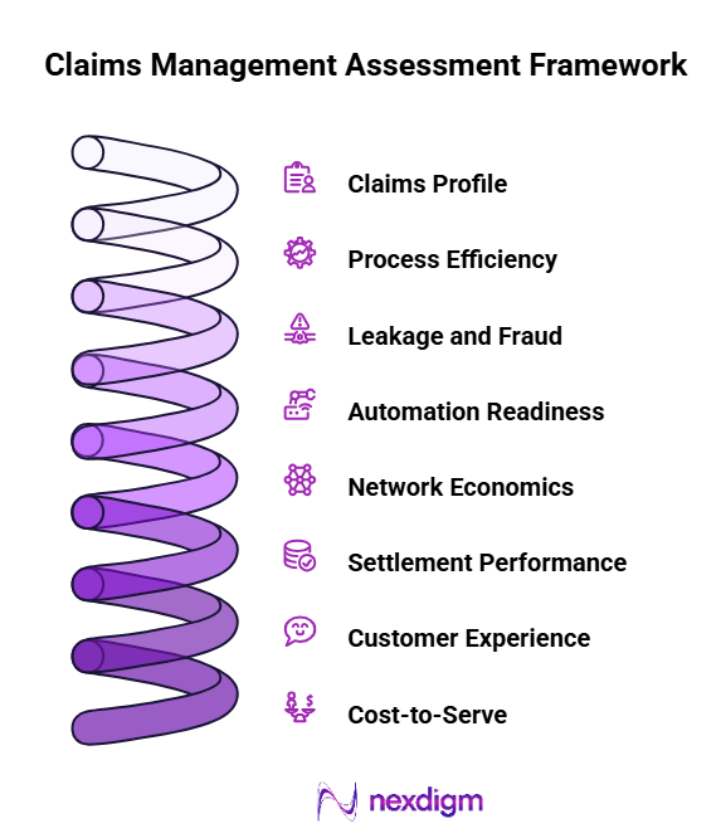
- Claims Profile: Segment claims by volume, severity, geography, seasonality, and product line to identify the areas generating the greatest operational load.
- Process Efficiency: Map the journey from first notice of loss through verification, assessment, approval, and settlement to locate cycle-time bottlenecks.
- Leakage and Fraud: Quantify losses associated with duplicate claims, inflated invoices, unnecessary procedures, fraudulent submissions, and other abnormal patterns.
- Automation Readiness: Assess where document processing, computer vision, fraud analytics, rules engines, and straight-through processing can generate measurable value.
- Network Economics: Evaluate provider coverage, negotiated tariffs, billing integration, accreditation, and vendor performance.
- Settlement Performance: Benchmark reserve accuracy, repudiation rates, disputes, litigation, and regulatory turnaround requirements.
- Customer Experience: Measure satisfaction, escalation rates, communication quality, and digital claims-tracking capabilities.
- Cost-to-Serve: Calculate administrative expenditure per claim across staffing, adjusters, technology, infrastructure, and external service costs.
The assessment converts these findings into operational priorities, distinguishing between technology investments, process redesign, fraud controls, and network interventions.
How Nexdigm Helps Insurers Improve Claims Performance
A large general insurer reviewed 1.4 million annual motor and health claims to identify sources of leakage and processing inefficiency. The assessment found leakage indicators across 7.5% of payouts, including duplicate hospital items and unsupported vehicle-part replacements. Following claims automation and preferred-network interventions, the insurer achieved a 4.8% reduction in aggregate claims costs, reduced standardized-claim settlement times from 12 days to under 48 hours, and lowered processing costs per claim by 22%.
To take the next step, simply visit our Request a Consultation page and share your requirements with us.
Harsh Mittal
+91-8422857704
[email protected]