

Insurance distribution is moving from a predominantly intermediary-led model toward a more fragmented ecosystem of agencies, bancassurance, digital platforms, and embedded channels. The shift is closely linked to product complexity. Products requiring explanation, negotiation, or detailed risk assessment continue to favour human intermediaries, while standardized products can increasingly be sold through digital and embedded journeys.
The economics of each channel are also changing. Customer acquisition costs, conversion rates, commissions, technology requirements, renewal behaviour, and access to customer data can materially alter the attractiveness of a distribution model.
Agents Remain Important for Complex Insurance
Traditional agency networks and commercial brokers continue to play a significant role in products involving substantial financial commitments, complex underwriting, or specialized risks. Whole-life insurance, key-person coverage, industrial property, cyber liability, and business interruption policies often require detailed consultation before purchase.
Commercial property illustrates the limitation of pure self-service distribution. Coverage can depend on site inspections, engineering assessments, customized endorsements, and detailed evaluation of the insured’s operations. Long-term financial products similarly require advice around beneficiaries, retirement planning, and individual financial circumstances.
The agency model is evolving rather than disappearing. Digital customer-management platforms, automated quotation systems, electronic onboarding, and remote advisory tools are allowing intermediaries to reduce administrative effort while retaining their role in complex transactions.
Digital Distribution Favours Standardized Products
Digital channels are most effective where insurance can be simplified into a transparent, comparable purchase. Motor own-damage, domestic travel, pet insurance, and other standardized products can increasingly be quoted, underwritten, and issued without extensive intermediary involvement.
The economics, however, depend heavily on acquisition costs. Search advertising, aggregator commissions, promotional spending, and price comparison can reduce the value of a first-year policy. Insurers therefore need to examine renewal rates and cross-selling potential alongside initial conversion.
A detailed insurance distribution channel assessment can identify where digital acquisition produces sustainable customer economics and where the higher cost of human distribution is justified by product value and complexity.
Embedded Insurance Is Changing Customer Acquisition
Embedded insurance places coverage inside an existing transaction rather than requiring the consumer to seek out a separate insurance product. Travel platforms can offer trip protection during booking, retailers can offer device protection at checkout, and platforms serving gig workers can incorporate accident or income protection into their services.
The model changes the economics of customer acquisition because the insurer gains access to an existing customer journey. The source material indicates conversion rates of approximately 10%–20% for embedded checkout compared with 1%–3% for standalone digital portals, while acquisition costs can be substantially lower.
Scaling this model requires more than a distribution agreement. Insurers need configurable product engines, API-based underwriting and issuance, real-time pricing capabilities, and data infrastructure capable of integrating with third-party platforms.
Nexdigm’s Channel Economics Framework
Nexdigm evaluates insurance distribution by starting with the product and customer, then testing whether each channel can deliver the required economics at scale.
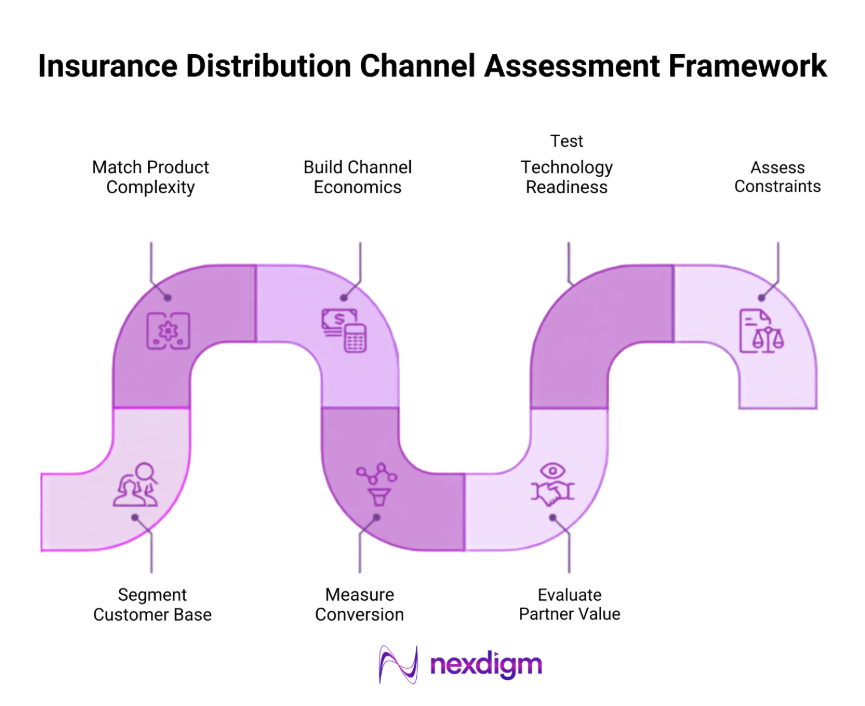
- Segment the Customer Base
Identify target customers by income, geography, digital behaviour, purchasing context, and insurance need. This establishes where customers already engage and which channels can reach them efficiently. - Match Product Complexity to Channel
Assess the level of advice, underwriting, customization, and documentation required. Simple products can be tested for self-service or embedded distribution, while complex products may require agents, brokers, or hybrid models. - Build the Channel Unit Economics
Calculate acquisition cost, commissions, partner revenue shares, technology expenditure, onboarding costs, servicing costs, and expected renewal value for each channel. - Measure Conversion Through the Funnel
Track customer engagement from exposure through quotation, underwriting, binding, and renewal. This identifies whether a channel is generating genuine incremental demand or simply shifting customers between acquisition routes. - Evaluate Partner Value
For embedded and bancassurance models, assess customer access, transaction volumes, data availability, revenue-sharing requirements, integration costs, and partner dependency. - Test Technology Readiness
Examine API capabilities, product-engine configuration, automated underwriting, real-time issuance, claims integration, and the insurer’s ability to support multiple external distribution environments. - Assess Regulatory and Operating Constraints
Evaluate licensing structures, point-of-sale requirements, customer disclosures, data privacy, intermediary obligations, and claims-support responsibilities before committing to a channel. - Prioritize the Channel Portfolio
Rank channels by customer reach, conversion, acquisition economics, lifetime value, scalability, strategic control, and implementation complexity. The output is a product-level channel strategy rather than a generic preference for agency, digital, or embedded distribution.
How Nexdigm Identifies the Right Distribution Model
An established composite insurer assessed six distribution channels across term life, family health, motor, and micro-protection. The analysis found that agents remained economically attractive for complex, high-value policies, while simpler products performed better through digital and embedded channels. The insurer subsequently integrated with payments and travel platforms, reducing acquisition costs for selected products by an illustrative 28% and increasing quote-to-bind conversion to 14.2%.
To take the next step, simply visit our Request a Consultation page and share your requirements with us.
Harsh Mittal
+91-8422857704
[email protected]