

Low insurance penetration is often treated as evidence of untapped demand. But a low premium-to-GDP ratio does not necessarily mean consumers are ready to buy more coverage. In many developing markets, limited disposable income, weak distribution, low trust, and inadequate risk infrastructure constrain insurance adoption.
The stronger opportunity emerges where economic exposure is growing faster than insurance coverage. Rising household assets, private debt, business investment, and exposure to climate-related risks can create protection needs before traditional insurance products reach those segments.
Protection Gaps Are Becoming More Visible
The gap between economic value at risk and insurance coverage is particularly visible across mortality, catastrophe, and small-business risks. It is estimated that the global mortality protection gap is at $432 billion in premium equivalent terms, with emerging markets accounting for approximately $271 billion, or 63%, of the shortfall.
Research indicates that 74% to 77% of small businesses are underinsured, leaving significant exposure to property damage, business interruption, liability, and other operational risks.
These gaps indicate that insurance demand cannot be assessed through penetration alone. The relevant question is where exposure, income, and asset accumulation are creating risks that existing products and distribution channels are failing to cover.
Where Protection Need Is Growing Faster Than Coverage
Rapidly urbanizing middle-income markets present one of the clearest opportunities. Households are acquiring homes, vehicles, and other assets while taking on greater debt for housing, education, and healthcare. Their financial exposure can therefore increase faster than their ability to absorb a major shock.
Small businesses face a similar imbalance. Micro and small enterprises often operate with limited financial reserves while remaining exposed to fire, flooding, liability claims, and supply-chain disruption.
Agricultural and coastal economies increasingly face weather risks that conventional indemnity products may struggle to price or settle efficiently.
A structured Insurance market assessment can map these localized exposures against existing premium density to identify where protection gaps are commercially addressable.
Product Design Determines Whether the Gap Converts
Identifying an uninsured population does not guarantee product demand. The product must match the customer’s risk, affordability, and preferred buying channel.
For example, middle-income households may require affordable pure-term life coverage rather than bundled savings products. Climate-exposed businesses may benefit from parametric policies linked to measurable weather triggers, while small enterprises can be better served by modular commercial covers with simpler underwriting and clearer limits.
Embedded and digital distribution can also reduce acquisition and servicing costs, making smaller policies more commercially viable.
Nexdigm’s Insurance Market Assessment Framework
Nexdigm evaluates protection opportunities by connecting the underlying risk exposure with affordability, existing coverage, distribution, competition, and regulatory conditions.
The assessment examines:
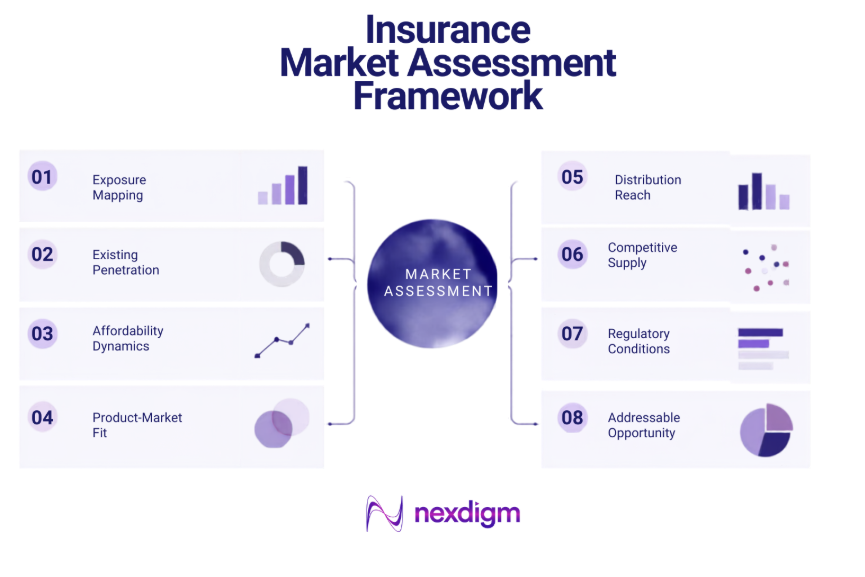
- Exposure Mapping: Quantify household assets, income pools, business assets, debt, and exposure to mortality, health, and climate risks.
- Existing Penetration: Identify coverage levels by geography, demographic group, and product category.
- Affordability Dynamics: Assess income distribution, premium-to-income thresholds, and willingness to pay.
- Product-Market Fit: Determine whether existing products address local risks or whether alternative models such as parametric, micro-insurance, or unbundled products are required.
- Distribution Reach: Evaluate agency networks, bancassurance, digital aggregators, and embedded channels.
- Competitive Supply: Benchmark insurer capacity, pricing, underwriting performance, and competitive intensity.
- Regulatory Conditions: Assess capital requirements, product regulations, sandbox opportunities, and pricing flexibility.
- Addressable Opportunity: Size the commercially viable premium pool by product, risk segment, geography, and distribution model.
How Nexdigm Identifies the Strongest Protection Opportunities
A multinational insurance group assessed 12 economic regions, nine product lines, and approximately 40 million households. The analysis identified markets where physical asset accumulation and household debt were growing faster than insurance premiums, highlighting concentrated mortality and commercial protection gaps.
The resulting strategy prioritized digital term-life coverage and parametric business-interruption insurance for selected markets, allowing the insurer to target specific protection deficits rather than pursuing broad-based expansion.
The commercial opportunity in insurance therefore lies less in finding markets with the lowest penetration and more in identifying where economic exposure is expanding faster than coverage, customers can afford protection, and products can be distributed profitably.
To take the next step, simply visit our Request a Consultation page and share your requirements with us.
Harsh Mittal
+91-8422857704
[email protected]