

Insurance markets can appear attractive long before they become profitable. Low penetration, rising protection needs, and expanding middle-class populations can indicate substantial demand, but none of these factors establish whether an insurer can build a sustainable underwriting business.
Before committing capital, an entrant needs to understand the risk pool, claims environment, distribution economics, regulatory capital requirements, and reinsurance capacity that will determine the economics of the business.
A Penetration Gap Is Not Automatically Paying Demand
Low insurance penetration can indicate an addressable opportunity, but the gap between uninsured risk and commercially viable demand can be significant. Households and businesses may manage risk through savings, informal borrowing, or asset liquidation rather than purchasing formal insurance.
An entry assessment therefore needs to establish whether target customers have:
- Insurable assets or exposures
- Sufficient disposable income to sustain premiums
- Awareness of the relevant risks
- Willingness to trust a new insurer
- Access to an economically viable distribution channel
The objective is to convert a headline penetration gap into an estimate of paying, reachable and profitable demand.
The Risk Pool Determines Whether Growth Creates Profit
Premium growth does not necessarily translate into underwriting profitability. The economics of each insurance line depend on claim frequency, severity, expense ratios, reserve requirements, fraud exposure, and the timing of claims.
The combined ratio remains a central measure:
Combined Ratio = Loss Ratio + Expense Ratio
A ratio below 100% indicates underwriting profit, while a ratio above 100% means premiums are insufficient to cover claims and underwriting expenses.
According to Nexdigm’s research, The entry case can therefore look very different across products:
- Retail health can offer strong demand but requires careful management of medical inflation, adverse selection, hospital pricing, and claims fraud.
- Commercial property can generate large premiums but carries catastrophe exposure and often depends heavily on broker relationships and reinsurance.
- Motor third-party involves long-tail claims and significant reserve requirements.
- Motor own-damage can offer faster claims resolution but remains exposed to repair costs, parts inflation, and pricing competition.
- Term protection can offer attractive underwriting economics but requires substantial investment in distribution and long-term customer retention.
The product portfolio should be selected according to the quality and capital intensity of the underlying risk pool, not simply its premium growth rate.
Distribution Can Determine the Entry Economics
Insurance profitability hinges on distribution economics. Tied agencies deliver reach and trust but carry high onboarding and incentive costs, while digital channels cut commissions only to inflate marketing spend. Bancassurance unlocks established, higher-ticket relationships, and brokers remain vital for commercial lines. Entrants must align channel selection with customer economics, balancing acquisition costs against premium size, persistency, claims performance, and lifetime value.
Regulation Has Changed the Entry Landscape
India’s insurance market has become more accessible to international capital following the Sabka Bima Sabki Raksha (Amendment of Insurance Laws) Act, 2025, which raised the foreign investment limit in Indian insurance companies from 74% to 100%. The reforms also reduced the Net Owned Fund requirement for foreign reinsurers from ₹5,000 crore to ₹1,000 crore, potentially improving access to reinsurance capacity.
That does not remove the capital discipline required for entry. Solvency requirements, licensing, product approvals, data protection, governance, reinsurance arrangements, and claims obligations all influence how much capital must be committed before the business reaches underwriting break-even.
The regulatory opportunity should therefore be evaluated alongside the regulatory burden.
Claims and Reinsurance Need to Be Tested Before Launch
An insurer must evaluate the local claims environment and reinsurance landscape before pricing products and committing capital. Factors like medical billing practices, repair networks, fraud, and litigation directly drive loss ratios, while treaty structures govern balance-sheet risk and capital strain as the portfolio grows.
Underwriting claims dynamics and reinsurance capacity upfront is therefore a strategic market-entry requirement, not a post-launch operational task.
Nexdigm’s Insurance Market Entry Framework
Nexdigm’s insurance market entry strategy reports evaluate entry through five connected workstreams:
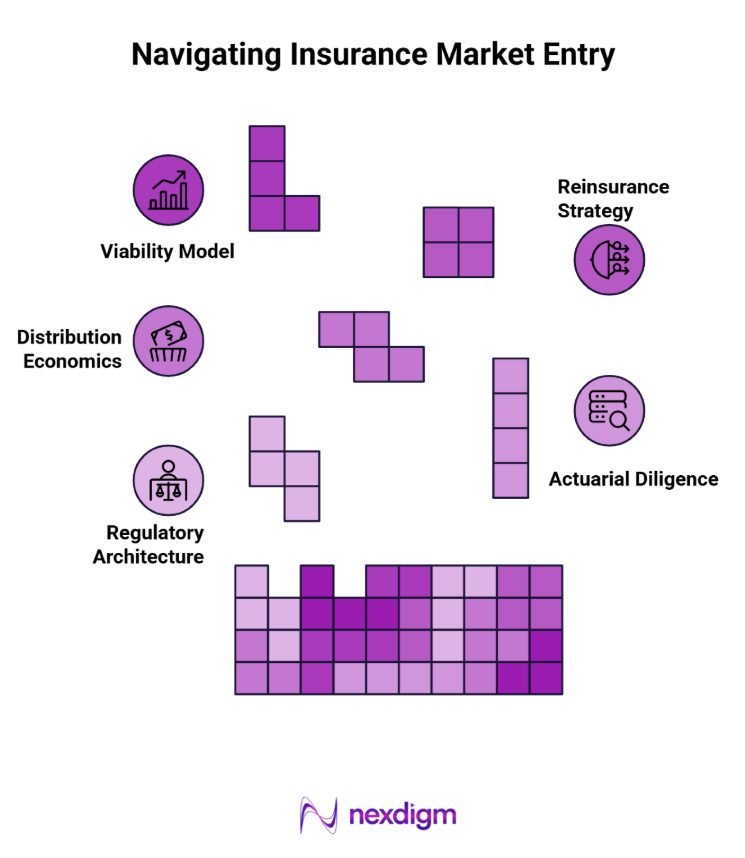
- Regulatory and Capital Architecture: Assess licensing, ownership structures, solvency requirements, regulatory obligations, and the capital needed to support the planned portfolio.
- Actuarial and Claims Diligence: Analyse loss ratios, claims frequency and severity, medical or repair inflation, fraud exposure, litigation, and risk-pool quality by product and geography.
- Distribution Economics: Compare agency, brokerage, bancassurance, digital, and partnership models using acquisition cost, persistency, conversion, and customer lifetime economics.
- Reinsurance Strategy: Determine appropriate risk-transfer structures, capacity availability, retention levels, and the impact of reinsurance on capital consumption.
- Five-Year Viability Model: Translate premium potential into GWP, earned premium, claims, expenses, solvency requirements, capital deployment, underwriting break-even, and return scenarios.
The assessment ultimately identifies which products, customer segments, geographies, and distribution channels can support a commercially viable entry.
How Nexdigm Tests Whether an Insurance Market Is Ready for Entry
A European financial services group evaluating an Indian greenfield health insurer compared four regional markets and three product lines. Nexdigm found corporate group health attractive for premium growth but structurally weak on underwriting economics, with loss ratios averaging 108% across major corporate accounts.
The resulting strategy focused on two underserved secondary urban corridors, six cooperative-bank partnerships, and 12 corporate brokers. The model projected ₹750 crore of initial capital, solvency above 180%, underwriting break-even by month 50, and ₹1,400 crore in Year-5 GWP.
To take the next step, simply visit our Request a Consultation page and share your requirements with us.
Harsh Mittal
+91-8422857704