

Insurance policy pricing benchmarking helps insurers compare premiums, coverage, deductibles, benefits, exclusions, and customer value across life, health, and general insurance segments. Integrated with robust pricing analysis, it reveals market gaps, underpriced risks, inconsistent product structures, and opportunities for stronger differentiation.
Insurers can use these insights to refine rate settings, improve affordability, protect underwriting margins, and strengthen regulatory alignment. This evidence-based approach supports better portfolio decisions, responsive product design and sustainable growth across increasingly complex and competitive insurance markets worldwide while adapting to evolving claims patterns today.
OECD’s latest market review reported 2024 life premiums grew 11.9% nominally across reporting jurisdictions, while non-life premiums increased 4.2% in real terms. These gains support insurance policy pricing analysis that improves competitiveness, risk alignment, product value, and sustainable portfolio growth.
Pricing Analysis for Balanced Insurance Premiums and Customer Value
Pricing analysis helps insurers balance risk, affordability, coverage value, and profitability by aligning premiums with claims experience, customer expectations, market conditions, and regulatory requirements across diverse insurance segments effectively. Some core benefits of the same are:
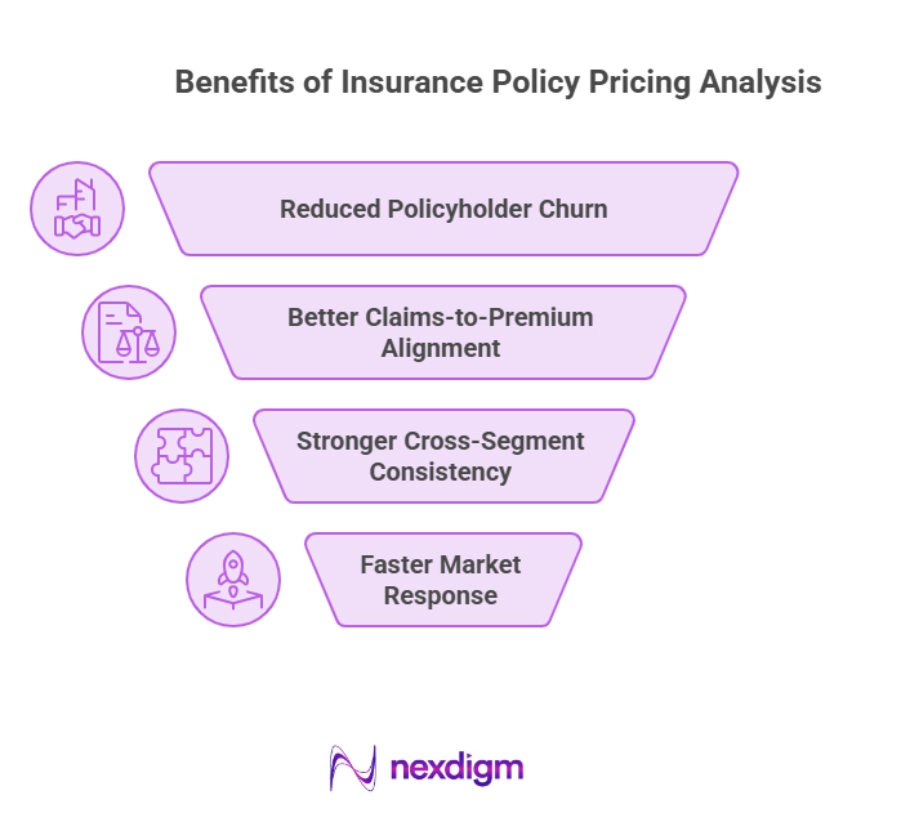
- Reduced Policyholder Churn: Pricing analysis identifies premium increases, coverage gaps, and affordability pressures that may trigger cancellations, enabling targeted adjustments that improve renewals and preserve valuable customer relationships.
- Better Claims-to-Premium Alignment: Insurers can connect claims frequency, severity, settlement patterns, and exposure changes with premium levels, improving pricing responsiveness and supporting sustainable loss-ratio performance across segments.
- Stronger Cross-Segment Consistency: Benchmarking life, health, and general insurance products helps remove unexplained pricing differences, improve internal coherence, and establish consistent principles across diverse policy portfolios and markets.
- Faster Market Response: Continuous competitor, claims, and regulatory monitoring allow insurers to update premiums, coverage terms, and discounts more quickly as risk conditions and customer expectations change.
Nexdigm’s Advisory Role in Providing Customer-Centric Insurance Pricing Analysis
Nexdigm helps insurers develop customer-centric insurance pricing through market benchmarking, claims analysis, customer segmentation, affordability assessment, and advanced pricing analysis. Nexdigm’s strategic approach and engagement support fair premium structures, stronger policy value, improve customer retention, regulatory alignment, and sustainable portfolio profitability. These insights enable insurers to optimize life, health, and general insurance pricing while strengthening competitiveness and long-term customer trust.
Nexdigm’s Pricing Analysis Architecture for Insurance Segments
Nexdigm’s pricing intelligence architecture connects multi-segment insurance data, customer needs, claims patterns, and market benchmarks to guide coordinated pricing decisions across life, health, property, casualty, and specialty portfolios with consistency. Important steps of Pricing Analysis Architecture are:
- Analyze Cross-Segment Pricing Data: Nexdigm integrates premiums, claims, coverage terms, customer profiles, expenses, and competitor benchmarks across insurance lines, creating a consistent foundation for comparative pricing analysis and decisions.
- Identify Segment-Specific Value Drivers: Customer expectations, policy usage, affordability, risk exposure, and service priorities are assessed to determine which pricing factors matter most within each insurance segment and market.
- Map Pricing Interdependency: Relationships between life, health, property, casualty, and specialty products are analyzed to identify cross-segment pricing inconsistencies, bundling opportunities, portfolio overlaps, and potential customer migration risks.
- Configure Coordinated Pricing Model: Distinct pricing models are developed for each segment while applying shared governance principles, ensuring premiums remain risk-aligned, competitive, transparent, and consistent across the broader portfolio.
- Activate Portfolio-Wide Pricing: Centralized dashboards, review triggers, approval workflows, and performance indicators enable insurers to monitor multi-segment pricing outcomes, address emerging gaps, and maintain coordinated portfolio optimization continuously.
Nexdigm’s Case
Nexdigm supported a multi-line insurer integrating pricing data across life, health, property, and casualty portfolios. The engagement aligned customer value, claims patterns, and segment economics. The results included a 12% improvement in pricing accuracy, 10% faster rate reviews, and an 8% increase in policyholder retention within ten months.
To take the next step, simply visit our Request a Consultation page and share your requirements with us.
Harsh Mittal
+91-8422857704