

Insurance pricing strategy benchmarking helps insurers balance growth ambitions, risk exposure, and customer affordability across changing markets. Integrated with advanced pricing analysis, it compares premiums, coverage terms, deductibles, claims experience, customer segments, and competitor positioning to identify sustainable pricing opportunities.
Insurers can use these insights to refine risk selection, improve product value, and protect margins without limiting access. This evidence-based approach also supports regulatory alignment, faster market responses and resilient portfolio expansion across life, health, property and specialty insurance segments worldwide over time.
Recent studies estimated global insurance premiums would grow 2% in real terms in 2025, while OECD insurance penetration reached 6.2% across member countries in 2024. These indicators support pricing analysis that improves affordability, risk alignment, competitiveness, and sustainable portfolio growth.
Strategic Pricing Analysis for Sustainable Insurance Portfolio Performance
Pricing analysis strengthens insurance portfolio performance by aligning premiums, evolving risks, claims costs, customer value, and market conditions through targeted strategies supporting profitability, resilience, competitiveness, and sustainable growth. Some important strategies used during the process are:
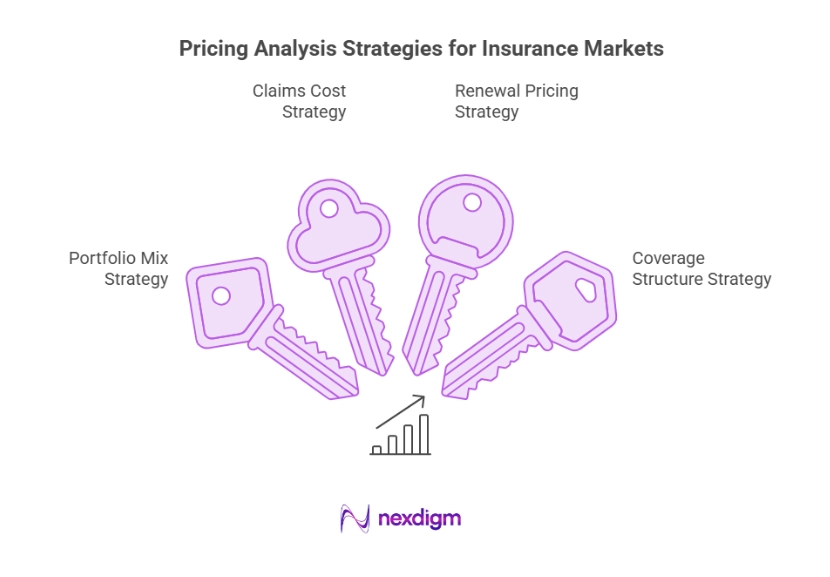
- Portfolio Mix Strategy: Reallocates growth priorities across profitable products, customer segments, and risk categories to reduce concentration, strengthen portfolio balance, and improve risk-adjusted returns over time consistently.
- Claims Cost Strategy: Analyzes claims leakage, provider expenses, settlement patterns, and fraud indicators to reduce avoidable losses, strengthen premium adequacy, and protect sustainable underwriting margins across portfolios.
- Renewal Pricing Strategy: Refines renewal premiums using claims history, customer value, price sensitivity, and retention risk to balance policyholder continuity with portfolio profitability and premium adequacy objectives.
- Coverage Structure Strategy: Adjusts deductibles, limits, exclusions, riders, and benefit levels to improve product value, control exposure, and maintain competitive premiums across targeted insurance segments and markets.
Nexdigm’s Tailored Pricing Analysis Solution for Insurance Portfolio Performance
Nexdigm delivers insurance pricing strategy benchmarking through advanced pricing analysis, portfolio benchmarking, risk segmentation, claims analytics, and competitive market intelligence. Such a strategic approach helps insurers optimize premium structures, strengthen underwriting decisions, improve portfolio performance, enhance customer affordability, and maintain regulatory compliance. By aligning pricing strategies with evolving market conditions, Nexdigm enables sustainable insurance growth, stronger profitability, resilient portfolios, and long-term competitive advantage.
Nexdigm’s Structured Blueprint for Insurance Pricing Analysis
Nexdigm’s structured blueprint integrates portfolio economics, customer behavior, claims signals, and market intelligence to guide accurate insurance pricing decisions. Key blueprint steps include:
- Prioritize Strategic Risk Exposure: Evaluate emerging risks, catastrophe exposure, demographic shifts, and claim volatility to prioritize insurance segments requiring pricing recalibration and focused portfolio attention.
- Benchmark Market Position: Compare premium levels, product features, underwriting practices, discounts, and competitor offerings to identify differentiation opportunities and strengthen pricing competitiveness across insurance markets.
- Align Pricing with Business Goals: Synchronize premium strategies with profitability targets, customer acquisition plans, retention objectives, and portfolio expansion goals to create balanced commercial outcomes.
- Enhance Pricing Transparency: Simplify premium structures, policy benefits, exclusions, and pricing communication to improve customer understanding, strengthen trust, and support informed insurance purchasing decisions.
- Pricing Innovation: Embed continuous pricing innovation through AI-driven analytics, predictive insights, regulatory monitoring, and market intelligence to maintain long-term competitiveness and portfolio resilience.
Nexdigm’s Case
Nexdigm supported an insurance provider in recalibrating premiums, benchmarking competitors, and aligning pricing with emerging risks and customer affordability. The engagement strengthened portfolio performance, delivering a 14% improvement in premium adequacy, 11% lower pricing leakage, and a 9% increase in policy renewal rates across priority insurance segments within twelve months.
To take the next step, simply visit our Request a Consultation page and share your requirements with us.
Harsh Mittal
+91-8422857704