

Insurance companies operate complex procurement ecosystems spanning claims services, technology, professional services, and outsourced operations. As these arrangements expand, identifying where expenditure can be better controlled has become increasingly important. A 2026 study of 302 senior property and casualty insurance leaders found that 58% expected to increase spending on third-party claims administration, while 82% acknowledged that procurement still prioritized cost per claim over outcome governance.
Separately, 64% of insurance executives surveyed planned to increase outsourcing over the following year. These developments underline the need for insurance procurement category benchmarking consulting to evaluate supplier costs, compare commercial arrangements, and identify improvement opportunities across critical procurement categories.
Where Insurance Procurement Spend Creates the Greatest Pressure
Not all procurement categories offer the same potential for cost improvement. Claims administration, technology, outsourcing, and professional services often involve different pricing models and supplier dependencies. Their costs can also vary according to service complexity, transaction volumes, geographic coverage, and contractual commitments. Comparing these categories against relevant market benchmarks helps insurers identify where spending patterns require closer examination.
The Procurement Categories That Deserve Closer Benchmarking
Claims management and third-party administration, technology and digital services, and business process outsourcing represent important areas for insurance procurement benchmarking. Claims-related expenditure requires scrutiny of handling fees, adjuster costs, and service outcomes, while technology spending calls for comparisons across software licensing, cloud infrastructure, and cybersecurity. Assessing these categories against relevant market benchmarks can help insurers identify cost variations, supplier dependencies, and potential efficiency improvements.
Nexdigm’s Research-Led View of Insurance Procurement Categories
Nexdigm approaches procurement analysis by connecting category-level expenditure with supplier intelligence and market research. Rather than reviewing costs in isolation, the assessment can examine the commercial conditions, sourcing models, and service requirements influencing procurement decisions. This enables insurers to understand how their spending compares with relevant market practices and where further evaluation may be valuable.
How Nexdigm Evaluates Category-Level Cost Improvement Opportunities
Nexdigm’s insurance procurement category benchmarking consulting approach can help insurers examine procurement categories through several complementary dimensions:
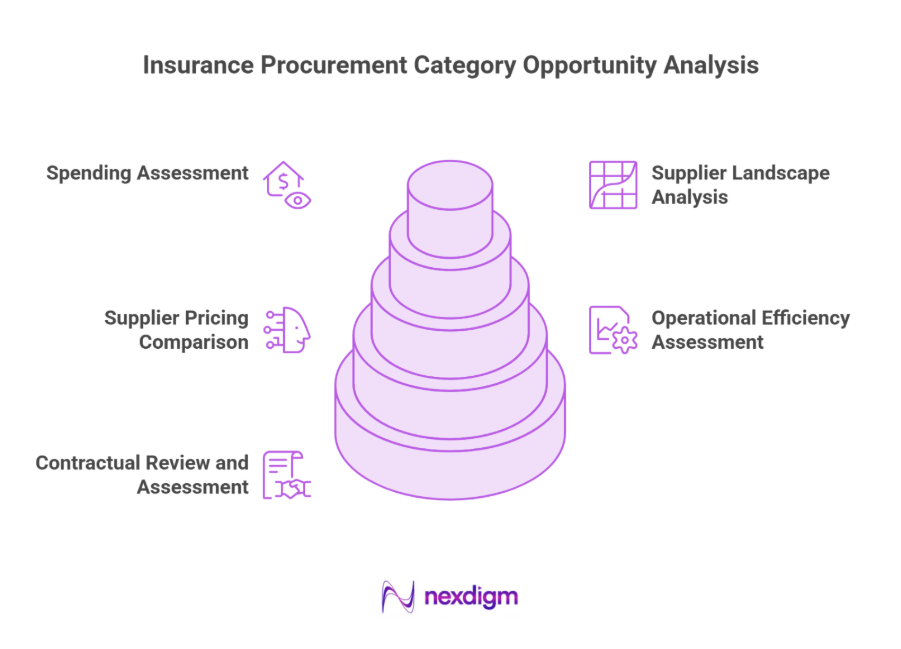
- Spend Assessment: Analyze expenditure patterns across claims, technology, outsourcing, and corporate services to identify significant cost pools and spending concentration.
- Supplier Pricing Comparison: Examine supplier rates, fee structures, pricing models, and commercial terms to identify differences across comparable service providers.
- Contractual Review: Assess renewal provisions, minimum commitments, escalation clauses, and service-level agreements to identify potential commercial disadvantages.
- Supplier Landscape Analysis: Research alternative providers, service capabilities, geographic coverage, and market positioning to support informed sourcing decisions.
- Operational Efficiency Assessment: Examine service utilisation, overlapping activities, delivery structures, and process arrangements to identify potential efficiency improvements.
By combining these dimensions, Nexdigm can help insurers develop a more informed understanding of category-level procurement performance and supplier competitiveness.
Nexdigm’s Benchmarking Intelligence Strengthening Competitiveness
Maintaining procurement competitiveness requires insurers to compare their spending, supplier relationships, and commercial arrangements with prevailing market practices. Through benchmarking consulting, Nexdigm can help insurers with:
- Category-Level Cost Comparison: Evaluate procurement costs against market benchmarks to identify pricing gaps and competitive advantages.
- Supplier Positioning: Compare supplier capabilities, service offerings, and commercial models to assess the competitiveness of existing partnerships.
- Sourcing Model Evaluation: Examine alternative sourcing arrangements to identify opportunities for improved cost and service alignment.
- Commercial Negotiation Support: Use market intelligence to inform supplier discussions and pursue more competitive contractual terms.
- Market Trend Assessment: Track changing supplier conditions and category developments to support proactive procurement decisions.
These insights help insurers strengthen supplier choices, improve commercial positioning, and maintain more competitive procurement practices.
Nexdigm’s Procurement Benchmarking Creating Long-Term Value
For insurers, the value of procurement benchmarking lies in its ability to inform decisions beyond immediate cost reduction. Nexdigm’s research-led insights can help organizations understand changing category dynamics, evaluate supplier market developments, and identify areas requiring strategic attention. This supports a more forward-looking procurement approach, enabling insurers to adapt sourcing strategies, manage supplier dependencies, and sustain commercial competitiveness as business requirements evolve.
Nexdigm’s Case
An insurance company engaged Nexdigm to benchmark 40 suppliers across claims management, technology, and outsourced services. The assessment identified 29% potential savings in selected procurement categories, 17% scope for supplier consolidation, and 23% improvement potential in contract efficiency. These findings helped prioritize sourcing reviews, strengthen supplier negotiations, and improve procurement planning.
To take the next step, simply visit our Request a Consultation page and share your requirements with us.
Harsh Mittal
+91-8422857704