

Insurance demand is becoming more fragmented. Customers are balancing protection, affordability, healthcare costs, vehicle ownership, property risks, and emerging exposures differently across markets.
Swiss Re expects global insurance premium growth to slow to 1.3% in real terms in 2026, before improving to 1.6% in 2027. At the same time, health insurance premium volume grew by more than 5% in 2025, according to Swiss Re.
The result is a market where overall growth can hide major differences between individual insurance products.
For insurers, investors, brokers, banks, and financial platforms, the key opportunity is to determine which products customers increasingly need, which remain underpenetrated, and where demand can translate into sustainable growth.
An Insurance product demand analysis helps compare these differences across life, health, motor, property, and specialty insurance.
Nexdigm combines customer behavior, demographic change, income, risk exposure, product penetration, competitive intelligence, and market economics to identify the strongest product opportunities.
Understanding the Shift in Insurance Product Demand
Insurance demand is not driven by a single market trend. Each insurance product category responds to a distinct set of economic, demographic, behavioral, and risk-related factors. As customer needs evolve, insurers must understand these product-specific demand drivers to identify the most attractive growth opportunities and allocate resources effectively.
- Life Insurance: Demand for life insurance is influenced by household income levels, financial planning priorities, family responsibilities, mortality protection needs, and long-term savings objectives.
- Health Insurance: Health insurance demand is shaped by rising medical costs, healthcare accessibility, employer-sponsored coverage, health awareness, and concerns around financial protection against medical emergencies.
- Motor Insurance: Growth in motor insurance is closely linked to vehicle ownership trends, urban mobility patterns, regulatory requirements, and changing consumer transportation preferences.
Because each insurance segment is influenced by different demand drivers, product-level analysis provides deeper market insights than overall industry growth, enabling insurers to identify high-potential opportunities more accurately.
Nexdigm’s Role in Identifying High-Potential Insurance Product Opportunities
Different insurance products respond to different market forces, making it essential to evaluate opportunities at a product level. Nexdigm combines demand drivers, customer behavior, market dynamics, and competitive intelligence to identify insurance segments with the strongest commercial potential. Some key areas evaluated include:
- Demand-Supply Gaps: Nexdigm identifies insurance categories where customer protection needs are growing faster than available market offerings.
- Customer Need Assessment: Analyzing financial priorities, risk exposure, and purchasing behavior helps uncover unmet customer requirements across product segments.
- Distribution Channel Effectiveness: Nexdigm evaluates which channels, including agents, brokers, bancassurance, and digital platforms, are best suited for specific products.
- Emerging Risk Identification: New risks such as cyber threats, climate events, and evolving business exposures are analyzed to identify future insurance demand.
By combining product-specific demand drivers with market, customer, and distribution insights, Nexdigm helps insurers focus on the most attractive opportunities and develop targeted, growth-oriented insurance strategies.
How Nexdigm Prioritizes Insurance Market Opportunities
Identifying opportunities is just the first step. Through insurance product demand analysis and opportunity assessment, insurers can understand which product segments offer the strongest growth potential. Nexdigm applies a structured analytical process to help organizations focus on opportunities most likely to deliver sustainable business growth. Key evaluation criteria include:
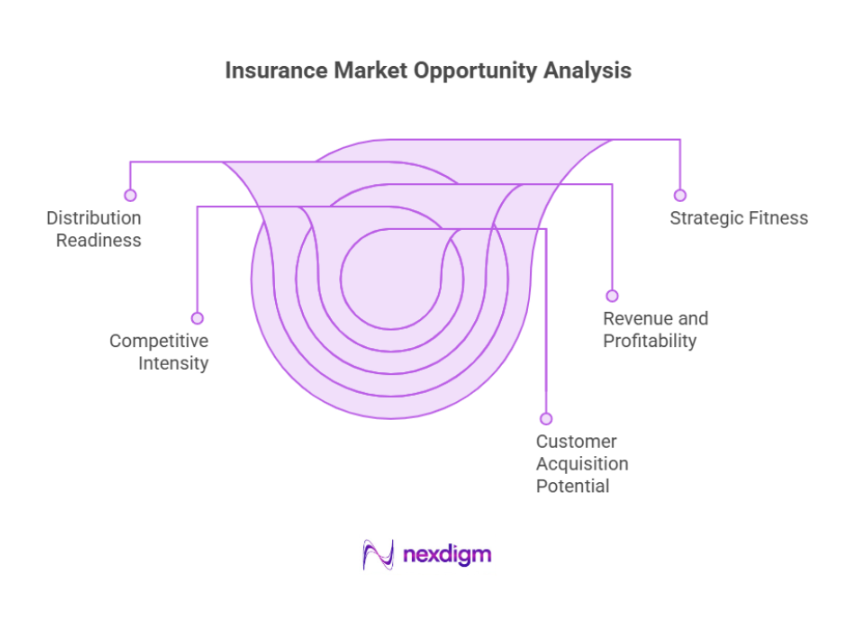
- Market Size and Growth Potential: Nexdigm assesses current market size, projected growth, and product-level demand trends to identify attractive opportunities.
- Customer Acquisition Potential: The framework evaluates how easily target customers can be reached, engaged, and converted into policyholders.
- Competitive Intensity Assessment: Markets with lower competition or clear differentiation opportunities may offer stronger growth potential.
- Revenue and Profitability Outlook: Expected premiums, customer lifetime value, and profit margins are analyzed to assess commercial attractiveness.
- Distribution Readiness: Nexdigm evaluates the effectiveness of agency, broker, bancassurance, and digital channels in supporting growth.
- Strategic Fitness: Opportunities are assessed against an insurer’s capabilities, product portfolio, technology maturity, and long-term objectives.
By combining this product demand analysis with market attractiveness, customer insights, competitive intelligence, and distribution assessments, Nexdigm helps insurers prioritize high-value opportunities and allocate resources more effectively for sustainable growth.
Turning Insurance Demand into Strategic Growth
Nexdigm transforms insights generated through insurance product demand analysis into targeted product, distribution, and customer-acquisition strategies. This helps insurers align their offerings such as:
- Product Portfolio Optimization: Nexdigm identifies products with the strongest demand potential and highlights areas requiring innovation, enhancement, or repositioning.
- Customer-Centric Product Design: Insights into customer needs help insurers develop offerings that address specific protection, savings, and risk-management requirements.
- Market Entry and Expansion Planning: Opportunity assessments help insurers prioritize regions, customer segments, and product categories for growth.
With these insurers can strengthen their market positioning, improve customer acquisition, and maximize returns from product, distribution, and investment decisions.
Nexdigm’s Case
An insurer used Nexdigm’s Insurance product demand analysis to identify high-potential customer segments and underpenetrated coverage categories. Within 12 months, qualified leads increased 31%, policy conversions rose 26%, cross-selling improved 22%, and digital engagement grew 34%, expanding coverage while improving customer value and distribution efficiency.
To take the next step, simply visit our Request a Consultation page and share your requirements with us.
Harsh Mittal
+91-8422857704