

Insurance companies rely on a broad technology environment to manage products, assess risk, administer policies and process claims. These functions are often supported by different applications, developed by specialised providers or integrated into larger insurance platforms. Selecting software therefore requires an understanding of how each system supports the insurance lifecycle.
A policy administration platform may be central to an insurer’s operations, but it does not necessarily provide the analytical depth required for underwriting or the workflow capabilities needed for complex claims. Vendor analysis should begin by separating these functional requirements before assessing integration and long-term fit.
Policy Administration: Managing the Insurance Lifecycle
Policy administration systems support the creation, modification, renewal and servicing of insurance policies. Their functions may include product configuration, premium calculation, endorsements, customer records and policy documentation.
The requirements differ across life, health and general insurance. Life insurers may need systems supporting long-duration policies, premium schedules and beneficiary information. General insurers may require more frequent policy changes, product variations and connections with distribution channels.
A vendor comparison should examine product configurability, workflow automation, document generation, renewal management and integration with billing and customer systems. Buyers should also assess whether the platform can accommodate new products without extensive custom development.
Claims Management: Improving Workflow and Visibility
Claims systems manage the process from initial notification to assessment, approval, payment and closure. They may support document collection, case allocation, communication, fraud referrals and settlement tracking.
The complexity of the workflow depends on the insurance category. Motor claims may involve repair networks, surveyors and external assessments. Health claims can require coordination among insurers, hospitals and third-party administrators. Life claims may involve beneficiary verification and supporting documentation.
Evaluation should focus on workflow configuration, case visibility, document management, rules-based processing, external integrations and exception handling. A platform that automates routine cases but cannot support complex claims may create additional manual work.
Underwriting Platforms: Connecting Data With Risk Decisions
Underwriting software helps insurers collect information, apply rules and support risk assessment. Some platforms focus on data ingestion and document extraction, while others provide decision engines, pricing tools or risk analytics.
The quality of underwriting technology depends on data availability, model governance and the insurer’s ability to configure rules for different products. Vendors should be compared on integration with internal policy systems, external data sources, audit trails, decision explainability and exception workflows.
Automation should be assessed in the context of the insurer’s risk appetite and regulatory obligations. A platform’s ability to generate a recommendation does not transfer accountability for underwriting decisions away from the insurer.
Customer Platforms: Supporting Distribution and Servicing
Customer-facing insurance software includes portals, mobile applications, agent platforms, broker systems and customer relationship management tools. These applications support product discovery, quotations, onboarding, policy servicing and renewal communication.
A strong customer platform should provide consistent information across channels. Customers should be able to access policy details, submit service requests and track relevant processes without repeatedly providing the same information.
Insurers should compare digital journey design, accessibility, multilingual support, agent workflows, integration with policy records and customer communication capabilities. The platform should also support appropriate consent, identity verification and data protection practices.
Integration and Commercial Considerations
Insurance software frequently operates across legacy systems, external distribution partners, payment services, data providers and regulatory reporting environments. Integration quality can determine the cost and complexity of implementation.
Insurance software vendor analysis should examine API coverage, data migration requirements, system compatibility, implementation support and upgrade arrangements. Buyers should also identify dependencies on third-party providers and understand how data is transferred between applications.
Commercial evaluation should account for licensing, implementation, customisation, infrastructure, maintenance and ongoing support. Pricing models may be based on users, policies, transactions or modules. These should be compared against projected business volumes rather than assessed in isolation.
The scale of India’s insurance sector makes this evaluation commercially relevant. During FY2024-25, the industry issued 41.84 crore policies and collected premiums of approximately ₹11.93 lakh crore. Such activity creates demand for systems that can support high-volume policy servicing while accommodating product and distribution complexity.
Insurance Software Vendor Analysis Framework
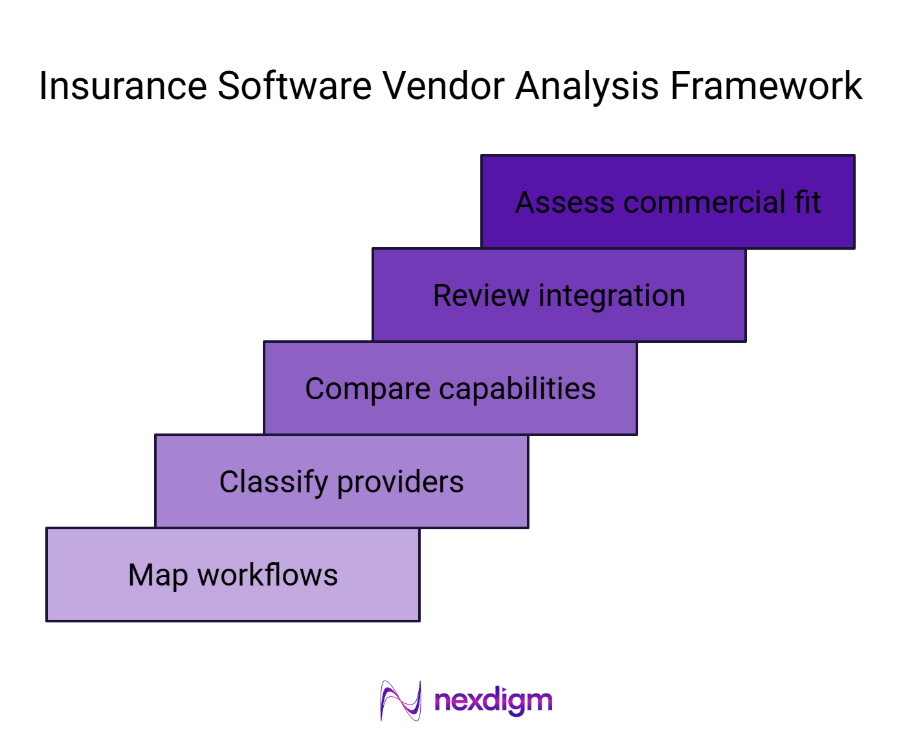
- Map the insurance workflows: Identify requirements across policy administration, underwriting, claims, customer servicing and distribution.
- Classify software providers: Separate core insurance platforms from specialised claims, underwriting, customer and analytics applications.
- Compare functional capabilities: Assess product configuration, workflow automation, data handling, reporting and support for relevant insurance segments.
- Review integration and governance: Examine APIs, legacy-system compatibility, security, auditability, data migration and third-party dependencies.
- Assess commercial fit: Compare implementation effort, licensing structures, maintenance and scalability before developing a function-specific shortlist.
Nexdigm’s Case Study: Insurance Software Provider Assessment
An insurer evaluating technology upgrades across policy servicing and claims needed to understand the overlap between core platforms and specialist applications. Nexdigm mapped 21 software providers across four functional areas, comparing product coverage, integration models and target customer segments to develop a shortlist of seven vendors.
To take the next step, simply visit our Request a Consultation page and share your requirements with us.
Harsh Mittal
+91-8422857704