

Insurtech platforms are changing how insurance products are designed, distributed and serviced. Their role extends beyond selling policies online. Technology providers now support embedded insurance, digital onboarding, underwriting assistance, policy administration, claims coordination and customer engagement.
For insurers, brokers, distributors and businesses exploring insurance partnerships, the challenge is identifying which platforms offer capabilities that match their operating model. A distribution platform may be effective at customer acquisition but provide limited support for policy servicing. A specialist technology provider may improve underwriting or claims workflows without offering a complete customer journey.
The strongest comparison begins with the function each platform performs.
Distribution Platforms: Expanding Access to Insurance
Digital brokers, aggregators and distribution technology providers connect customers with insurance products across online and assisted channels. Their capabilities may include product comparison, quotation journeys, lead management, digital onboarding and renewal communication.
Some platforms operate directly with consumers, while others provide infrastructure for banks, employers, marketplaces and agents. This distinction affects their commercial model, customer ownership and integration requirements.
Vendor assessment should examine insurer partnerships, product coverage, customer acquisition channels, conversion support and post-sale servicing. Buyers should also understand whether the platform supports multiple insurance categories or focuses on a specific segment such as health, motor or employee benefits.
Embedded Insurance: Connecting Products With Customer Journeys
Embedded insurance platforms enable businesses to offer relevant insurance products during the purchase or use of another service. Examples include device protection at checkout, travel cover during booking or insurance offered through an employer platform.
These models depend on integration with the distribution partner’s systems. The platform must support product presentation, eligibility checks, customer consent, policy issuance and relevant servicing workflows.
Evaluation should consider API capabilities, partner onboarding, product configuration, insurer connectivity and reporting. Buyers should also examine how customer information is handled and how responsibilities are divided between the platform, insurer and distribution partner.
The commercial model may involve commissions, platform fees or other arrangements. These should be assessed alongside customer acquisition costs, conversion rates and renewal potential.
Underwriting and Product Innovation Platforms
Specialist insurtech providers support underwriting through data integration, document processing, risk assessment tools and workflow automation. Their technology can help insurers evaluate applications and configure products for different customer segments.
Product innovation may also depend on the ability to create modular coverage, adjust eligibility rules and support distribution through new channels. Platforms that allow insurers to configure products without extensive redevelopment may offer greater flexibility.
However, technology does not independently determine whether a product is actuarially sound or appropriate for a target market. Insurers remain responsible for pricing, risk appetite, product governance and regulatory compliance.
Vendor comparisons should therefore examine configurability, data quality, decision traceability, integration with core systems and the ability to support different product structures.
Operational Efficiency: Servicing, Claims and Customer Experience
Operational insurtech platforms address activities that occur after a policy is purchased. These may include policy changes, renewals, customer support, claims assistance, document collection and workflow coordination.
The relevant technology differs by use case. A health benefits platform may focus on employee enrolment and hospital network access, while a claims technology provider may specialise in document processing, fraud indicators or case management.
India’s insurtech ecosystem includes providers across distribution, embedded insurance, underwriting, health and wellness, claims and customer service. The India InsurTech Association’s 2025 ecosystem material illustrates how specialised these segments have become. This makes category-level comparison more useful than ranking every platform against a single set of criteria.
Efficiency should be assessed through measurable operating indicators, such as processing time, manual intervention, customer response time, application completion and renewal support. Vendors should explain how their technology contributes to these outcomes and what data is available to validate performance.
Commercial Fit and Platform Dependencies
Insurtech platforms may charge through subscriptions, per-policy fees, transaction charges, commissions or customised enterprise agreements. The most suitable model depends on policy volumes, distribution arrangements and the level of technology integration required.
Buyers should identify dependencies on insurers, data providers, third-party administrators and external distribution partners. A platform may offer an attractive customer experience while relying on several external systems for policy issuance or claims fulfilment.
Commercial due diligence should therefore include pricing assumptions, ownership of customer relationships, data access, service responsibilities and exit arrangements.
Insurtech Platform Supplier Benchmarking Framework
Implementing a structured approach to insurtech platform supplier benchmarking ensures that insurers and digital businesses systematically evaluate vendor capabilities against specific operational requirements and strategic goals.
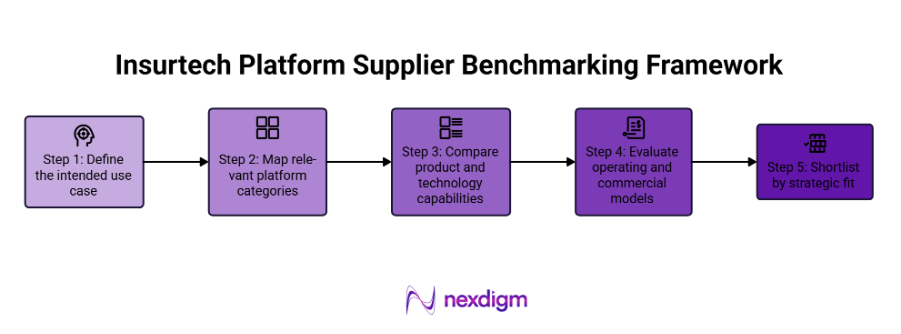
- Define the intended use case: Specify whether the requirement involves distribution, embedded insurance, underwriting, product configuration, servicing or claims support.
- Map relevant platform categories: Identify specialist insurtech providers and broader platforms with capabilities aligned to the use case.
- Compare product and technology capabilities: Assess APIs, configurability, insurer connectivity, data handling, workflow automation and customer experience.
- Evaluate operating and commercial models: Review pricing, partner dependencies, service responsibilities, customer ownership and regulatory considerations.
- Shortlist by strategic fit: Compare providers against expected volumes, target customer segments, integration requirements and future product plans.
Nexdigm’s Case Study: Insurtech Platform Benchmarking
A digital distribution business exploring insurance partnerships needed to identify platforms supporting embedded products and policy servicing. Nexdigm assessed 18 insurtech providers across distribution, API infrastructure and operational capabilities, narrowing the landscape to six candidates for partnership evaluation.
To take the next step, simply visit our Request a Consultation page and share your requirements with us.
Harsh Mittal
+91-8422857704