
Freight decisions are often made around the visible freight rate. That can produce the wrong answer. A shipment that is cheaper on a line-haul basis can become more expensive once first- and last-mile trucking, terminal handling, inventory carrying costs, safety-stock requirements, and schedule reliability are included. The right mode therefore depends on the economics of the complete journey, not the rate charged for one leg.
India’s expanding freight infrastructure, particularly the operationalization of Dedicated Freight Corridors (DFCs), is changing these trade-offs across road, rail, and maritime transport.
The Mode Decision Starts With Total Landed Cost
Road remains attractive because it offers direct factory-to-warehouse movement, flexible scheduling, and limited transfer requirements. Rail can offer substantially lower line-haul costs, particularly for heavy or long-distance cargo. Maritime shipping can be even more economical for suitable long-haul movements.
The comparison changes once the full cost structure is considered:
- Line-haul freight rates
- First- and last-mile drayage
- Terminal handling and transshipment
- In-transit inventory carrying costs
- Safety-stock requirements
- Detention and storage exposure
- Reliability-related costs
This is particularly relevant in India, where logistics costs are estimated at 7.97% of GDP. Road freight is estimated to account for roughly 65%–70% of national freight volumes, despite its higher line-haul and emissions profile.
Distance Changes the Economics
The optimal mode changes materially with haul length.
Dedicated rail infrastructure can bring rail line-haul rates down to approximately ₹1.50–₹1.96 per tonne-kilometre, compared with ₹2.80–₹3.80 for diesel road freight. But these savings can disappear on shorter routes when cargo must be trucked to a railhead, transferred through an ICD or MMLP, and moved again at the destination.
For DFC-integrated intermodal movements, the research indicates a break-even range of approximately 500–600 kilometres for containerized industrial cargo. Below this threshold, road’s flexibility can outweigh rail’s lower line-haul cost. Beyond it, rail’s cost advantage becomes increasingly significant.
Cargo Characteristics Can Override the Distance Rule
Distance alone does not determine modal suitability. The value, weight, perishability, and delivery requirements of the cargo matter just as much.
High-value and time-sensitive products such as pharmaceuticals, electronics, and perishables can justify higher road freight costs when faster and more predictable delivery reduces inventory exposure and handling risk.
Heavy commodities such as coal, fertilizers, cement clinker, and iron ore are better suited to rail over long distances because their low value-to-weight ratios make freight cost a larger component of landed economics.
Containerized manufactured goods occupy the middle ground. Automotive components, machinery, and consumer durables can shift to rail when the line-haul savings compensate for transfer and drayage costs.
Capacity Is a Network Constraint
The commissioning of India’s 2,843-kilometre Dedicated Freight Corridor network has expanded the potential for faster, higher-capacity freight movement. The Western DFC spans 1,506 kilometres between Dadri and JNPT, while the Eastern DFC covers 1,337 kilometres.
DFC infrastructure supports 25-tonne axle-load trains, double-stack container rakes, and operating speeds of approximately 50–60 km/h, compared with around 20–25 km/h on conventional mixed-use rail routes. Transit between the NCR and JNPT can therefore move from more than 72 hours to below 48 hours on suitable services.
Yet additional line capacity does not automatically translate into network efficiency. Railyards, ICDs, MMLPs, port connectivity, gate processing, and first-mile trucking can become the next bottlenecks.
The Transfer Point Can Decide the Route
Intermodal economics are particularly sensitive to what happens between the main transport legs.
Terminal handling charges, lift-on/lift-off fees, temporary storage, railyard delays, and drayage can materially reduce the advantage of rail. A route with an efficient rail corridor but poorly connected terminals may therefore perform worse than a slightly more expensive road alternative.
The relevant calculation is:
Total Logistics Cost = Line-Haul Freight + Drayage + Handling + Inventory Carrying Cost + Safety Buffer Cost
This shifts route planning from selecting a mode to designing an efficient combination of modes.
Nexdigm’s Intermodal Transport Market Analysis Framework
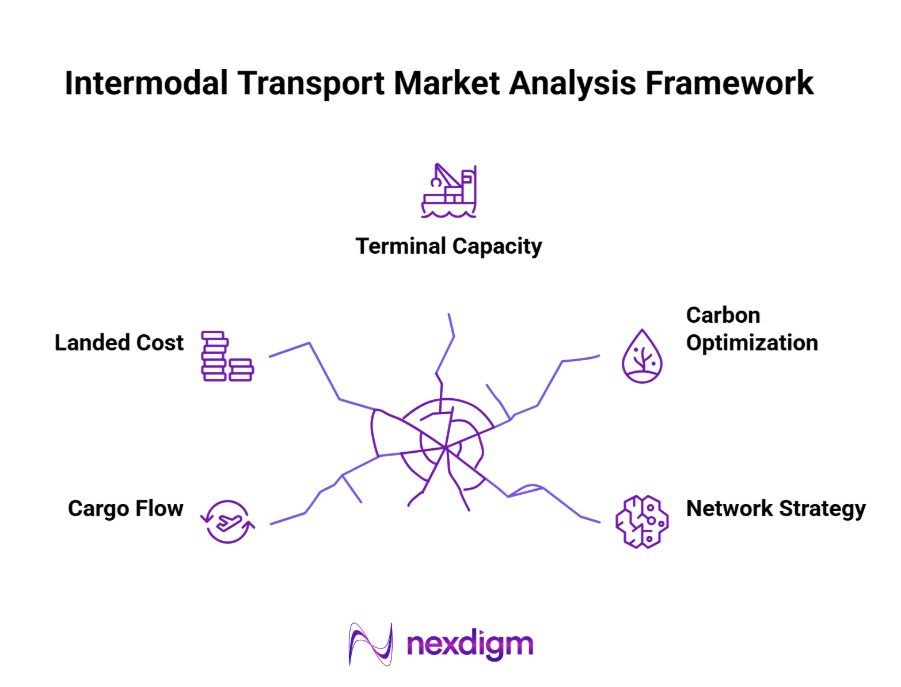
- Cargo flow mapping: Origin-destination volumes are segmented by cargo type, payload, value, perishability, and seasonality.
- Landed-cost modeling: Road, rail, maritime, and intermodal configurations are compared across line-haul, drayage, handling, and inventory costs.
- Terminal and capacity assessment: ICDs, private freight terminals, and MMLPs are evaluated for handling equipment, railyard capacity, gate processing, and connectivity.
- Carbon optimization: Emissions are assessed by mode and corridor to quantify potential Scope 3 reductions alongside financial benefits.
- Network strategy: The analysis identifies modal allocation, private siding opportunities, and commercial requirements with CTOs and 3PL providers.
Nexdigm’s Intermodals Transport Market Analyses evaluates freight corridors by connecting cargo demand with route economics, infrastructure capacity, and operating constraints.
How Nexdigm Identifies the Most Efficient Freight Corridors
For a manufacturing enterprise moving 1.6 MMT of steel, engineering equipment, and automotive components annually, Nexdigm assessed 12 freight corridors across four cargo categories and compared road, conventional rail, and DFC-integrated intermodal configurations.
Three long-haul corridors exceeded the 500–600 kilometre intermodal break-even threshold. Shifting 1.1 MMT of cargo to DFC-linked rail, redesigning drayage, and securing scheduled departures reduced landed logistics costs by 27.2%, generating ₹136 crore in annual savings. Transit times fell 36%, while Scope 3 emissions declined 58%.
To take the next step, simply visit our Request a Consultation page and share your requirements with us.
Harsh Mittal
+91-8422857704