

International business entry research is a critical process for organizations planning to expand into foreign markets. It helps businesses evaluate market potential, understand customer demand, assess competition, and examine regulatory feasibility before making investment decisions. This research supports the development of an effective market entry strategy by identifying the most suitable mode of entry, such as exporting, licensing, joint ventures, or direct investment.
By analyzing economic conditions, legal requirements, cultural factors, and industry trends, international business entry research reduces uncertainty and improves decision-making. It enables companies to enter new markets strategically, competitively, and in compliance with local regulations.
A strong market entry strategy helps businesses reduce risk, allocate resources effectively, and respond to changing global trade and investment conditions. Global foreign direct investment reached about $1.6 trillion in 2025, while merchandise trade growth is expected to slow sharply by 2026. These figures suggest that firms must carefully assess market potential, competitive intensity, and regulatory conditions before expansion.
Understanding the Role of Market Entry Strategy in International Expansion
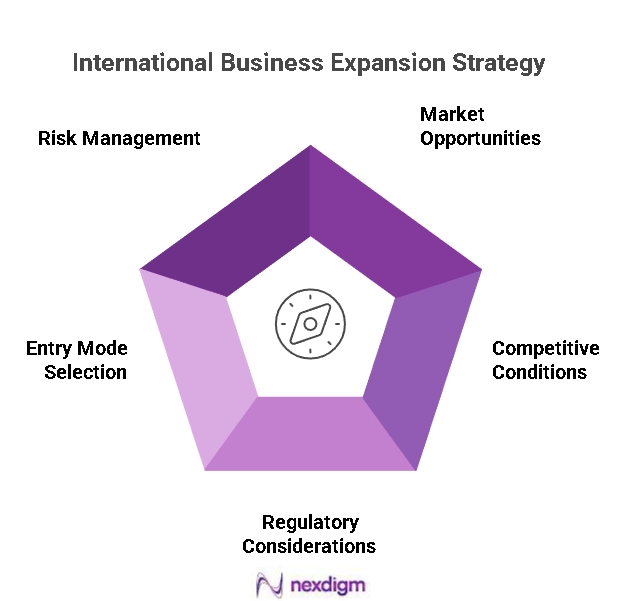
A market entry strategy guides how a business enters a foreign market by assessing opportunities, risks, competition, regulations, and resources to ensure successful international expansion and long-term growth:
-
Assessment of Market Opportunities
Companies analyze demand, customer needs, purchasing power, and growth potential before selecting a foreign market for expansion.
-
Evaluation of Competitive Conditions
Businesses study existing competitors, pricing, product positioning, and market share to identify advantages and possible challenges.
-
Regulatory and Legal Considerations
Market entry planning includes reviewing trade laws, taxes, licensing, investment rules, and compliance requirements in the target country.
-
Selection of Entry Mode
Firms choose between exporting, licensing, franchising, joint ventures, partnerships, or direct investment based on risk and control.
-
Risk Management in Entry Decisions
A market entry strategy helps identify political, economic, cultural, financial, and operational risks before committing resources internationally.
Nexdigm’s Regulatory and Compliance Assessment for International Business Entry
Nexdigm’s Regulatory and Compliance Assessment for International Business Entry helps businesses understand legal, tax, trade, and operational requirements before entering a new market. It includes reviewing foreign investment rules, licensing needs, sector-specific regulations, import-export norms, and compliance obligations. This assessment reduces entry risks, supports informed decision-making, and ensures the market entry strategy aligns with local regulatory frameworks.
How Nexdigm Evaluates Market Size, Demand Potential, and Growth Prospects in International Expansion
Nexdigm evaluates market size, demand potential, and growth prospects by analyzing industry trends, customer segments, consumption patterns, competitor presence, economic indicators, and market drivers to support informed international expansion decisions.
-
Market Size Estimation
Nexdigm assesses total addressable market, sector value, customer base, and revenue potential to understand expansion opportunities.
-
Demand Potential Analysis
It studies customer needs, purchasing behavior, consumption patterns, and unmet demand to evaluate product or service acceptance.
-
Industry Trend Review
Nexdigm analyzes market trends, technological changes, regulatory shifts, and economic developments influencing future business opportunities.
-
Customer Segment Identification
It identifies target customer groups based on demographics, income levels, business needs, preferences, and buying capacity.
Nexdigm’s case:
Nexdigm helped a mid-sized consumer goods company assess its international expansion opportunity in Southeast Asia. Through market size estimation, demand analysis, and competitor benchmarking, Nexdigm identified a target market valued at approximately USD 2.8 billion, with expected annual growth of 7–9%. The assessment also revealed that 62% of urban consumers preferred premium imported products. Based on these insights, Nexdigm supported the company in selecting a phased market entry strategy, reducing entry risk and improving expansion readiness.
To take the next step, simply visit our Request a Consultation page and share your requirements with us.
Harsh Mittal
+91-8422857704