

International crop pricing competitiveness directly influences whether agricultural exporters can win buyers, protect margins, and sustain growth across global markets. Through pricing analysis, export price benchmarking, landed-cost assessment, competitor intelligence, currency evaluation, and customer willingness-to-pay research, businesses can identify optimal price positions for different crops and destinations.
Effective analysis also accounts for quality grades, certifications, logistics, tariffs, channel margins, and seasonal demand. These insights help exporters strengthen quotations, differentiate products, improve price realization, manage volatility, and build competitive agricultural export strategies across diverse international markets.
Recent indicators highlight growing export opportunities. Global trade reached US$34.65 trillion in 2025, increasing 7%, while goods trade expanded 6%. Pricing Analysis Services help agricultural exporters benchmark markets, optimize quotations, capture demand, and convert trade growth into stronger margins.
Crop Export Pricing Analysis for Stronger Agricultural Market Positioning
Crop export pricing strategies help agribusinesses align international prices with costs, customer value, competitor benchmarks, and market conditions, strengthening margins, buyer confidence, competitiveness, and sustainable positioning across global agricultural markets. Core benefits of agricultural pricing analysis are:
- Reduced Commercial Risk: Risk-adjusted pricing accounts for credit exposure, trade restrictions, logistics volatility, and payment delays.
- Stronger Buyer Retention: Transparent, consistent, and contract-based pricing builds trust and supports long-term commercial relationships.
- Sustainable Export Growth: Regular monitoring and market-linked pricing help exporters remain competitive as demand, costs, and trade conditions change.
- Faster Market Entry: Structured pricing intelligence enables confident quotations, distributor negotiations, and entry into new export markets.
- Greater Channel Participation: Sustainable importer and distributor margins encourage stronger promotion, distribution, and repeat business.
Nexdigm’s Support for Crop Export Pricing Analysis Services
Nexdigm helps agribusinesses develop destination-specific crop export pricing through pricing analysis services, international crop pricing competitiveness, export price benchmarking, market intelligence, landed-cost analysis, and price optimization. By evaluating destination-market demand, competitor prices, buyer expectations, trade conditions, and logistics costs, Nexdigm enables exporters to optimize pricing, strengthen global market positioning, improve export margins, and drive sustainable international growth.
Nexdigm’s Integrated Pricing Analysis Blueprint for Agricultural Markets
Nexdigm’s Integrated Pricing Blueprint combines market intelligence, commercial analytics, and pricing analysis to help agribusinesses establish competitive, profitable, and scalable pricing strategies across diverse agricultural markets. Key steps of the blueprint are:
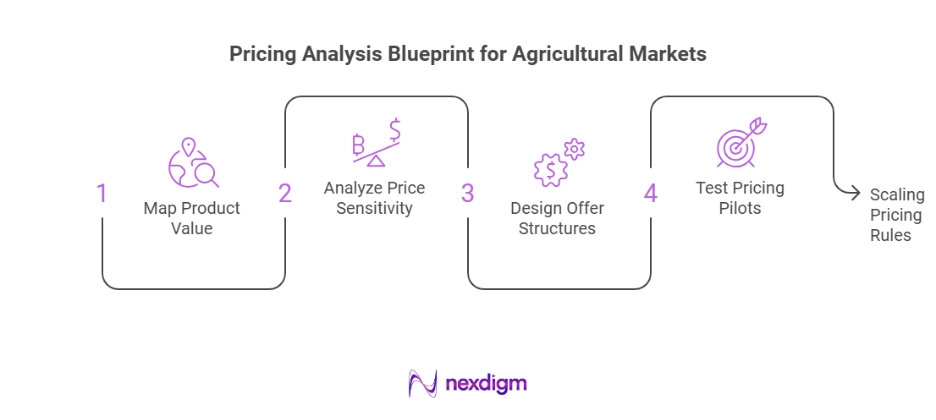
- Map Product Value Across Markets: Assess how product quality, performance, service, sustainability, and reliability are valued across regions to identify differentiated pricing potential and stronger positioning opportunities.
- Analyze Customer Price Sensitivity: Use buyer interviews, historical sales, willingness-to-pay research, and elasticity analysis to understand acceptable price ranges and likely demand responses across segments.
- Design Market-Specific Offer Structures: Create tailored bundles, pack sizes, payment terms, service inclusions, and price points that reflect local buying behaviour, affordability, and channel requirements.
- Test Pricing Through Controlled Pilots: Introduce revised pricing in selected markets, measure conversion, volume, margin, and customer feedback, then refine assumptions before broader implementation.
- Scale Through Pricing Rules: Develop repeatable market playbooks covering price corridors, discount limits, approval rules, and adjustment triggers to support consistent execution across agricultural markets.
Nexdigm’s Case
Nexdigm supported an agribusiness in integrating market-specific pricing across multiple agricultural segments. The engagement improved pricing compliance by 22%, increased premium-product contribution by 17%, strengthened customer renewal rates by 14%, and reduced approval cycle time, supporting scalable, profitable growth.
To take the next step, simply visit our Request a Consultation page and share your requirements with us.
Harsh Mittal
+91-8422857704