

International expansion can diversify a chemical company’s revenue, bring it closer to downstream customers and open access to new industrial applications. It can also expose the business to unfamiliar product regulations, volatile logistics costs, trade restrictions and competition from established suppliers. A country that looks attractive on demand forecasts may offer weak returns once duties, distribution margins and compliance costs are included.
A credible expansion strategy therefore needs to connect country attractiveness with the economics of serving each market. The objective is to identify where a company can compete profitably, which entry route fits the local conditions and what evidence is needed before investment.
International Investment Is Recovering, but Opportunities Are Concentrated
Global capital flows offer a useful backdrop for expansion planning. UN Trade and Development reported in July 2026 that global foreign direct investment rose 6% to US$1.6 trillion in 2025, ending two years of decline. However, inflows to developing economies grew by only 2%, reaching US$901 billion, and the world’s 20 largest host economies attracted more than 80% of global FDI.
The implication for chemical investors is that a broad recovery in international investment does not mean capital is distributed evenly. Infrastructure, supplier ecosystems, industrial demand and policy conditions can make some markets substantially easier to serve than others. Country selection must be grounded in sector-level evidence rather than headline investment flows.
Screen Countries Against the Requirements of the Product
A chemical company should begin by identifying the markets where the product has a defensible commercial role. Relevant demand signals include imports of the product category, domestic industrial output, downstream capacity additions, customer concentration and the presence of sectors that use the chemical as an input.
Country screening should then examine five dimensions:
- Demand depth: Estimate consumption by end-use industry, customer type and application. Distinguish actual purchases from announced projects and general market forecasts.
- Regulatory access: Check product registration, chemical inventories, labelling, safety documentation, environmental rules and import restrictions.
- Delivered cost: Include feedstock, freight, insurance, duties, warehousing, local distribution margins and customer credit terms.
- Route to market: Determine whether sales require direct technical coverage, distributors, local agents, approved suppliers or a domestic manufacturing presence.
- Supply-chain resilience: Evaluate alternative ports, shipping routes, input availability, inventory requirements and exposure to trade-policy changes.
The weighting depends on the product. For a high-value specialty chemical, regulatory approval and technical qualification may dominate the decision. For a lower-margin product, freight, energy and feedstock costs can determine whether cross-border supply is viable at all.
Regulation and Supply Chains Can Change the Ranking
Regulatory requirements are commercial variables, not administrative details to examine after a market has been selected. Registration timelines can delay revenue, while documentation and testing obligations may require additional staff or external support. Restrictions on certain substances or uses can also reduce the addressable market.
Supply-chain design matters just as much. Chemical products may require specialised storage, controlled handling or reliable delivery schedules. Long lead times can force companies to carry more inventory, tying up working capital and increasing exposure to demand fluctuations. A local distributor may solve some of these problems, but it also adds cost and reduces direct control over customer relationships.
A country with a slightly smaller market may therefore be more attractive if it offers predictable approvals, better logistics and access to qualified customers. The comparison must account for both revenue potential and the cost of reaching that revenue.
From Country Rankings to an Investment Decision
A structured international expansion strategy consulting chemicals industry assessment should separate initial screening from detailed feasibility. A broad country longlist can be filtered using trade data, industry demand and basic regulatory eligibility. A shorter list can then be evaluated through landed-cost modelling, customer interviews, competitor mapping and route-to-market analysis.
The financial model should compare expected contribution margins, working capital, time to market and investment requirements. It should also test scenarios involving slower demand growth, higher freight costs, currency movements and changes in tariffs or regulation.
Management should not treat a country score as a final investment decision. The score identifies where further validation is worthwhile. Customer confirmation, regulatory review and operating economics determine whether the company should export, partner, acquire or establish local production.
Turning International Screening Into a Capital Plan
The expansion plan should sequence markets by readiness. Some may support immediate distributor-led sales. Others may require technical qualification, a local partner or additional regulatory work before commercial entry. Markets with attractive long-term demand but poor current economics can remain on a watchlist rather than consume capital prematurely.
A Cross-Border Chemical Market Prioritisation Framework
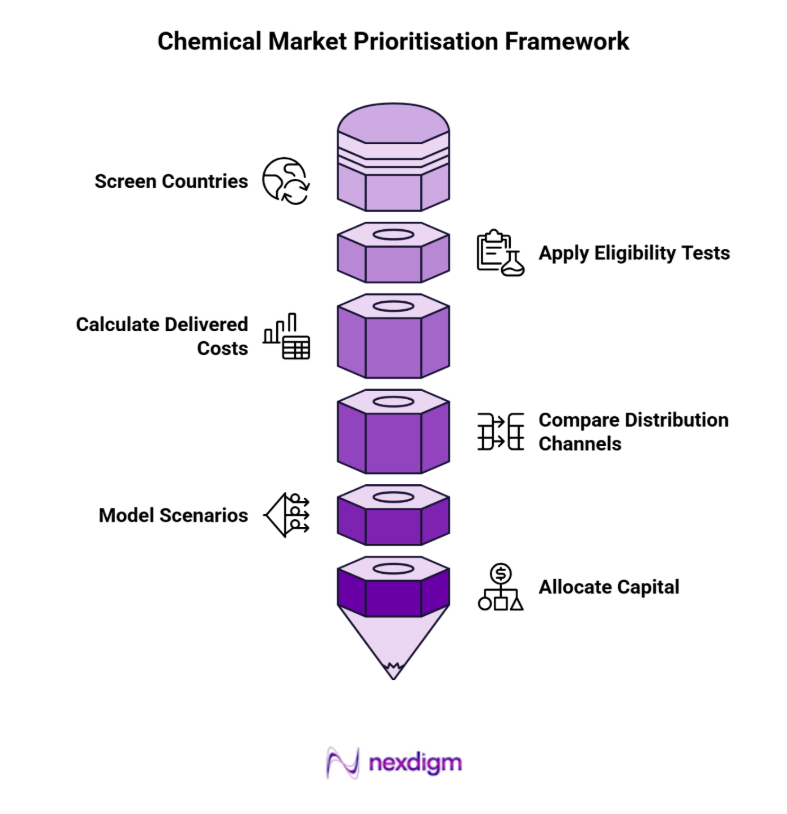
- Screen Countries Using Product-Level Demand and Trade Data: Analyse import volumes, consumption trends, trade flows and competitor presence by product category to identify countries with strong demand and promising growth potential.
- Apply Regulatory and Operational Eligibility Tests: Assess product registration requirements, chemical regulations, import restrictions, documentation standards and local operating conditions to eliminate markets that are difficult or impractical to enter.
- Calculate Delivered Costs and Customer-Level Margins: Estimate production or sourcing costs, freight, insurance, tariffs, distribution expenses and selling prices across customer segments to determine the profitability of serving each market.
- Compare Distribution Channels and Supply Chain Requirements: Evaluate direct sales, distributors and local partnerships alongside supply chain reliability, logistics infrastructure, inventory requirements and investment commitments.
- Model Base, Upside and Downside Scenarios: Test how changes in demand, selling prices, input costs, exchange rates and operating conditions could affect margins, cash flow and the overall business case.
- Allocate Capital Based on Market Readiness: Prioritise markets according to validated demand, regulatory preparedness, commercial viability and execution risks. Establish clear investment milestones and performance thresholds before committing additional resources to expansion.
Nexdigm Case Study
A chemical producer compared seven overseas markets across demand, regulatory access, landed cost and distribution readiness. Three markets passed the initial screening, but only two remained attractive after freight, inventory and channel margins were modelled. The company prioritised a distributor-led launch in the stronger market and deferred local manufacturing pending customer-volume validation.
To take the next step, simply visit our Request a Consultation page and share your requirements with us.
Harsh Mittal
+91-8422857704