

International food trade has expanded significantly over the past two decades, creating a larger and more interconnected marketplace for producers, processors, exporters, importers, and distributors. According to FAO, the value of global food and agricultural trade increased fivefold between 2000 and 2024, reaching around US$2 trillion. This expansion has also increased the importance of understanding which products and markets are driving cross-border growth.
Growth, however, is uneven. Different food categories respond to changes in income, population, consumption preferences, production conditions, climate events, and trade policies in different ways. FAO also highlights increasing exposure of agricultural commodity markets to weather, geopolitical, and economic shocks, making historical trade patterns important but insufficient on their own.
This is where international food trade analysis can help companies identify the products, markets, suppliers, buyers, and trade corridors contributing to cross-border growth.
Identifying High-Growth Food Products in Global Trade
Understanding which food products are driving international trade growth helps businesses prioritize markets, align offerings, and capture emerging opportunities.
- Demand Growth Analysis: Evaluates rising import demand across food categories, helping businesses identify products gaining sustained traction in international markets.
- Emerging Consumption Trends: Assesses how changing consumer preferences, health consciousness, and lifestyle shifts influence global demand for specific food products.
By identifying high-growth products and evolving demand patterns, businesses can focus resources on the most promising international trade opportunities.
Understanding the Markets Powering Cross-Border Food Demand
Growth in international food trade is often concentrated within specific importing and exporting markets. Some countries experience rising demand due to consumption growth and supply deficits, while others strengthen their export positions through production advantages, quality standards, or competitive pricing. Assessing trade flows, destination market growth, supplier dynamics, and changing competitive landscapes helps businesses identify the markets and trade corridors contributing most significantly to cross-border food trade expansion.
Why Food Trade Signals Need Industry Context
Trade data can reveal where products are moving, but the reasons behind those movements are often rooted deeper in the food value chain. Production cycles, processing capacity, consumption preferences, supply availability, logistics, regulations, and competitive behaviour can all influence cross-border trade.
For businesses, interpreting these factors is essential to distinguish temporary trade fluctuations from sustainable demand shifts. A market showing rapid import growth may reflect genuine consumption expansion, domestic supply shortages, inventory requirements, or changing sourcing strategies. Understanding the underlying drivers therefore becomes critical before translating trade activity into commercial priorities.
Nexdigm’s Food Industry and Trade Intelligence Approach
Food trade movements are shaped by interconnected factors such as production capacity, processing infrastructure, consumption patterns, sourcing strategies, distribution networks, pricing, and regulatory conditions. Understanding these relationships requires more than tracking customs records.
Nexdigm combines its food and agriculture industry understanding with trade intelligence, market research, competitive assessment, and primary research to interpret how these factors influence international trade. Our international food trade analysis can examine products, companies, countries, ports, and trade corridors to identify changing demand, emerging supply bases, competitive shifts, and market opportunities.
This industry-led approach enables businesses to understand not only where food trade is growing, but what is driving that growth and how it could influence market-entry and competitive decisions.
Nexdigm’s International Food Trade Analysis
Nexdigm can assess cross-border food growth through the following dimensions using industry-led expertise. Such dimensions are:
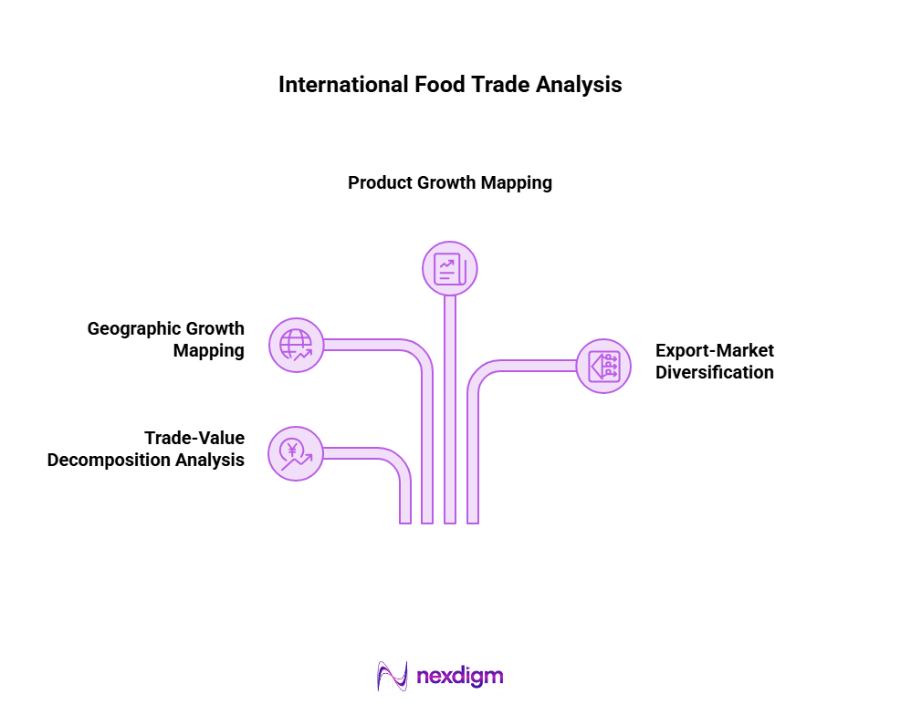
- Product Growth Mapping: Nexdigm identifies food products and categories showing sustained increases in trade values, volumes, and shipment activity across international markets.
- Geographic Growth Mapping: Comparing origin and destination markets to identify countries and regions experiencing stronger food-trade expansion and emerging commercial relevance.
- Trade-Value Decomposition: Nexdigm separates changes in trade value and volume to determine whether growth reflects increased quantities, higher prices, or both.
- Export-Market Diversification: Examining destination expansion to identify exporters entering new markets and assess opportunities for broader geographic growth.
This assessment helps businesses identify which products are driving growth, which markets are becoming more attractive, where competitive positions are shifting, and which opportunities warrant commercial action.
How Nexdigm’s Analysis Identifies and Prioritizes Attractive Food Trade Opportunities
Assessment findings become more valuable when they are translated into clear commercial priorities. Nexdigm can use the combined trade, market, competitive, and pricing evidence to help businesses distinguish high-potential opportunities from markets that may require caution or further validation. The findings can support decisions such as:
- Which products to prioritize: Identify food categories with stronger demand momentum and relevant competitive conditions.
- Which markets to enter: Compare destination markets based on demand, competition, pricing, accessibility, and buyer activity.
- Where to source: Identify alternative origins and suppliers that can improve procurement flexibility.
- Which buyers to target: Prioritize importers and distributors with demonstrated purchasing activity.
This creates a practical link between international food trade analysis and strategic action, enabling businesses to move from identifying trade movements to deciding where resources, market-development efforts, and investment should be directed.
Nexdigm’s Case
Nexdigm supported a food-sector client in assessing its international sourcing network by analyzing supplier concentration, country-of-origin shares, product-level imports, and indicative unit values. The assessment identified 14 alternative suppliers across four countries and supported a sourcing strategy that reduced supplier concentration by 19%.
To take the next step, simply visit our Request a Consultation page and share your requirements with us.
Harsh Mittal
+91-8422857704