

International market entry planning helps companies expand into high-growth global markets with a structured, research-led approach. Entering a new country requires more than identifying demand; businesses must evaluate market size, customer behavior, competition, pricing, regulations, distribution channels, and operational readiness.
As part of a strong market entry strategy, international market entry planning enables companies to choose the right entry model, localize offerings, reduce risks, and build a practical roadmap for growth. It supports informed decision-making, stronger market positioning, and smoother expansion into new regions where opportunities are attractive but business conditions may be complex.
Global expansion remains attractive but complex. Companies entered an average of 1.1 new markets in 2025 and plan to enter 1.5 markets in 2026, reflecting a 36% increase in expansion intent. At the same time, global foreign direct investment rose 14% in 2025, though growth was concentrated in developed economies. These figures show why international market entry planning must balance opportunity, risk, and market readiness.
Assessing High-Growth Global Markets Before Making an International Expansion Decision
Assessing high-growth global markets helps companies evaluate demand, competition, regulations, customer behavior, pricing, and entry risks before committing resources to international expansion and market entry decisions.
- Market Size and Growth Potential: Evaluate current demand, future growth, customer base, and revenue opportunity before selecting a global market for expansion.
- Customer Behavior and Preferences: Study buying habits, needs, expectations, and decision-making patterns to understand whether the offering fits local demand.
- Competitive Landscape: Analyze key competitors, pricing, positioning, market share, and differentiation gaps to identify realistic entry opportunities.
- Regulatory and Compliance Environment: Review local laws, approvals, tax rules, import requirements, and sector-specific regulations before entering the market.
- Pricing and Profitability Assessment: Assess affordability, cost structures, margins, competitor pricing, and willingness to pay to confirm commercial feasibility.
Nexdigm’s Market Entry Expertise for High-Growth Global Markets
Nexdigm’s market entry expertise helps companies evaluate and enter high-growth global markets with a research-led approach. It includes assessing market potential, customer demand, competition, regulations, pricing, and entry channels. These insights help businesses choose the right market entry strategy, reduce expansion risks, localize offerings, and build a practical roadmap for sustainable international growth.
Nexdigm’s Entry Model Evaluation for International Business Expansion
Nexdigm’s entry model evaluation helps companies compare options such as partnerships, distributors, joint ventures, acquisitions, or direct setup to choose the most suitable international expansion approach:
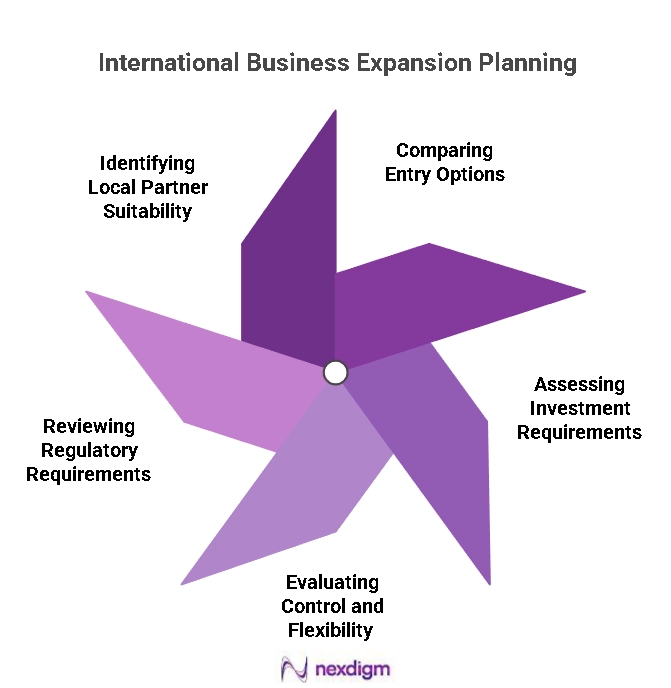
- Comparing Entry Options: Evaluate distributors, partnerships, joint ventures, acquisitions, franchising, or direct setup based on business goals and market conditions.
- Assessing Investment Requirements: Review capital needs, setup costs, operating expenses, and expected returns for each international entry model.
- Evaluating Control and Flexibility: Understand how much operational control, decision-making power, and flexibility each entry option provides in the target market.
- Reviewing Regulatory Requirements: Analyze ownership rules, licensing needs, tax implications, and compliance obligations linked to each entry model.
- Identifying Local Partner Suitability: Assess potential partners, distributors, or acquisition targets based on market reach, credibility, capability, and strategic fit.
Nexdigm’s case:
Nexdigm helped a European industrial equipment company evaluate the right entry model for expansion into Southeast Asia. Nexdigm compared five options, including distributor-led entry, joint venture, acquisition, direct setup, and strategic partnership. The team assessed 12 potential partners, reviewed regulatory requirements across four countries, and modeled setup costs for three priority markets. The analysis helped the company shortlist two viable entry models, reduce estimated setup risk by 25%, and build a phased international expansion roadmap.
To take the next step, simply visit our Request a Consultation page and share your requirements with us.
Harsh Mittal
+91-8422857704