

International schooling in India is evolving alongside changing parental aspirations, rising global mobility, and increasing interest in internationally recognized education pathways. Nexdigm’s research has identified India as the second-largest schooling system globally, while its assessment for a UK-based educational institute found the international school segment expanding at an estimated 14% CAGR. The study also observed that a select number of metropolitan cities host a high concentration of international schools.
The opportunity, however, is not uniform across locations or curricula. British, American, International Baccalaureate (IB), and other international pathways appeal to different parent segments and educational objectives. For school operators and investors, understanding where demand is concentrated and which curriculum models are gaining relevance is critical before entering or expanding within a market.
An International school demand assessment can help identify attractive locations, evaluate curriculum preferences, benchmark competing schools, and determine whether local demand is sufficient to support a new campus or school format.
Demand Is Shifting Toward Globally Oriented Education
Parents considering international schools often look beyond conventional academic outcomes. Global university pathways, international curricula, English-medium instruction, holistic learning, extracurricular opportunities, and exposure to international standards can influence school selection.
However, demand differs by city, household segment, and affordability. Metropolitan markets with internationally oriented families may support premium international schools, while emerging urban markets may require different fee structures or curriculum propositions.
Curriculum Choice Can Shape the Market Opportunity
Curriculum selection is closely linked to the target student segment and the proposition a school intends to build. British pathways such as Cambridge and Edexcel, IB programmes, American curricula, and other international models can differ in academic structure, assessment, university pathways, positioning, and fee expectations. A thorough assessment can compare curriculum models across these dimensions to help education providers understand their relevance within a target market.
Identifying Markets That Can Support International Education
Selecting the right curriculum is only one element of a successful international-school strategy. Long-term success also depends on the strength of local demand, the characteristics of the target student population, parent preferences, and the competitive environment.
Nexdigm helps education providers evaluate these critical market factors to identify locations where international education offerings can achieve sustainable enrollment, differentiated positioning, and long-term growth.
How Nexdigm Identifies Attractive International Education Markets
Identifying a viable international-school opportunity requires a comprehensive understanding of market demand, student demographics, parent preferences, and competitive dynamics.
Nexdigm applies a structured International school demand assessment approach to evaluate these factors, helping education providers identify attractive markets, validate expansion opportunities, and develop growth strategies aligned with local market conditions.
Nexdigm’s International School Demand Assessment
Nexdigm can evaluate international-school opportunities through an International school demand assessment, which combines quantitative and qualitative market research. The assessment connects several areas such as:
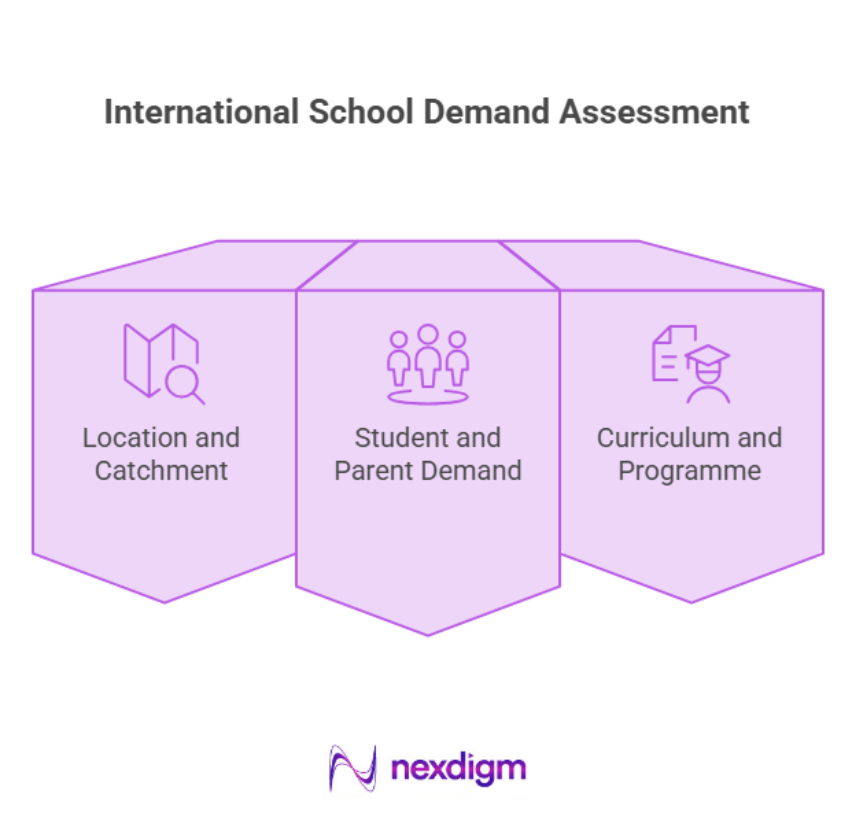
- Location and Catchment Assessment: Nexdigm can assess potential cities and catchments using demographic characteristics, household profiles, accessibility, residential development, existing international-school concentration, and competitive intensity. This helps identify locations where the addressable student population and market conditions can support an international-school proposition.
- Student and Parent Demand Assessment: Understanding the target student population is central to assessing international-school potential. Nexdigm can examine school-age demographics, household characteristics, education preferences, international exposure, and factors influencing parents’ school-selection decisions. The assessment can help determine which student cohorts are most likely to consider international education and whether demand is concentrated within particular age groups, household segments, or geographic areas.
- Curriculum and Programme Assessment: Nexdigm can compare international curricula and programmes based on market presence, parent preferences, student age coverage, competitive adoption, positioning, and potential differentiation. This enables operators to evaluate whether an established curriculum has sufficient local demand or whether a differentiated programme could address an underserved segment.
Where Nexdigm’s Assessment Supports International School Growth
The findings from an international school demand assessment can support several strategic decisions across the development lifecycle. These areas are:
- Market Selection: Compare cities and catchments based on student demand, household profiles, international-school penetration, competition, affordability, and future growth.
- Curriculum Selection: Evaluate British, IB, American, and other international programmes against local parent preferences, competitor offerings, student segments, and positioning opportunities.
- New Campus Development: Determine whether a target location has sufficient addressable demand and competitive whitespace to support a new international school.
- Fee and Positioning Strategy: Benchmark competitor fees and propositions to establish an appropriate price point and differentiated value proposition.
Nexdigm’s Case
A leading UK-based educational institute engaged Nexdigm to evaluate India’s international-school landscape and identify opportunities for expansion. Nexdigm conducted qualitative and quantitative research covering market structure and international-school programmes, business models. The study included 27+ ecosystem stakeholder interviews and a detailed assessment of international-school offerings in a selected metropolitan market. The findings helped the client formulate its India market-entry strategy.
To take the next step, simply visit our Request a Consultation page and share your requirements with us.
Harsh Mittal
+91-8422857704